• العربية
  • پښتو
  • فارسی
Brand
  • Afghanistan
  • Sport
  • Analysis
  • Markets
  • Afghanistan
  • Sport
  • Analysis
  • Markets
  • Theme
  • Language
    • العربية
    • پښتو
    • فارسی
  • Afghanistan
  • Sport
  • Analysis
  • Markets
All rights reserved for Volant Media UK Limited
volant media logo

Taliban Seeks To Draw Pakistan Into Yemen Conflict, Say Sources

Sep 18, 2026, 15:49 GMT+1

Informed security sources say the Taliban administration is seeking to encourage the Houthis to intensify attacks on Saudi Arabia, with the aim of drawing Pakistan into the Yemen conflict.

According to the sources, the Taliban is seeking, through direct and indirect engagement with the Houthis, to increase the group’s attacks against Saudi Arabia.

The sources told Afghanistan International that the Taliban’s objective is to open a new front for Pakistan and divert Islamabad’s military and security focus away from the Afghanistan-Pakistan border.

They said the Taliban wants to draw Pakistan into the Yemen crisis in order to reduce Pakistani military pressure on armed groups inside Pakistan and along the Afghan border, giving groups allied with the Taliban greater room to operate.

The Taliban is pursuing these efforts at a time when relations between Kabul and Islamabad have become severely strained in recent months.

Pakistan accuses the Taliban of allowing Tehreek-e-Taliban Pakistan to operate from Afghan territory. The Taliban denies the allegation.

Turkish and Qatari Delegations Visit Kabul

The reported Taliban efforts coincide with visits to Kabul by senior security officials from Türkiye and Qatar.

İbrahim Kalın, head of Türkiye’s National Intelligence Organisation, and Hamad bin Khamis Al-Kubaisi, Qatar’s deputy national security adviser, travelled to Kabul on Tuesday and met several senior Taliban officials.

After meetings in Kabul and Kandahar, Kalın travelled to Islamabad, where he met Pakistani Prime Minister Shehbaz Sharif, army chief Asim Munir and intelligence chief Asim Malik.

In Kabul, Kalın and Qatar’s deputy national security adviser met senior Taliban officials, including Abdul Ghani Baradar, Sirajuddin Haqqani, Abdul Haq Wasiq and Mohammad Yaqoob Mujahid.

Sources told Afghanistan International that restarting talks between Kabul and Islamabad and reviewing the regional situation were among the main topics of the meetings.

The sources added that the high-level Turkish and Qatari delegations travelled to Kabul at the Taliban’s request as part of efforts to resume negotiations with Pakistan.

Türkiye and Qatar have previously mediated to reduce tensions between the Taliban and Pakistan and have hosted talks between the two sides.

At the same time as the senior Turkish and Qatari officials visited Kabul, the Taliban Foreign Ministry described a Houthi drone attack near Mecca as a matter of deep concern and condemned any action targeting Islam’s two holy mosques. The Houthis are backed by Iran.

In Islamabad, Kalın also stressed Turkey’s efforts to resolve tensions between the Taliban and Pakistan through dialogue.

Turkish and Pakistani officials also discussed regional developments and tensions in the Middle East, including developments involving Yemen and Saudi Arabia.

Pakistan’s Position on Houthi Attacks Against Saudi Arabia

The Mecca Mutual Defence Pact was signed on 7 August in Mecca in the presence of Saudi Crown Prince Mohammed bin Salman, Turkish President Recep Tayyip Erdoğan and Pakistani Prime Minister Shehbaz Sharif.

Under the publicly disclosed terms of the pact, an armed attack on any one of the three member states is regarded as an attack on all three. Its stated aim is to strengthen collective deterrence against external aggression.

Pakistani officials have said Islamabad would stand with Saudi Arabia if the conflict in Yemen escalates.

Pakistan’s Defence Minister Khawaja Asif said on Wednesday that if the situation escalated, Pakistan would stand with Saudi Arabia practically and diplomatically. He also referred to the defence agreement between Pakistan, Türkiye and Saudi Arabia.

Pakistan’s Foreign Ministry on Thursday described the situation around the Bab al-Mandab Strait as very serious and said the joint defence agreement with Saudi Arabia was operational, with several Pakistani forces stationed in the kingdom.

Islamabad has nevertheless stressed that the crisis should be resolved through dialogue and diplomacy.

Houthi attacks against Saudi Arabia have intensified in recent days.

The Saudi-led coalition on Wednesday accused the Houthis of attempting a drone attack on Mecca. The Houthis denied the allegation.

Taliban’s Objective

Informed security sources say the Taliban’s aim in drawing Pakistan into the Yemen crisis is to alter Islamabad’s security calculations.

According to the sources, the involvement of Pakistani forces in a military crisis in the Middle East could divert some of Pakistan’s capabilities and attention away from the Afghan border and operations against armed groups opposed to Islamabad.

The reported efforts come as Islamabad is increasing pressure on the Taliban to prevent Tehreek-e-Taliban Pakistan from operating in Afghanistan, while Pakistan is also facing security threats at home.

Security sources say the Taliban is seeking to create pressure on an external front to gain greater room to manage tensions and the activities of allied groups along the Afghanistan-Pakistan border.

The Financial Times, citing informed sources, reported that Pakistan’s army chief Asim Munir has repeatedly urged Iranian officials to help stop Houthi attacks on Saudi Arabia and its energy infrastructure.

Most Viewed

Afghanistan At UN Security Council: Shared Concerns, Different Approaches To Taliban
1

Afghanistan At UN Security Council: Shared Concerns, Different Approaches To Taliban

2

Legal Action Against Taliban Remains On Track, Says Australia

3

Turkish Intelligence Chief Heads To Pakistan After Afghanistan

4

Khalilzad Must Clarify Where He Stands On Taliban, Says Pakistan

5

Taliban Defence Minister Meets Turkish & Qatari Security Delegations

•
•
•

More Stories

Germany Presses Ahead With Legal Action Against Taliban Over Women’s Rights

Sep 18, 2026, 13:23 GMT+1
100%

A source at Germany’s Foreign Ministry told Afghanistan International that Berlin, together with international partners, is pursuing efforts to hold the Taliban accountable for violations of women’s rights.

The German Foreign Ministry official said initial legal steps had been taken under Article 29 of the Convention on the Elimination of All Forms of Discrimination against Women.

According to the source, Germany supports international mechanisms, including the UN-led Doha process, aimed at improving the human rights situation in Afghanistan.

The German official stressed that the country would continue its efforts to ensure Afghanistan fulfils its obligations under the Convention on the Elimination of All Forms of Discrimination against Women.

Germany’s Foreign Ministry added that, together with Australia, Canada and the Netherlands, it had taken the first necessary steps under Article 29 of the convention and had contacted the Taliban administration.

Legal Process at the International Court of Justice

Australia had previously also announced that it was pursuing the legal process.

A spokesman for Australia’s Foreign Ministry told Afghanistan International that Canberra, in cooperation with Germany, Canada and the Netherlands, was pursuing legal action to hold the Taliban accountable for widespread violations of the rights of women and girls.

Under Article 29 of the Convention on the Elimination of All Forms of Discrimination against Women, disputes between member states over the interpretation or application of the convention can, after specified procedures, be referred to arbitration and ultimately to the International Court of Justice.

In September 2024, Germany, Australia, Canada and the Netherlands jointly announced that they had initiated legal proceedings under Article 29 of the convention and called on the Taliban administration to enter into dialogue over the matter.

The Rawadari human rights organisation and several other civil society groups have also recently launched campaigns urging the countries that initiated the process to continue with their commitments and legal action.

More than 20 countries have backed the move by Germany, Australia, Canada and the Netherlands to use the mechanism provided under Article 29 of the convention. They include Spain, Sweden, Belgium and South Korea.

Since the Taliban returned to power in August 2021, sweeping restrictions have been imposed on the rights and freedoms of women and girls in Afghanistan.

Girls are barred from education beyond sixth grade, while women and girls are also prohibited from attending universities.

Women have also been excluded from many areas of public and social life, with broad restrictions imposed on their employment and freedom of movement.

In several cases, women and girls have been detained or questioned for failing to comply with Taliban dress requirements.

Human rights organisations have described the Taliban’s policies as a clear example of gender apartheid.

The Taliban has previously rejected allegations of human rights violations and discrimination against women, saying citizens’ rights in Afghanistan are protected within the framework of Sharia law and that no one is discriminated against.

Ex-NSA Mohib Accuses Khalilzad Of Betraying Afghan Republic In New Book

Sep 18, 2026, 12:24 GMT+1
100%

Former Afghan national security adviser Hamdullah Mohib has published a book titled Shadows Over Kabul: An Insider Account of the Fall of the Afghan Republic, accusing former US envoy Zalmay Khalilzad of betrayal.

Mohib writes that Khalilzad bears significant responsibility for the collapse of the Afghan republic.

In the book, co-written with Tom Hussain, Mohib sharply criticises Khalilzad’s role in the US negotiations with the Taliban and describes his conduct as a major betrayal.

The book was published in English on Thursday, 17 September.

According to Mohib’s account, former Afghan president Ashraf Ghani was sceptical of Khalilzad’s mission from the outset of his appointment as Washington’s chief negotiator on Afghanistan and believed his involvement could have disastrous consequences for the country.

Mohib writes that Khalilzad’s professional background and his links to the oil company Unocal created what Ghani saw as an ethical ambiguity surrounding his mission.

According to Mohib, Khalilzad had a strong ability to connect government activities with personal interests and was also secretive in his working style.

The former Afghan national security adviser goes on to accuse Khalilzad of establishing contacts with the Taliban without informing the Afghan government at the time.

Mohib writes that Khalilzad had known several Taliban officials since the 1990s.

According to Mohib, the Taliban’s confidence increased significantly after Khalilzad was appointed US envoy and entered the Afghan peace process because the group realised it could negotiate directly with Washington while excluding the Afghan government.

Mohib says that after arriving in Kabul, Khalilzad did not even meet him or Salam Rahimi, who was responsible for the peace process in the former government, preventing Afghan officials from presenting their position on the negotiations.

In this section of the book, Mohib writes that Khalilzad’s work was a major betrayal.

He also recounts that after a trip to Pakistan; Khalilzad returned to Kabul without briefing Ashraf Ghani on the details of his discussions.

Mohib says Afghan government officials later learned that Khalilzad had met the Taliban in Pakistan.

Mohib writes that Khalilzad, without informing officials of the former government, spoke directly to the Taliban on our behalf and marginalised us.

He adds that, at the time, Afghan officials were unclear whether Khalilzad was acting under official US policy or following his own views and personal initiative.

According to Mohib, former government officials tried to determine the answer but did not reach a clear conclusion.

In another section of the book, Mohib refers to a trip he made to Washington, where he says he publicly stated that Khalilzad’s efforts were weakening the Afghan government and strengthening the Taliban.

He writes that he questioned whether Khalilzad was pursuing such a policy with the support of, and on behalf of, the US government.

According to Mohib, the responses he received were contradictory, and his scheduled meetings with US State Department officials were ultimately cancelled.

Overall, in his account of the peace process, Mohib accuses Khalilzad of sidelining the Afghan government from negotiations, holding direct and secret talks with the Taliban and strengthening the group’s political position.

He argues that Khalilzad played a significant role in a process that ultimately contributed to the collapse of the Afghan republic.

Shadows Over Kabul: An Insider Account of the Fall of the Afghan Republic, written by Hamdullah Mohib and Tom Hussain, presents an account from inside Afghanistan’s former government of the events that led to the republic’s collapse.

Pak Ready To Reopen Afghan Border If Taliban Cooperates, Says Foreign Ministry

Sep 18, 2026, 10:16 GMT+1
100%

Pakistan’s Foreign Ministry says the country is ready to reopen border crossings and resume trade with Afghanistan if the Taliban cooperates in stopping armed groups that Islamabad says cross from Afghan territory into Pakistan.

Sajjad Haider Khan, the new spokesman for Pakistan’s Foreign Ministry, said on Wednesday that Islamabad wanted to resolve its problems with Afghanistan through dialogue and diplomacy.

He said Pakistan had also sought mediation from Qatar, Turkiye and China to ease tensions, but those diplomatic efforts had yet to produce a clear outcome.

Khan accused the Taliban of refusing to guarantee that armed groups would stop using Afghan territory to operate against Pakistan. The Taliban has repeatedly denied the presence of foreign armed groups in Afghanistan and rejected claims that Afghan soil is being used against neighbouring countries.

Asked about visits by Turkish and Qatari security officials to Kabul, the Pakistani Foreign Ministry spokesman said Islamabad was not aware of the details of the trips but noted that Qatar and Turkey had previously played a role in mediating between Pakistan and the Taliban.

He also referred to China’s efforts to facilitate dialogue between the Taliban and Pakistan.

Pakistan’s Foreign Ministry also said Afghan students who hold valid visas and are enrolled in recognised academic programmes are allowed to continue and complete their studies in Pakistan.

According to Khan, students who have finished their studies and are not yet enrolled in further education or specialist programmes may be deported to Afghanistan.

Earlier, the Pakistan Medical and Dental Council had instructed universities not to admit new Afghan students and ordered the removal of Afghan students already in the country. The decision prompted protests from students.

The Lahore and Sindh high courts, and in one case the Islamabad High Court, suspended implementation of the decision for several students who had challenged it.

The ministry said Afghan students with scholarships may also continue their studies, and that hundreds of Afghan students are currently studying in Pakistan.

The possible invitation of a Taliban administration representative to a meeting of ministers from the Economic Cooperation Organisation in November was also raised at the briefing.

The Pakistani Foreign Ministry spokesman said no decision had yet been made on the matter.

Legal Action Against Taliban Remains On Track, Says Australia

Sep 17, 2026, 14:09 GMT+1
100%

Australia’s Foreign Ministry says it is pursuing legal action with international partners, including Canada, Germany and the Netherlands, to hold the Taliban accountable for widespread violations of the Convention on the Elimination of All Forms of Discrimination against Women.

A ministry spokesman told Afghanistan International that the Taliban was carrying out a campaign of sustained and systematic repression aimed at completely excluding women from public life.

According to Australia’s Foreign Ministry, the Taliban’s actions demonstrate a blatant disregard for the human rights and fundamental freedoms of women and girls in Afghanistan.

Information released by the Australian government says the four countries have invoked Article 29 of the Convention on the Elimination of All Forms of Discrimination against Women and activated its dispute-resolution mechanism, calling on the Taliban administration to enter good-faith negotiations.

In late 2024, Germany, Australia, Canada and the Netherlands jointly warned that they would take the Taliban to the International Court of Justice if the situation of women and girls in Afghanistan did not change.

The International Court of Justice is the United Nations’ principal judicial body and hears disputes between states, including cases involving international legal obligations.

Australian officials said that although the process would take time, Canberra remained firmly committed to supporting Afghan women and girls. The next stages could include referral to international arbitration and ultimately bringing the case before the International Court of Justice.

The Australian Foreign Ministry spokesman said pursuing legal action under the Convention on the Elimination of All Forms of Discrimination against Women did not alter Canberra’s position that the Taliban administration is illegitimate.

The Australian government again stressed that it does not recognise the Taliban as the legitimate representative of the Afghan people and has no intention of accepting diplomats, honorary consuls or any other representatives appointed by the group.

In line with that position, it had previously been agreed that the Afghan embassy in Canberra would cease its activities in Australia.

Australian officials say the legal initiative is grounded in the lived experiences of Afghan women and that Australia is committed to meaningful engagement with Afghan women and civil society organisations throughout the process.

As part of these efforts, Germany hosted civil society consultations in Berlin in March last year involving legal delegations from partner countries. Australia also plans to hold domestic consultations with civil society in October this year to examine the initiative in greater detail.

The joint legal action by the four Western countries comes amid continuing criticism from international human rights organisations over Taliban policies towards women.

UNICEF and Amnesty International have again called on the Taliban administration to lift all restrictions on girls’ education and allow women and girls to return immediately to schools and universities.

Amnesty International has also called for urgent and coordinated international action to pressure the Taliban to reopen girls’ schools.

More than 20 countries have backed the decision by Germany, Australia, Canada and the Netherlands to pursue a case against the Taliban before the International Court of Justice. They said they condemned human rights violations in Afghanistan, particularly gender discrimination against women and girls by the Taliban.

Albania, Andorra, Belgium, Bulgaria, Chile, Croatia, Finland, Honduras, Ireland, Iceland, South Korea, Latvia, Liechtenstein, Luxembourg, Malawi, Morocco, Moldova, Montenegro, Romania, Slovenia, Spain and Sweden are among the 23 countries supporting the initiative by Germany, Australia, Canada and the Netherlands.

The Taliban has previously rejected allegations of human rights violations and gender discrimination in response to the four countries’ decision.

A Taliban Foreign Ministry spokesman said that at the time human rights are protected in Afghanistan and there is no discrimination against anyone.

Afghanistan At UN Security Council: Shared Concerns, Different Approaches To Taliban

Sep 17, 2026, 09:36 GMT+1
100%

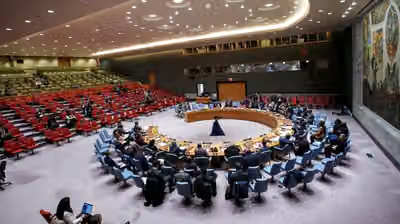
The UN Security Council met in New York on Wednesday, 16 September, to discuss Afghanistan. Georgette Gagnon, acting head of UNAMA, presented the latest UN report on the country’s security, politics, human rights and economy.

Representatives largely focused on five issues: the activities of terrorist groups, tensions between the Taliban and Pakistan, the humanitarian crisis, restrictions on women, and how the international community should engage with the Taliban.

Terrorism and Rising Insecurity

Almost all Security Council members described the activities of terrorist groups in Afghanistan as a threat extending beyond the country’s borders.

Iran’s representative said the Taliban must prevent Afghan territory from being used to plan or carry out attacks against neighbouring countries. He described ISIS-Khorasan as a serious threat and called for broader regional cooperation.

China urged the Taliban to act decisively against ISIS-Khorasan, al-Qaeda, the East Turkistan Islamic Movement and Tehreek-e-Taliban Pakistan, and to demonstrate greater resolve in doing so.

Russia also expressed concern about ISIS-Khorasan’s ability to recruit fighters, saying members of terrorist groups were being transferred from Syria to Afghanistan.

Russia’s representative said that Islamic State- Khorasan, the East Turkistan Islamic Movement and other terrorist groups remain present in Afghanistan, and the Taliban has so far been unable to fully confront them.

The US ambassador to the United Nations, accused the Taliban of sheltering terrorist groups and said the consequences of developments in Afghanistan would not remain confined within the country’s borders.

He urged the Security Council to demand action, not words from the Taliban. Waltz also accused the group of using foreign nationals as bargaining chips and called for their release.

Denmark also described the presence of Tehreek-e-Taliban Pakistan, al-Qaeda and ISIS-Khorasan as a threat to Afghanistan, its neighbours and international security. France, Britain and Pakistan raised similar concerns.

According to the UN secretary-general’s report, the number of security incidents in Afghanistan increased by 11% compared with the same period last year. Armed groups opposed to the Taliban claimed responsibility for 88 attacks across 21 provinces during the reporting period.

Taliban-Pakistan Tensions

Pakistan’s representative claimed that Tehreek-e-Taliban Pakistan and armed Baloch groups were operating from Afghan territory with impunity.

He said Pakistan had suffered more than 4,700 casualties over the past three years in attacks that Islamabad says were organised from Afghanistan. Pakistan’s representative urged the Taliban to take concrete and verifiable action against the groups.

He also warned about armed groups gaining access to advanced weapons and equipment left behind by international forces in Afghanistan.

Russia and Britain called for de-escalation and for the Taliban and Pakistan to return to dialogue.

The UN secretary-general’s report described the border situation between the two sides as unstable. According to the report, air strikes, reconnaissance drone flights and cross-border shelling have affected parts of Ghazni, Kunar, Khost, Paktika, Paktia, Kandahar and Nangarhar.

The clashes killed at least 57 civilians and wounded another 342 between 1 April and 30 June.

Meanwhile, Turkiye and Qatar have again become involved in mediation efforts. Turkiye’s intelligence chief and Qatar’s deputy national security adviser travelled to Kabul on Tuesday and met Taliban officials.

There has so far been no sign of a lasting improvement in relations between Kabul and Islamabad.

Restrictions on Women and the Humanitarian Crisis

Taliban restrictions on women and girls were another major focus of the meeting.

Britain’s representative said no country could prosper while half its population was excluded from public life.

He referred to the year-long ban on Afghan female employees entering UN offices and said the restriction had disrupted humanitarian assistance. Britain will provide more than $140 million a year in aid to the Afghan people over the next three years.

France described the ban on Afghan women working for the United Nations as unacceptable and said the international community had listened to the Taliban’s demands, and that the Taliban must now respond with practical action to the demands of the international community.

The US representative also recalled remarks by Meryl Streep, saying that a female cat in Kabul had more rights than an Afghan woman because it could leave the house and see sunlight. He described the five-year deprivation of women and girls from education as tragic.

According to the UN secretary-general’s report, around one-third of Afghanistan’s population is experiencing acute food insecurity.

An estimated 13.8 million people are expected to face crisis or emergency levels of food insecurity this year.

Around 3.7 million children under the age of five and 1.2 million pregnant and breastfeeding women are also expected to suffer from acute malnutrition.

From 1 January to 13 August, nearly 1.15 million Afghans returned from neighbouring countries. The large-scale returns have placed additional pressure on the labour market and public services.

Georgette Gagnon said peace did not simply mean the absence of war, but that people must also have dignity, opportunities to progress and hope for the future.

She said Afghans had reported that despite five years of relative calm, Taliban policies had pushed them to the margins. The country’s economy also remains extremely fragile.

Disagreement Over How to Engage With the Taliban

Security Council members agreed on the need for continued engagement with Afghanistan but expressed different views over what form that engagement should take and what conditions should be attached.

The United States, Britain and France said engagement must be accompanied by accountability from the Taliban.

They stressed the need for practical action against terrorist groups, respect for women’s rights, the formation of an inclusive government and the release of foreign nationals.

China, Russia and Iran, however, called for continued dialogue, expanded economic cooperation and efforts to avoid isolating Afghanistan.

China said isolating Taliban-controlled Afghanistan would not solve the country’s problems.

Russia said Afghanistan should not be subjected to pressure or intimidation.

Iran described political engagement and regional cooperation as the most effective way to address Afghanistan’s problems.

India’s representative criticised the mass expulsion of Afghan migrants and the closure of trade routes between Afghanistan and Pakistan, describing it as “trade and transit terrorism”.

He said human rights could not be improved separately from security, development and economic opportunities.

Naseer Ahmad Faiq, Afghanistan’s representative to the United Nations, said no lasting solution could emerge from dialogue between the Taliban and foreign governments without the participation of the Afghan people.

He said that Afghanistan is more than the Taliban. Afghans must be participants, not spectators, in decisions about their future.

Faiq said five years of experience had shown that neither isolating the Taliban alone nor engagement without a clear political objective had produced results.

He said the international community should pursue principled and results-oriented engagement aimed at creating a legitimate, representative and accountable government.

Shared Concerns, Different Solutions

Security Council members agreed on the need for stability in Afghanistan and on preventing the country from becoming a safe haven for terrorist groups.

The main disagreement concerned how that goal should be achieved.

Some countries said pressure, accountability and clear conditions for the Taliban were necessary, while others argued that continued dialogue and expanded economic cooperation would be more effective.

The tone of the meeting showed that the activities of al-Qaeda, ISIS-Khorasan, the East Turkistan Islamic Movement, Tehreek-e-Taliban Pakistan and extremist groups from Central Asia have once again placed Afghanistan at the centre of regional and international security concerns.

Alongside these threats, Taliban-Pakistan tensions, the humanitarian crisis and sweeping restrictions on women remain among the main factors shaping the international community’s policy towards Afghanistan.