Over 50 Afghan Refugees Arrested In Pakistan, Deported To Afghanistan

The Taliban's media office in Nangarhar province has announced that more than 50 Afghan refugees who were detained in Pakistan have returned to Afghanistan after their release.

The Taliban's media office in Nangarhar province has announced that more than 50 Afghan refugees who were detained in Pakistan have returned to Afghanistan after their release.
The Pakistani government had started detaining Afghan refugees in Islamabad on Friday.
The Taliban's media office in Nangarhar on Monday, January 6, wrote on social media platform X that many of those who were arrested and then deported to Afghanistan also had legal documents.
The Taliban has said that many of these people were held in Pakistani police custody for one to two months.
The Taliban report states that these individuals were handed over to the group in Torkham after their release.
Reports in Pakistan indicate that in the past four days, the harassment and detention of Afghan migrants and asylum seekers in Islamabad, the capital of Pakistan, has intensified. On the other hand, the Taliban's Ministry of Refugees and Repatriations has announced that Islamabad police have arrested 127 Afghans during an operation.
According to reports, Pakistani police forces have arrested and imprisoned dozens of Afghan refugees, including women and children, in the operation.
The fate of the recent detainees remains unclear.
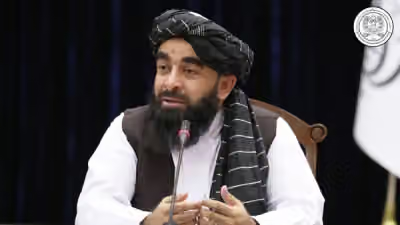

India's Ministry of External Affairs on Monday condemned Pakistan's recent airstrikes on Paktika province that killed 46 people, including women and children, saying it was a long-standing practice for Pakistan to blame its neighbours for its internal failures.
Indian External Affairs Ministry spokesperson Randhir Jaiswal on Monday expressed concern over Pakistan's airstrikes on Barmal district of Paktika in response to media queries.
"We have taken note of media reports of airstrikes on Afghan civilians, including women and children," Jaiswal said. "We unequivocally condemn any attack on innocent civilians."
"It is a long-standing practice for Pakistan to blame its neighbours for its internal failures," he said.
Pakistani airstrikes killed at least 46 people, including several women and children, in Barmal district of Paktika.
The Indian newspaper "Times of India" wrote that Pakistani airstrikes on seven villages, especially the village of Laman, caused significant casualties, wherein five members of a family were killed in the strikes.
After these attacks, tensions on the border increased, and the Afghan Taliban, along with their Pakistani allies, launched attacks on the border posts of Pakistani forces.

Fada Hossein Maleki, a member of the Iranian parliament's National Security Committee and a former ambassador to Afghanistan, called the Taliban's rule a threat to all countries in the region.
Referring to the Taliban's non-compliance with Afghanistan's commitments, Maleki said that the Taliban has neither a parliament nor a government.
Maliki told ILNA news agency on Sunday that neighbouring countries do not have a positive perception of the Taliban government. According to him, "If we look at what is currently happening in the so-called Taliban rule with a regional attitude, it does not give good feedback for neighbouring countries."
The member of the National Security and Foreign Policy Committee of the Iranian parliament said that today's rulers of Afghanistan are treating Iran, Pakistan, and some neighbouring countries and the region in a way that was unprecedented in the previous governments of Afghanistan.
"There was interaction with the previous governments of Afghanistan on every issue, which affected the relations of the countries given the position that Afghanistan had, but we have seen something different during this period when the Taliban took over the sovereignty of this country," he said.
He called the issue of water rights the biggest challenge in Iran's relations with the Taliban and said, "Unfortunately, the Taliban does not adhere to the rules, contracts and historical treaties between the two countries."
In a part of his remarks, Maleki expressed concern over the Taliban's construction of dams.
"I believe that the construction of dams in Afghanistan is questionable, I believe that any action should be taken in the atmosphere of partnership between the two countries, which is not the case today, of course, it is natural that the Taliban does not have a parliament or a government, nothing is in place in this government," he said.
Referring to his talks with the Iranian president and foreign minister, he said that the water issue is on the government's agenda.
Taliban officials recently inaugurated the Pashdan Dam in western Afghanistan. Some Iranian officials have expressed concern about the Taliban's dam construction, saying that the purpose of the dam construction in the western region is specifically to limit the flow of water to Iran.

The Taliban's minister of border affairs has described the group's relations with Tajikistan, a supporter of the National Resistance Front, as "good" during a visit to Takhar, just a few days after the group’s deputy prime minister echoed the same sentiments.
Noorullah Noori said that the Taliban want good relations with all neighbouring countries.
According to a statement from the Ministry of Borders, Noori visited the port of Ay Khanum in Dasht-e-Qala-e-Takhar district and inspected its situation.
He is the second Taliban official to speak about improving relations with Tajikistan in the past week.
Earlier, Abdul Kabir, the Taliban's deputy prime minister, had announced the increase in the group's political relations with Tajikistan. He also said that delegations have traveled between the two countries. However, he did not provide an explanation in this regard.
The Taliban's political deputy prime minister reiterated, "Our political relations with Tajikistan are improving and there is a difference compared to the past. Their delegation has come here and our delegation has gone there, and God willing, there will be more such engagements. Our trade is also going on through Sher Khan Bandar and we have no problems."
Sources said that some Tajik security officials have recently visited Kabul and a Taliban security official has also visited Tajikistan.
Following statements by Taliban officials about improving relations with Tajikistan, the National Resistance Front (NRF) warned in a statement last week without mentioning these relations that Ansarullah, a Tajik militant group, is seeking to overthrow the government of President Emomali Rahmon in cooperation with the Taliban.
Ansarullah is an Islamist group opposed to the rule of Emomali Rahmon. The group pledged allegiance to the Taliban and participated in the war between the former government and foreign forces in Afghanistan. Tajikistan has always expressed concern about threats emanating from Afghan soil.
Tajikistan hosts the National Resistance Front and has supported the Taliban's opponents for the past three and a half years.

Rana Sanaullah, a senior adviser to Pakistan's prime minister, warned that if there is a threat or danger of an attack from Afghan soil, Pakistan will attack the country again.
In an interview, he stated that under international law, Pakistan has the right to act across the border.
In an interview with Sama TV on Sunday, Sanaullah said, "It is an international law that if there is a threat to your territory from a place or there is preparation for an attack taking place there, you have the right to take action against such terrorists or enemies to protect yourself and your security."
He stressed that whenever there is a threat to Pakistan, it will take action at the right time.
Earlier, Pakistani Prime Minister Shehbaz Sharif, referring to the recent airstrike on Paktika, threatened to respond strongly to attacks from across the border.
Referring to the attacks on the Tehreek-e-Taliban Pakistan (TTP), Pakistan's prime minister on Friday (January 3) said at a meeting of the Central Apex Committee on National Action Plan that the group is responsible for numerous attacks against security forces and civilians.
At least 50 people, including women and children, were killed in a Pakistani army airstrike on Barmal district of Paktika in December, the Taliban said. It was the second attack in 2024.
Pakistani officials said that the attack targeted TTP's military and media centres and killed a number of the group's commanders. The United Nations Assistance Mission in Afghanistan (UNAMA) confirmed the deaths of women and children in a Pakistani airstrike.
The attack has inflamed tensions between the two countries. Abbas Stanekzai, the Taliban's deputy foreign minister, warned Pakistan not to be proud of its weapons and military equipment. He claimed that five Taliban members were enough to drive Pakistanis to the sea.

Ahsan Iqbal, Pakistan’s Minister for Planning, Development and Special Initiatives, has asserted that it is the responsibility of the Taliban to prevent any group in Afghanistan from using its territory for terrorist activities.
He emphasised that Pakistan has made significant sacrifices for the Afghan people.
Speaking at a conference in Lahore on Saturday, the minister highlighted Pakistan’s efforts to foster regional stability and underscored the importance of reducing political tensions to achieve economic progress.
Iqbal reiterated Pakistan’s expectation that the Taliban would uphold their commitment to ensuring Afghan soil is not used for terrorism. He expressed concerns over the growing proliferation of drugs and weapons, stressing that if any group found refuge in Afghanistan for terrorist activities, it was the Afghan government’s duty to prevent them.
He also criticised the previous government, led by the Pakistan Tehreek-e-Insaf (PTI) party, for the resurgence of militant activities. Iqbal noted that Pakistan is now confronting a renewed wave of terrorism.
The minister remarked that the people of Pakistan have endured significant hardships and made substantial sacrifices for the people of Afghanistan, bearing the repercussions to this day.
Relations between Pakistan and the Taliban-led government in Afghanistan have become increasingly strained due to security concerns and border disputes. Pakistan has voiced alarm over claims that Afghan territory is being used by militant groups to stage cross-border attacks. However, the Taliban have consistently denied these allegations.