Taliban, Belarus Officials Discuss ‘Political & Economic’ Cooperation
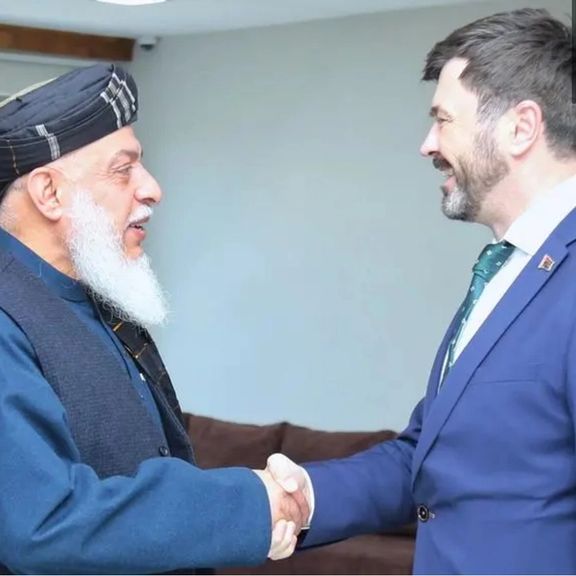
On Sunday, the Taliban’s Ministry of Foreign Affairs announced the visit of Sergei Lukashevich, Deputy Minister of Foreign Affairs of Belarus, to Kabul.
On Sunday, the Taliban’s Ministry of Foreign Affairs announced the visit of Sergei Lukashevich, Deputy Minister of Foreign Affairs of Belarus, to Kabul.
According to the ministry’s statement, Sergei Lukashevich met with Sher Mohammad Abbas Stanikzai, the Taliban’s Deputy Foreign Minister for Political Affairs, to discuss “political and economic” cooperation.
Stanikzai described the Belarusian official’s visit to Kabul as a significant development in relations between Belarus and Afghanistan, signalling the start of long-term collaboration.
According to the Taliban’s statement, Lukashevich expressed Belarus’s interest in fostering cooperation with Afghanistan across various sectors.
Hafiz Zia Ahmad, the Taliban’s Deputy Spokesperson, shared the statement on the social platform X, noting that both Stanikzai and Lukashevich agreed that technical teams from both sides would conduct further discussions in Kabul and Minsk.

Anna Paulina Luna, a member of the United States House of Representatives, has strongly criticised the $40 million aid package being sent by the United States to the Taliban.
Writing on the social media platform X (formerly known as Twitter), she stated, “Terrorists must not receive even a penny from American taxpayers’ money.”
Ms Luna emphasised, “We are sending $40 million a week to the Taliban—the very group that threatens our sovereignty and security.”
The congresswoman voiced her support for fellow Representative Tim Burchett’s proposal to halt financial assistance to the Taliban. She further added that Burchett’s proposed bill aims to put an end to such financial transfers.
Last week, Burchett announced that he had submitted a bill to the House of Representatives seeking to prohibit taxpayer money from being directed to the Taliban. Referring to this legislative proposal, Luna remarked that the bill would terminate the transfer of funds to the militant group.
Luna represents the state of Florida in the U.S. Congress.
The issue of financial assistance to Afghanistan under Taliban rule has become a focal point of debate among Republican lawmakers. Recently, Elon Musk, the billionaire entrepreneur and influential advisor to President-elect Donald Trump, also commented on the controversy.
Donald Trump, the U.S. President-elect, stated during a press conference on Tuesday that the U.S. government is “sending billions of dollars to the Taliban.” He condemned the financial aid as “unacceptable” and insisted that such assistance “should not be happening.”
Critics of the Taliban have welcomed the remarks made by the incoming administration, arguing that the Taliban is using American taxpayers’ money to fuel terrorism within Afghanistan.
However, Taliban officials have denied receiving any financial assistance from the United States.
Germany has expressed concern over the mass deportation of Afghan refugees from Pakistan, saying that their situation in the country has deteriorated significantly since 2023.
Currently, more than 3,000 Afghan refugees who have received German admission are in Pakistan.
Germany has come under fire in recent months for its slow process of accepting Afghans. Human rights groups say that the country's bureaucratic delays have put vulnerable people at risk.
However, the German government says that it is in close contact with Pakistani authorities and is constantly working to support eligible refugees.
The German government, through the German Association for International Cooperation (GIZ), houses and finances eligible asylum seekers in guest houses in Pakistan.
On December 31, 2024, Pakistani security forces detained six Afghan asylum seekers who had been accepted by Germany, including a former local employee of the German government, and deported them to Afghanistan. However, two of them were able to return to Islamabad with German support.
The German Foreign Ministry announced that Pakistan's deportation of Afghan refugees "is a matter of concern to the federal government".
The Foreign Ministry added that the German embassy in Islamabad is in close contact with Pakistani authorities to facilitate the speedy return of the deportees to Pakistan.
The ministry stressed that people who are currently undergoing asylum procedures in Germany or other countries are not the target of these deportations.
The German Foreign Ministry also announced that all people under the care of the German government in Pakistan will receive letters of support from the German embassy in Islamabad to prevent their arrest and deportation.
After the fall of Afghanistan to the Taliban in August 2021, more than 36,000 Afghans, mainly local employees, have been resettled in Germany, and about 3,000 others are currently in Germany to process their asylum cases.
Ali Maisam Nazary, the head of foreign relations of the National Resistance Front (NRF) of Afghanistan, says he hopes the new US administration led by Donald Trump will support the resistance to topple the Taliban.
Nazary called on Trump to consider the National Resistance Front as a partner of the United States in the fight against terrorism.
Nazary, the head of foreign relations of the National Resistance Front of Afghanistan, said in an interview with the National Journal that after the withdrawal of US forces from Afghanistan, the US government no longer has accurate information about the situation inside Afghanistan. Nazary said that thousands of foreign fighters are currently operating under the banner of various terrorist groups in Afghanistan.
He also added that the National Resistance Front needs strong allies to fight terrorism in Afghanistan.
He added that the NRF has a close relationship with some key officials of the Donald Trump administration and stressed that these officials will reconsider Afghanistan in the new US administration.
The NRF official named to-be National Security Advisor Michael Waltz and Senator Marco Rubio, the new US secretary of state, as officials who better understand Afghanistan's issues and monitor the current situation in the country. He said that the officials could change US policy toward Afghanistan.
Meanwhile, Taliban officials have said that they are ready to expand relations with the United States after Trump's victory in the US presidential election.
Abbas Stanekzai, the Taliban's deputy foreign minister, had previously said that Trump was "bold and serious" and that the Taliban wanted to establish relations with him.
The Agroexport Centre, owned by the Russian Ministry of Agriculture, announced Afghanistan as the largest buyer of Russian flour in 2024.
According to the centre's data, flour worth $80 million was delivered to Afghanistan in 2024, which is twice as much as in 2023.
In 2023, the Russian Grain Market Information website announced that the country's flour exports to Afghanistan have increased 20 times since mid-2021.
At the same time, Agroexport said that grain production, including flour, in Afghanistan has been severely affected by war and political instability.
According to the centre, Afghanistan's domestic production is unable to meet the needs of the country's population and is dependent on food imports, including flour.
In an open letter, a group of protesting Afghan women has called on the leaders of Islamic countries to take action against the Taliban's restrictions on women and girls.
They have called for the formation of a committee led by the Organisation of Islamic Cooperation (OIC) to oversee the Taliban's policies.
In this open letter, Afghan women protesters have expressed regret over the silence of these countries in the face of the restrictions imposed on women and girls in Afghanistan.
The letter reads, "Your silence as leaders of Islamic countries is very painful. It sends the message that the suffering of Afghan women is not a priority and that our cries for help do not deserve your attention. But this is not the Islam we know."
The letter refers to the deprivation of women and girls from education, work, travel, and other restrictions, and emphasises that these restrictions are imposed by the Taliban under the name of "Islamic Sharia".
"We call on the leaders and members of the Islamic Ummah of the world to stand with us and uphold the principles of justice, fairness and compassion that define our common faith," the letter said.
In the letter, the protesting women stressed that leaders of Islamic countries should use their influence to condemn the Taliban's actions against women and encourage the group to respect the rights of women and girls.
"Strengthen the teachings of Islam, which promote justice, science and the protection of all people, regardless of gender, and provide resources, opportunities and facilities for women and their families seeking safety and justice," the letter said.
Afghan women have also stressed that engagement with the Taliban must be guaranteed to lift restrictions on women and girls and ensure their participation in diplomatic negotiations.
The letter comes as a conference titled "Girls' Education in Muslim Societies" is scheduled to be held in Pakistan on Saturday and Sunday, January 11 and 12, with the participation of more than 40 Islamic countries.
Diplomatic sources, however, told Afghanistan International that the Taliban would not participate in the meeting.