Taliban & Iranian Officials Discuss Banking Cooperation

Noor Ahmad Agha, the head of the Taliban’s central bank, met with Ali Reza Bekdeli, Iran’s ambassador to Afghanistan, to discuss enhanced banking collaboration between the two nations.

Noor Ahmad Agha, the head of the Taliban’s central bank, met with Ali Reza Bekdeli, Iran’s ambassador to Afghanistan, to discuss enhanced banking collaboration between the two nations.
During the meeting, Agha highlighted the importance of expanding banking ties for fostering trade and pledged his administration’s full cooperation.
According to a press release issued by the Taliban’s central bank on Sunday, the discussions centred on boosting trade, facilitating banking services, and advancing electronic banking systems. Agha emphasised the crucial role of electronic banking in promoting trade development, adding that Afghanistan’s central bank is committed to modernising its financial system by learning from international best practices.
The Iranian ambassador also underscored the importance of strengthening trade and banking relations and assured Iran’s comprehensive support in this regard.
In November 2024, the Taliban administration announced that bilateral trade with Iran had surpassed $1.8 billion. According to a report by the Bakhtar News Agency, the Ministry of Industry and Commerce, under Taliban oversight, disclosed that within the past seven months, Afghanistan had exported $30 million worth of goods to Iran while importing nearly $1.8 billion worth of Iranian products. Currently, Afghanistan ranks as the sixth-largest market for Iranian exports.
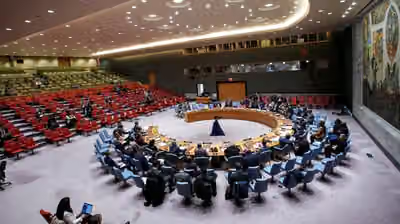
Asif Durrani, former Pakistani envoy for Afghan affairs, has asserted that the majority of the Afghan population does not support the Taliban regime.
Referring to the Taliban’s claim of engaging with 40 countries worldwide, he emphasised that the group lacks both domestic and international legitimacy and remains isolated on the global stage.
In an interview on the “Ambassador Lounge” programme, the senior Pakistani diplomat remarked the Taliban must recognise that they remain globally isolated. If they believe they have established relations with over 40 countries, they are gravely mistaken, as none of these nations has officially recognised their rule, he stressed.
Durrani further highlighted that Islamabad’s diplomatic efforts to persuade the Taliban to prevent Afghan soil from being used against Pakistan have not yielded results.
In response to a query about the available options to pressure the Taliban, Durrani noted that airstrikes have been one of the measures undertaken, while closing trade routes proved to be less effective.
He added that the Taliban fully understand that they cannot progress without Pakistan.
Durrani also pointed out that the Taliban face a significant legitimacy crisis within Afghanistan, stating that sixty-four per cent of the Afghan population does not support the Taliban. They must understand that they are living in a glasshouse and should avoid throwing stones, he added.
The former envoy also addressed the contentious Durand Line, commenting:
“Let me make it clear: the Durand Line is neither our concern nor our issue. It has never been part of our policy discussions. It is an internationally recognised border. The views of the Taliban or any other party on this matter are irrelevant—it is their issue.”
The Taliban regime, like previous Afghan administrations, considers the Durand Line to be an “imposed and imaginary” boundary and continues to refuse recognition of it as an official border between Afghanistan and Pakistan.
Durrani recalled that after the international community’s intervention in Afghanistan, several members of the Taliban were arrested in Pakistan and subsequently transferred to Guantanamo Bay.
He remarked that these individuals pose a significant threat to Pakistan.
Key Taliban figures arrested and transferred to Guantanamo included Abdul Salam Zaeef, Mullah Fazl, Khairullah Khairkhwa, Noorullah Noori, Abdul Hakim Haqqani, and Abdul Rauf Khadim. Abdul Ghani Baradar, the current deputy head of the Taliban administration, was also arrested in Karachi, Pakistan, in 2010 and remained imprisoned until 2018. He was released by the former U.S. envoy to participate in the peace negotiations in Doha.
Many of the former Taliban detainees from Guantanamo now hold leadership positions in the group’s political institutions in Kabul.

Amid growing calls for the cutting U.S. financial aid to Afghanistan under Taliban rule, the Afghanistan currency has once again depreciated against the U.S. dollar. On Sunday, one U.S. dollar was traded at 74 Afghanis in Afghanistan's currency markets.
U.S. President-elect Donald Trump, in a press conference on Tuesday, January 7, condemned the decision of President Joe Biden’s administration to send funds to the Taliban-led government, calling it unacceptable and stressing the need to halt these payments.
Internal pressures and widespread criticism in the U.S. House of Representatives, coupled with Trump’s recent remarks about cutting aid to the Taliban government, have contributed to the continued decline of the Afghan currency.
Several members of Congress have argued that U.S. assistance has unintentionally strengthened the Taliban government. Anna Paulina Luna, a U.S. House Representative, criticized the country for sending $40 million per week to the Taliban, a group she described as a serious threat to the United States. She insisted that no cent of taxpayer money should be directed to the Taliban.
Earlier reports by the U.S. Special Inspector General for Afghanistan Reconstruction (SIGAR) revealed that nearly three billion dollars have entered Afghanistan since the Taliban assumed control.
In response, Afghanistan’s central bank, operating under Taliban control, announced measures to stabilize the currency market and curb further devaluation of the Afghani. A statement released on Sunday, January 12, assured that "sufficient resources" are available for market intervention and that foreign currency demand will be met if necessary. The bank also emphasized that it is closely monitoring exchange rate fluctuations to maintain economic stability.
The future of U.S. financial assistance to Afghanistan remains uncertain. With potential leadership changes in the U.S. and the possibility of Trump’s return to power, some American politicians are calling for a complete cessation of aid, arguing that it inadvertently strengthens the Taliban—contrary to U.S. values.
Since the Taliban’s return to power, Afghanistan has faced severe economic challenges due to international sanctions and the suspension of foreign aid. However, humanitarian assistance has temporarily prevented the collapse of the Afghan currency and alleviated some of the country's economic crisis.

Malala Yousafzai, the Nobel Peace Prize laureate, urged the leaders of Islamic countries at the Girls' Education Summit in Islamabad to recognize the Taliban regime as a perpetrator of gender apartheid.
She stated that the Taliban hides their actions against women and girls under cultural and religious justifications.
On the second day of the International Girls' Education Summit in Islamabad, Yousafzai addressed the restrictions imposed by the Taliban on girls and women, especially the ban on education and learning.
Referring to the decrees issued against women in Afghanistan, she called on the leaders of Islamic countries not to recognize the Taliban government. The Nobel Peace Prize winner expressed concern that in Taliban-controlled Afghanistan, an entire generation of girls is being lost.
She also said that scholars and Muslim leaders must prevent the systematic exclusion of Afghan women and girls. She further stated that the Taliban's mission was clear—they aimed to remove women and girls from every aspect of public life and erase them from society. She also noted that the Taliban had created a gender apartheid system.
Yousafzai called on the leaders of Islamic countries to support the treaty on crimes against humanity and, by condemning the oppressive laws of the Taliban, to emphasize the values of Islam. She said that the way forward for Afghanistan is a political solution, not military force.
She emphasized that this path lay in the power of international law, human rights, and justice. The Girls' Education Summit in Islamabad began on Saturday. Ministers and ambassadors from 44 countries, as well as representatives from the United Nations and the World Bank, are also attending the event.

The Taliban announced on Saturday that a joint coordination meeting, chaired by Mullah Yousuf Wafa, was held among governors, police chiefs, and intelligence heads of the northern zone in Maimana, the capital of Faryab province.
Photos shared by the Taliban Media Center on the social media platform X show Mullah Yousuf Wafa, the governor of Balkh and a trusted associate of Mullah Hibatullah, the group’s leader, presiding over the meeting, with northern governors and police chiefs reporting to him.
Wafa is reportedly close to the Taliban's leader and is seeking to expand Kandahar's influence in the north. It appears that he does not answer to Sirajuddin Haqqani, the group’s Interior Minister.
Some observers view this development as a consolidation of power by Kandahari representatives and weakening of the Haqqani faction within the Taliban's structure.
Prior to Wafa, Dawood Muzammil served as the Taliban governor of Balkh but was killed in an attack by ISIS. Prior to Muzammil, Qudratullah Hamza, a figure close to the Haqqani faction, held the position.
Reports of internal disputes and factional tensions within the Taliban have surfaced before.
Previously, on November, Mullah Hibatullah unexpectedly issued a decree stripping the Ministry of Interior, Ministry of Defense, and Intelligence Directorate of the authority to distribute weapons, ammunition, and military equipment.
The decree stated that only the group’s leader would have the authority to make decisions regarding the distribution of military equipment.

The Taliban's Ministry for the Propagation of Virtue and Prevention of Vice has reported the arrest of 22 individuals within a week on charges related to "moral corruption" and "witchcraft."
According to a statement shared on the social media platform X, the ministry stated that 13 individuals were arrested in the provinces of Daikundi, Kabul, Takhar, and Sar-e Pul on suspicion of "moral corruption." These individuals were handed over to the Taliban's judicial authorities for further investigation and the implementation of "divine rulings."
The ministry also reported the detention of nine people in the provinces of Ghazni, Bamiyan, Daikundi, and Sar-e Pul on charges of "witchcraft." The Taliban alleges that these individuals were promoting practices deemed contrary to "Islamic Sharia" and causing discord within families. However, it remains unclear what specific actions the Taliban considers as "witchcraft."
Earlier, the ministry announced the arrest of nine individuals in Kabul on suspicion of "moral corruption" and "gambling." These individuals were reportedly released after providing guarantees.
The Taliban's morality police conduct mobile patrols across Afghanistan, monitoring the behavior and actions of citizens. The Taliban's Promotion of Virtue law grants the group's morality police extensive powers, enabling them to enforce the group's strict interpretation of Islamic law.
