NATO's Residual Weapons In Afghanistan Fueled Growth Of Terrorism, Says Pakistan's Ex-PM

Former Pakistani Prime Minister Anwar ul Haq Kakar has said that NATO's remaining weapons in Afghanistan have led to an increase in terrorism.

Former Pakistani Prime Minister Anwar ul Haq Kakar has said that NATO's remaining weapons in Afghanistan have led to an increase in terrorism.
The equipment is now in the hands of militants who pose a serious security threat to the area, he added.
There are reports that American weapons have fallen into the hands of the Pakistani Taliban and that these equipment are being bought and sold in the open market.
“In 2014, terrorism wasn’t defeated — it merely relocated to Afghanistan. When the environment became conducive, militants struck back. We must discourage the phenomenon of rationalising terrorism under any pretext,” Kakar said at a meeting in Islamabad.
The former Pakistani prime minister said, "We cannot leave this region like the Americans who left Afghanistan. If the fight against terrorism takes a century, Pakistan will do it."
Anwar ul Haq Kakar said that this is not just a fight against militants, but a struggle for regional stability.
Kakar spoke at the unveiling of the "Comprehensive National Security Charter" prepared by the Pakistan Institute for Conflict and Security Studies in Islamabad. The ceremony was attended by diplomats, experts and representatives of research centres.
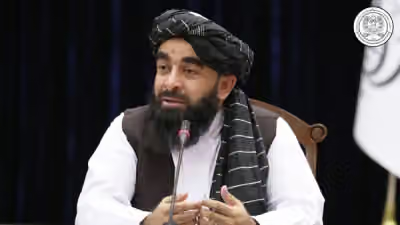

The United Nations has formed an economic working group based on the decision of the Doha meeting, which aims to coordinate economic aid to Afghanistan under the control of the Taliban.
The first meeting of the economic group is scheduled to be held in Kabul on Tuesday, which is mainly at the level of ambassadors of regional countries and heads of Taliban ministries.
Representatives of 25 countries and 11 international organisations are members of the working group, which includes representatives of five ministries of the Taliban administration and four representatives of Afghanistan's commercial sector.
The meeting will be held virtually on Tuesday, January 14.
Last month, the United Nations Assistance Mission in Afghanistan (UNAMA) held the first meeting of the Counter Narcotics Working Group.
These working groups were formed based on the decisions of the third meeting in Doha. UNAMA has previously said that this task force will provide the ground for coordinated interaction with the Taliban.
According to information provided to Afghanistan International, representatives of Canada, China, Germany, India, Indonesia, Iran, Italy, Japan, Kazakhstan, Kyrgyzstan, Navarre, Pakistan, Qatar, Russia, Saudi Arabia, Switzerland, Turkey, Turkmenistan, the United Arab Emirates, the United Kingdom, the United States, and Uzbekistan are attending the second meeting of the Doha Working Group.
Representatives of the Taliban's Ministries of Foreign Affairs, Finance, Industry and Commerce, Economy and the Central Bank, are attending the meeting.
Eleven international organisations, including several UN agencies, are participating in the meeting.
The third Doha meeting was held in the presence of special representatives of countries for Afghanistan last year. At the time, the United Nations stated that the purpose of the meeting was to "increase international engagement with Afghanistan in a coherent and structured manner".
After the formation of these two working groups, the fourth meeting in Doha is scheduled to be held.

Before returning to power in Afghanistan, the Taliban signed an agreement with the Pakistani Taliban, al-Qaeda and other foreign fighters.
According to the agreement, the Taliban pledged to support foreign fighters in "jihad" and the establishment of a Sharia system in Pakistan after their victory.
A source close to the Pakistani Taliban told Afghanistan International that Sirajuddin Haqqani signed the agreement with leaders of the Tehreek-e-Taliban Pakistan (TTP), al-Qaeda commanders, Hafiz Gul Bahadur, leader of the Ittehadul Mujahideen Shura of North Waziristan, Maulvi Sadiq Noor Dawar and some other Taliban leaders in the Mir Ali area of North Waziristan.
Haqqani was the deputy of Mullah Hibatullah, the leader of the Taliban at the time. The Taliban's agreement with foreign groups and fighters is known as the "Mir Ali Agreement".
The source added that after Pakistan's airstrikes on its militants in April 2022 in Spera District, Khost Province, Taliban Defence Minister Yaqoob Mujahid summoned Pakistani Taliban leaders, including Hafiz Gul Bahadur, and asked them to stop their attacks in Pakistan.
However, Hafiz Gul Bahadur, who has supported the Haqqani Network and al-Qaeda in North Waziristan for years, showed Mullah Yaqoob the Mir Ali Accord document, which emphasised on the Afghan Taliban's support for these foreign militants.
Islamabad has repeatedly accused the Afghan Taliban of supporting Pakistani militants over the past three years. However, the Afghan Taliban has denied these accusations and said that Afghan soil is not used against neighbouring and foreign countries. However, the Mir Ali Agreement shows that the Afghan Taliban actively supports the Pakistani Taliban.
The agreement was signed because foreign militants, especially the Tehreek-e-Taliban Pakistan (TTP), fought alongside the Afghan Taliban against the former Afghan government, NATO, and US forces to revive the Taliban regime. In the agreement, the Taliban pledged to reciprocate cooperation with foreign fighters and jihadi militants from other countries.
‘Transporting Militants From Kabul’
Another source told Afghanistan International that after the death of former al-Qaeda leader Ayman al-Zawahiri, Sirajuddin Haqqani and Yaqoob Mujahid asked foreign fighters to move to remote areas, where they are away from domestic and international surveillance.
They no longer considered Kabul safe for foreign fighters, al-Qaeda leaders and TTP commanders.
"Hafiz Gul Bahadur went from Shakardara in Kabul province to the border areas of Barmal district in Paktika and Mufti Noor Wali Mehsud, who lived in an area in Khairkhana in Kabul until recently, went to Kunar province," the source added.
In June 2023, the United Nations Security Council announced in a report that the killing of al-Zawahiri in Kabul has caused mistrust among some members of the Taliban.
Some of them believed that al-Zawahiri's whereabouts had been reported to the United States by the group's internal forces. The presence of the al-Qaeda leader in Kabul worried some Taliban leaders, especially the Doha negotiators, because they had pledged in the Doha agreement not to turn Afghanistan into a haven for global terrorists again.
Sources in Afghanistan International say that Mullah Baradar told Sirajuddin Haqqani, the Taliban's interior minister, in a meeting, "By sheltering Ayman al-Zawahiri, you proved me a liar to the international community. But Sirajuddin Haqqani replied that al-Zawahiri's residence in Kabul was provided with the consent of Mullah Hibatullah Akhundzada."
‘Uyghur Fighters Transferred To Herat’
According to Afghanistan International's investigation, al-Qaeda has transferred some of its members to the provinces of Logar, Helmand, Nuristan, Kunar, Zabul, Herat and Farah. Uyghur fighters of the East Turkestan Movement have also been sent to Shindand district of Herat province due to China's sensitivities.
In May 2022, the Taliban government proposed at Pakistan's request that TTP members be transferred from Afghanistan's border areas to the north, Logar and Ghazni, but the TTP did not consider these areas suitable for its activities.
Another source told Afghanistan International that the Taliban's interior minister promised foreign fighters that roads and houses would be built for them, and that these areas would be connected to centres. Based on this commitment, roads were built between the border areas of Pasa Mila Paktika and Dowa Manda district of Khost province, Spera district of Khost province and the Madakhil area of Paktika.
Sources close to the TTP said that the Taliban government had asked TTP leader Mufti Noor Wali Mehsud to refrain from appearing in public, but he replied, "The sun cannot be hidden with two fingers."
According to sources, the Taliban government has banned leaders and commanders of the Tehreek-e-Taliban Pakistan (TTP) and other militant groups from giving interviews to the media and appearing in cities.
Mir Ali's agreement has become a major problem for the Taliban government after coming to power, as it has now become difficult for them to control internal and external fighters.

The German Foreign Ministry said in a statement that in view of the serious violation of women's rights in Afghanistan, the country has decided to consider the Taliban responsible for the violation of the United Nations Convention on the Rights of Women.
Germany, in cooperation with Australia, Canada, and the Netherlands, has taken this decision against the Taliban.
A statement issued by the German Foreign Ministry on Monday said that since the Taliban took power, "women and girls in Afghanistan have been subjected to severe human rights violations".
The statement went on to say that "various decrees, policies and other measures taken by the Taliban have seriously and systematically deprived women and girls of the public sphere".
The German Foreign Ministry said that women are subject to "systematic discrimination" under the Taliban's rule.
"We have repeatedly called on the Taliban government to comply with all of Afghanistan's obligations under international law and to lift any restrictions on the rights of women and girls," the German Foreign Ministry statement said.
Despite the special emphasis on women's right to education, "unfortunately, the situation has not improved, on the contrary, it is deteriorating in a very worrying way", it added.
Afghanistan is a signatory to the United Nations Convention on the Elimination of All Forms of Discrimination against Women.
The German Foreign Ministry said that "even after the Taliban came to power, the Afghan government is committed to the convention under international law and is responsible for violating the numerous obligations of the agreement under international law."
Germany said that it has decided to hold Afghanistan and the Taliban responsible for violating the UN Convention on the Rights of Women along with Australia, Canada and the Netherlands.
"Together, we called on Afghanistan to comply with the convention by relying on the dispute settlement process provided for in the convention," the ministry added.
The initiative was announced on September 25, 2024 on the sidelines of the United Nations General Assembly and has been supported by Albania, Belgium, Bulgaria, Chile, Denmark, Croatia, Finland, Honduras, Ireland, Iceland, Lithuania, Luxembourg, Morocco, Republic of Moldova, Montenegro, New Zealand, Spain, Sweden, the United Kingdom, and Romania.

Pakistan's Deputy Foreign Minister Amna Baloch met with Roza Otunbayeva, head of the United Nations Political Office in Afghanistan (UNAMA).
The meeting was held on the sidelines of the International Conference of Islamic Countries on Girls' Education in Islamabad.
Pakistan's Foreign Ministry on Monday, January 13, wrote on its official account on social media platform X that the meeting was aimed at reviewing the current developments in Afghanistan and assessing the efforts of the international community to resolve the country's humanitarian crises.
Pakistan's Foreign Ministry and UNAMA have not released further details of the meeting.
The International Conference on Girls' Education in Muslim Communities was held on Saturday and Sunday in Islamabad, the capital of Pakistan.
The conference was attended by more than 150 clerics, ministers, ambassadors, experts, and representatives of reputable organisations such as the Organisation of Islamic Cooperation, UNESCO, UNICEF, and the World Bank.
Nobel Peace Prize laureate Malala Yousafzai called on Muslim leaders to challenge the Taliban government and its repressive policies towards Afghan women. "The Taliban do not see women as human beings in Afghanistan," Yousafzai said.

Nobel Peace Prize laureate Malala Yousafzai has called on Muslim leaders to challenge the Taliban government and its repressive policies towards Afghan women.
"The Taliban do not see women as human beings in Afghanistan," Yousafzai said at an international conference on girls' education in Islamabad.
Addressing Muslim leaders at the meeting, which was attended by dozens of government officials and religious scholars from Muslim-majority countries, Yousafzai said that the Taliban's policies, which include preventing girls and women from accessing education and work, are "not Islamic at all".
The Nobel Peace Prize laureate, who was shot in the head by the Pakistani Taliban members at the age of 15 for a campaign to support girls' education, and who later left Pakistan, said on Sunday in Islamabad that she was happy to be back home. She has only returned to Pakistan a handful of times since the 2012 attack, after making her first return in 2018.
‘Gender Apartheid in Afghanistan’
Malala Yousafzai said on Sunday that the Taliban have re-established a "gender apartheid system" by imposing restrictions on women and girls.
The Taliban "punish women and girls who dare to violate the group's vague laws by beating, detaining and torturing them", she said.
Malala added that the Taliban "cover up their crimes under cultural and religious justifications", but in reality, the group's policies are "contrary to everything that our faith dictates".
Taliban officials were invited to the meeting, which was organised by the Organisation of Islamic Cooperation, the government of Pakistan, and the World Islamic League, but did not attend.
Conference participants included dozens of government officials and scientists from Muslim-majority countries who advocated for girls' education.
Since the Taliban regained control of Afghanistan in 2021, the group's rule has not been recognised by any country. Western powers have conditioned the recognition of the Taliban government on a change in the group's policies, especially with regard to the situation of women and girls.
"Afghanistan is the only country in the world where girls are completely banned from studying beyond the sixth grade," Yousafzai said on Sunday.