Afghanistan Worsens In 2024, Says Human Rights Watch Annual Report

According to Human Rights Watch's annual report, the human rights situation in Afghanistan has deteriorated drastically in 2024.

According to Human Rights Watch's annual report, the human rights situation in Afghanistan has deteriorated drastically in 2024.
The Taliban has exacerbated the economic and humanitarian crisis by intensifying repression against women and girls, imposing severe restrictions on freedom of expression, media, and human rights.
On Thursday, January 16, Human Rights Watch released its annual report on the human rights situation in nearly 100 countries, including Afghanistan.
The international human rights organisation has announced that its monitoring of the situation in Afghanistan shows that the human rights situation in the country has deteriorated in 2024.
Human Rights Watch's annual report states that more than 23 million people in Afghanistan are in need of humanitarian assistance, while the rights of women and girls to education, employment, and freedom of movement have been severely violated. Also, the repression of political dissent, arbitrary arrests and torture continues.
The report emphasises that the Taliban has enacted new laws during this period that deprive women of many of their basic rights, including a ban on higher education, severe restrictions on freedom of movement and employment, and strict measures on public dress and behavior.
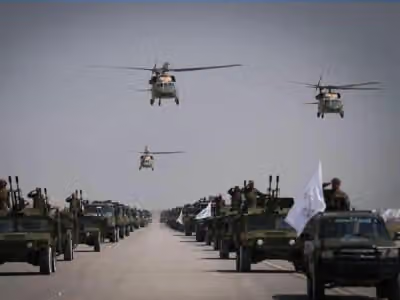

The Afghanistan Security Watch said there were at least 39 security incidents in Afghanistan in December.
It said on Thursday that 25 of the incidents had been confirmed by independent sources.
According to the Afghanistan Security Watch, the Afghanistan Freedom Front has organised 12 attacks against the Taliban, while the National Resistance Front has carried out six attacks on the Taliban during this period.
The Afghanistan Security Watch said in a statement on Thursday, January 16, that one security incident during this period was carried out by ISIS-K and six other incidents were carried out by unknown factors. The attacks took place in Kabul, Badghis, Herat, Parwan and Nangarhar provinces, the organisation said.
The Afghanistan Security Watch noted that security incidents in December were three fewer than in November. However, it acknowledged that the incidents confirmed by independent sources increased by 10 in December compared to the previous month.
In its statement, the security agency said that the Afghanistan Freedom Front has organised the most attacks on the Taliban this month. The Afghanistan Security Watch wrote that the National Resistance Front and Afghanistan Freedom Front said that they had killed 67 Taliban members and injured 64 of the group's fighters this month.
The National Resistance Front of Afghanistan and the Afghanistan Freedom Front are political-military movements opposed to the Taliban that are led from outside Afghanistan. The two fronts have previously said that no civilians were harmed in their attacks against the Taliban.

The International Organisation for Migration (IOM) announced that more than 1.2 million Afghan refugees returned to Afghanistan from Iran in 2024.
The organisation said that 67% of Afghan refugees had been forcibly deported.
The International Organisation for Migration (IOM) wrote in a note on Thursday, January 16, that it has provided humanitarian assistance to at least 324,000 migrants deported from Iran in 2024.
The organisation said that humanitarian aid to Afghan refugees has been provided with the support of the European Union and other donors.
Earlier, Nader Yar Ahmadi, the head of the Centre for Foreign Citizens and Migrants Affairs of the Iranian Ministry of Interior, said that more than three million Afghan refugees have been deported from Iran in the past three years.
According to reports, after the Taliban's takeover of Afghanistan and the spread of poverty and unemployment in the country, the rate of Afghan migration has increased. It is said that many Afghan refugees have taken refuge in neighbouring countries, including Iran, due to fear of the Taliban's reprisals.

Iranian President Masoud Pezeshkian announced that he had discussed Afghanistan issues with his Tajik counterpart Emomali Rahmon.
In a joint press conference with Emomali Rahmon, he said, "Afghanistan is an important country in our neighbourhood and we consider the growth and stability of this country to be in line with our interests, and it is important for us to maintain the security of the borders."
According to the Iranian president’s office, "Both the presidents discussed many issues, including the issue of Afghanistan.”
The Tajik president’s office also wrote in a statement that Emomali Rahmon and Masoud Pezeshkian emphasised on cooperation in the fight against terrorism, extremism and drug trafficking.
According to a statement issued by the Tajik presidency on Thursday, January 16, the meeting stressed on the need for coordinated cooperation in the region and the world to combat the negative manifestations of terrorism and extremism, drug trafficking, transnational organised crime and cybercrime.
Pezeshkian arrived in Dushanbe, the capital of Tajikistan, on the evening of Wednesday, January 15. During this visit, 22 documents and memorandums of understanding were signed for joint cooperation.

Abbas Stanekzai, the Taliban's deputy foreign minister, stressed on the need to control Afghanistan's waters at the National Conference on Climate Change in Kabul.
He warned that if the country's water continues to flow uncontrolled to other countries, people will not even have drinking water in the near future.
He called on the group's officials to build dams with "speed, seriousness and sobriety" and control the flow of Afghanistan's rivers.
On Wednesday, January 15, the Taliban's Environment Department held a meeting titled "National Climate Change Conference" in Kabul to review the results and consequences of the 29th World Climate Change Summit.
At the meeting, Abbas Stanekzai said that Afghanistan is facing a water shortage crisis and the water level is constantly declining.
Stanekzai warned, "If we do not control the flow of our water and the water goes to other places indiscriminately, it will be detrimental to us. A day will come when we will not even have drinking water throughout Afghanistan."
He called on the Taliban's Ministry of Energy and Water to use the available facilities to do more in the field of water control and the construction of dams. "I am confident that the Ministry of Energy is working in this area, but these efforts are not enough," he said. “We need to work with more speed, seriousness and poise to control our waters in the next few years."
Referring to the consequences of the long-running wars in Afghanistan, he stated that these wars have caused serious damage to the country's environment. The Taliban official added that about 80% of Afghanistan's forests have been destroyed.
Stanekzai also addressed the UN envoy in part of his speech, saying, "It is your duty to take practical measures in the field of the environment."
The Taliban's dam construction has raised concerns among countries in the region, including Iran and Central Asia.
Referring to the Taliban's dam construction in the western region, Iranian officials have threatened to take their water rights from the Taliban by force. Central Asian countries are also concerned about the construction of the Qosh Tepa Canal.

Qatar’s Ministry of Foreign Affairs said that it hosted a joint “labour committee” meeting with Taliban representatives in Doha on Wednesday.
The meeting was co-chaired by Sheikha Najwa bint Abdulrahman Al Thani, Qatar’s Deputy Minister of Labour and Mohammad Amin Anis, head of labour deployment at the Taliban-led Ministry of Labour and Social Affairs.
According to the Gulf Times, the meeting "discussed the latest developments in the field of work between the two countries and other related issues".
The Qatari government has refused to provide details on the topics of the agenda of the meeting. However, the Taliban have already asked countries such as Qatar to use Afghan workers.
The Qatari government has received the Taliban delegation with official ceremonies. The Qatari delegation was led by a woman. The Qatari government, like other countries, has included a female official in its delegation with the Taliban, a group that has completely excluded women from the public sphere and confined them to the four walls of their homes.
The Taliban have focused on sending labour out of the country. Recently, the ministers of foreign affairs, labour, and social affairs, and the deputy ministers of public health, interior affairs, and the head of the Taliban's National Bureau of Statistics, in a meeting in Kabul, emphasised on the acceleration of plans to send the workforce abroad.
According to a statement from the Taliban's Ministry of Labour and Social Affairs, Taliban leader Mullah Hibatullah has also ordered "relevant agencies to play a role in the process of legal sending Afghan workers abroad, consolidating professions, health, birth certificates and other documents, and work in accordance with their responsibilities".