Over 700,000 People Have Left Afghanistan In Three Months, Says IOM
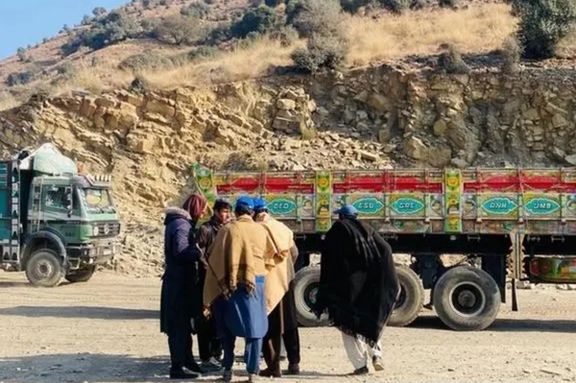
The International Organisation for Migration (IOM) reported that 740,356 people left Afghanistan in the past three months.
The International Organisation for Migration (IOM) reported that 740,356 people left Afghanistan in the past three months.
According to the organisation, more than 983,000 people from the two neighbouring countries, Iran and Pakistan, returned to the country voluntarily and forcibly.
The International Organisation for Migration (IOM) quarterly report, which covers the entry and exit of Afghans from October 1 to January 1, was released on Wednesday, January 22.
The organisation has announced that Afghans have left or returned to Afghanistan through the main crossings of Islam Qala, Spin Boldak and Torkham, and the secondary crossings of Abu Nasr Farahi, Bahram Chah, Angur Ada, Ghulam Khan and Pattan.
The International Organisation for Migration (IOM) has also spoken to more than 75,000 people at the borders. According to the report, 50 percent of respondents cited deportation or forced return as the reason for crossing the border.
The report shows that 39% of respondents cited voluntary return as the reason for crossing borders. Also, 21 percent cited economic reasons and 20 percent cited insecurity in the Islamic Republic of Iran as the reason for their return.
According to the International Organisation for Migration (IOM), the total number of Afghans entering the country during 2024 has reached more than 3,386,000, and the number of people who have left Afghanistan has been reported to be more than 2,469,000.
Accordingly, the number of people who have returned to Afghanistan is about 900,000 more than those who have left the country.

The Taliban's Security and Clearance Commission on Wednesday, January 22, in its annual report, named the citizens of Tajikistan and Pakistan as the main perpetrators of attacks in Afghanistan.
In the report, the Taliban claimed that the attacks were "mainly designed outside Afghanistan".
The Taliban's Security and Clearance Commission said that "evil projects" have been completely destroyed in Afghanistan in the past three years. The Taliban call their opposition groups "mischievous".
The commission has claimed that many commanders, heads of key branches, masterminds and perpetrators of high-profile attacks, and hundreds of its members have been killed and detained in Afghanistan.
This comes as following the Taliban's rise to power, there have been reports of the arrest and torture of the members of security forces of the former Afghan government by the Taliban.
In the past three years, the Taliban has killed or arrested a large number of people on charges of collaborating with ISIS, the National Resistance Front, performing their duties in the security agencies of the former regime, and disobeying orders.
Afghanistan International's findings show that these individuals are being tortured in various ways in the detention centres of the Taliban's intelligence directorates in Kabul and other provinces of Afghanistan.
Announcing that there are a large number of foreign nationals among them, the Taliban's Security and Clearance Commission said, "Some of the leaders and members of this project, who fled to Afghanistan's neighbouring countries after the crackdown, started their organisation with impunity, and indirect support from some factions."
According to the report, these groups deployed in Balochistan and some tribal areas of Khyber Pakhtunkhwa, have been provided with training camps, fundraising facilities, and conditions for propaganda and recruitment from different countries of the world.
The Taliban's Security and Clearance Commission has claimed to have reliable information that these individuals transfer new recruits from some Asian and European countries to their bases in Balochistan and the tribal areas of Khyber Pakhtunkhwa through the airports of Karachi and Islamabad.
The Taliban has not provided any evidence for their claim.
"The attacks are mainly planned outside Afghanistan, and the perpetrators came to Afghanistan from abroad under various guises, many of which were carried out by foreign nationals, especially citizens of Tajikistan and Pakistan," the commission's annual report said.
This comes as Tajikistan has repeatedly expressed concern over the presence of ISIS in Afghanistan and has called for the creation of a security belt around Afghanistan. In October 2022, Tajik President Emomali Rahmon proposed the plan at an extraordinary meeting of the Collective Security Treaty Organisation (CSTO), which has been welcomed by countries in the region. At the time, he stressed that in order to prevent danger, it was necessary to create a security belt around Afghanistan.
Pakistan also blames Afghanistan for the increase in attacks on its soil. Officials in this country have repeatedly announced that members of the Tehreek-e-Taliban Pakistan (TTP) have safe havens in Afghanistan and plan and carry out their attacks from this country.
Asif Durrani, Pakistan's former envoy to Afghanistan, announced in January that the Tehreek-e-Taliban Pakistan (TTP) is operating in eastern Afghanistan with the support of the Haqqani Network. Referring to the history of the Haqqani Network's closeness to Pakistan's intelligence, Asif Durrani said, "This network plays the role of friend and foe at the same time.
Following the increase in insecurity in Pakistan, the country's army bombed targets in Paktika province in airstrikes.
‘Expulsion of corrupt people from Taliban ranks’
In another part of the report, the Taliban's Security and Clearance Commission announced the expulsion of "undesirable and corrupt individuals" from the ranks of its security and defence forces.
In its annual report on Wednesday, January 22, the Taliban's Security and Clearance Commission wrote, "In the past twelve months, undesirable and corrupt individuals who have been involved in harassing people or committing various crimes have been identified and expelled from the ranks."
The Taliban's Security and Clearance Commission did not provide details about the fate of these individuals.
In the report, the Taliban claimed that all factors of insecurity in Afghanistan have been eliminated and a safe environment has been provided for work.
At the same time, the commission claimed that it has made significant achievements in strengthening borders and security monitoring, reducing crimes, drugs, and training and strengthening its security forces.
The Taliban's Foreign Ministry announced that Amir Khan Muttaqi, the group's foreign minister, met with Roza Otunbayeva, the UN Secretary-General's Special Representative for Afghanistan.
The ministry said in a statement on Wednesday that Otunbayeva praised the Taliban's economic efforts and said that she would discuss the group's achievements at UN meetings.
Zia Ahmad Takal, the Taliban's deputy foreign ministry spokesman, also quoted Otunbayeva as saying that for the first time in the past year, development aid to Afghanistan has increased.
He quoted the head of UNAMA as saying, "This is a very positive development and will have a positive impact on the Afghan economy."
Amir Khan Muttaqi, the Taliban's foreign minister, has also said that Afghanistan is on the path of growth after the establishment of stability.
UNAMA has not yet commented on the meeting or Roza Otunbayeva's remarks.
Sources confirmed to Afghanistan International that unidentified gunmen killed a Chinese citizen in Khwaja Bahauddin district of Takhar on Tuesday evening, January 21.
According to sources, the translator and the driver of this person fled the scene of the accident and went to the Taliban outpost.
Local Taliban officials confirmed the death of the Chinese citizen.
A spokesman for the Taliban's police command in Takhar said that the Chinese citizen's name was "Li".
Mohammad Akbar Haqqan, a spokesman for the Taliban's security command in Takhar province, wrote in a statement that the Chinese citizen "was traveling with his interpreter last night without informing the Chinese officials and security officials from the office in an unknown direction, and unfortunately he was killed by unidentified people on the way to Dasht-e-Qala in Takhar province".
Local sources said that the incident took place in the Katkajar area of Khwaja Bahauddin district, on the border with Dasht-e-Qala district.
The Taliban official said that the translator of the Chinese citizen was not injured in the incident.
The Taliban said that they had launched an investigation into the matter.
Sources told Afghanistan International that the Taliban intelligence agency has interrogated the Chinese citizen's driver and translator.
According to sources, the Chinese citizen worked in the mining sector.
A research institution called the Panjshir Studies Centre has published the findings of its survey of the residents of Panjshir province.
The organisation said that 90% of the survey respondents believe that the Taliban are "looting" the mines of Panjshir and that the people of the province do not benefit from their revenues.
According to the report, residents of Panjshir have said that the mines of this province are extracted by traders and their revenues are handed over to the Taliban government.
The report states that the Taliban has also issued work permits to 1,700 miners and received 10,000 afghanis from each licence. It is said that 550 miners are currently working in Panjshir.
According to the report, the Taliban has sold 43,000 carats of Panjshir emeralds in 32 auctions, and the proceeds have reached the Taliban administration in the centre worth 78 million afghanis.
The Panjshir Studies Centre said that miners in Panjshir reported that the Taliban had been extorting 2,000 afghanis from them every month.
The report also said that the Taliban also sells explosives needed for mining "exclusively" and at high rates.
The Panjshir Studies Centre said that in this survey, it spoke to 250 men and women across Panjshir and asked them five major questions. The survey was said to have been conducted over a period of two months.
‘Non-implementation of development projects in Panjshir’
According to the survey, 98% of the participants said that the Taliban government has not implemented any development projects in Panjshir.
According to the report, two percent of respondents hope for the construction of a road from Panjshir to Badakhshan.
At the same time, 60 percent of respondents said that some small projects, such as cleaning agricultural and drinking water canals, have been implemented by charities.
The Panjshir Studies Centre said that 97 participants said in response to a question that they had not seen any "positive performance" from the Taliban government.
‘Taliban meetings under guise of people's support for group's government’
The report of the Panjshir Studies Centre states that the residents of Panjshir claimed that the Taliban government regularly holds programmes and gatherings in Panjshir under the title of "supporting the emirate system".
The report states that no criticism of the Taliban government is raised in these meetings, and if anyone does so, they will be threatened.
The Panjshir Studies Centre said that in the past year alone, Mohammad Agha Hakim, the Taliban's governor in Panjshir, has held 23 meetings under the title of "Supporting the Emirate System" in different districts of the province.
According to the report, these meetings are held at "exorbitant costs", and the Taliban ask the speakers to praise the group's government.
The Panjshir Studies Centre also said that the Taliban "abused students" in schools and asked them to sing dozens of poems and songs in praise of the Taliban's governor in Panjshir and the group's government.
The Taliban government has not yet responded to the findings of the survey.
Jean-Louis Denis, a Belgian Islamist preacher, who was sentenced to five years in prison in 2016 for recruiting young people for jihad, has traveled to Afghanistan.
His visit to Afghanistan has raised concerns about his possible links to jihadist groups operating in the region.
French television channel TF1 reported that the Belgian Islamist preacher had recently announced in a video that he had traveled to Afghanistan after serving his sentence in Belgium.
He also stated that his goal is to live "according to the principles of Sharia" and "show the true face of Afghanistan".
In the video, which was posted on YouTube, Jean-Louis Denis said that he went to Kunduz. He said he lives near an orphanage and plans to support it with a project.
Denis also claimed that he did not come to Afghanistan to participate in jihad, but rather to implement a project in the field of sustainable agriculture.
Although the Belgian Islamist preacher has said that he does not seek jihad in Afghanistan, he has previously praised the Taliban for "beheading infidels" in his remarks.
Jean-Louis Denis was released in December 2018 after serving his sentence in prison. He was expelled from Benin (a West African country) in 2022 for extremist activities and links to jihadist groups.
Noting that Denis adhered to extremist ideologies even after serving his sentence, the report wrote that his approach may only be a cover for his activities to join jihadist groups and expand their influence.
Denis was involved in recruiting and organising the travel of dozens recruits from European countries to war zones such as Syria.
One of the people facilitated by Jean-Louis Denis was Najim al-Ashrawi, the suicide bomber of the March 22, 2016 attack in Brussels.
While security experts warn of the rise of jihadist groups in Afghanistan, US officials have also expressed concern about the increasing threat of ISIS in Afghanistan.
Senior Republican Senator Lindsey Graham has said in a recent statement that he is concerned about the group's attack on the United States as ISIS' presence in Afghanistan increases and wars spread around the world.
A report by independent international organisations shows that ISIS continues to recruit and expand its influence in Afghanistan. According to the UN Security Council report, ISIS has even infiltrated the Taliban's security institutions.