Fighter Jets Seen Over Herat; Taliban Reports Clash At Border Crossing

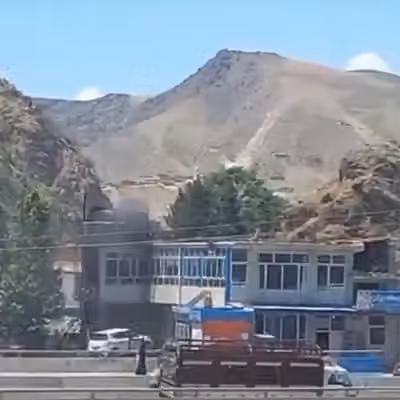
Local sources in Herat Province told Afghanistan International that fighter aircraft were seen patrolling the skies over the province on Sunday night.

Local sources in Herat Province told Afghanistan International that fighter aircraft were seen patrolling the skies over the province on Sunday night.
At the same time, a Taliban official reported an attack on Pakistani positions at the Angoor Ada border crossing in the Barmal district of Paktika Province.
Ahmadullah Muttaqi, head of information and culture for the Taliban in Herat, posted a video on X that he said showed the group’s forces attacking Pakistani positions at Angoor Ada. The footage appears to show Taliban fighters using heavy weapons at night against what were described as Pakistani military posts.
Residents of Herat said drones remained in the province’s airspace and that gunfire was heard for several minutes.
A source near the Islam Qala crossing said at least two explosions were heard following the aircraft activity. Taliban authorities have not commented on the identity of the aircraft or the cause of the reported gunfire in the province.
Attaullah Tarar, Pakistan’s minister for information and broadcasting, said that by 9 a.m. on Saturday at least 331 militants had been killed and more than 500 wounded in recent clashes.
In a statement posted on X on 28 February, Tarar said those killed included members of the Afghan Taliban, Tehreek-e-Taliban Pakistan and other armed groups.
He said Pakistani forces had destroyed 104 Taliban bases, seized 22 others and disabled 163 tanks and armoured vehicles.
Tarar added that airstrikes had been carried out at 37 locations inside Afghanistan.
According to Pakistani officials, the operations took place in the provinces of Nangarhar, Kandahar and Paktia , as well as in parts of Pakistan’s Chitral District.
The European Union has urged the Taliban to prevent militant groups from using Afghanistan as a base, warning that rising tensions with Pakistan could have serious regional consequences.
In a statement issued on Saturday, the EU expressed concern over escalating tensions between the Taliban and Pakistan, saying Afghan territory must not be used to threaten or attack other countries.
The bloc called on the Taliban authorities to take effective action against all militant groups operating in Afghanistan and to ensure the country’s territory is not used against neighbouring states.
The statement warned that continued tensions could have serious implications for the wider region and urged both sides to de-escalate immediately and halt hostilities.
Pakistan has repeatedly alleged that groups opposed to it, including Tehreek-e-Taliban Pakistan and some Baloch separatist organisations, operate from Afghan territory. The Taliban have consistently denied the claims. The United Nations Security Council has also previously expressed concern about militant groups using Afghanistan as a base.
The EU further called on both parties to engage in dialogue and stressed that international law, including humanitarian law, must be fully respected by all sides. It said the protection of civilians and civilian infrastructure must be ensured and that all possible measures should be taken to prevent further harm.
Earlier, the United States voiced support for Pakistan’s counterterrorism efforts, while China also said it backs Pakistan in combating terrorism.
As tensions escalate between the Taliban and Pakistan, Bakhtiyor Saidov, Uzbekistan’s foreign minister, held a telephone conversation with Amir Khan Muttaqi.
According to a statement from the Taliban’s Foreign Ministry, Saidov stressed that diplomacy is the only solution to the conflict.
Muttaqi said the Taliban’s recent security measures were carried out solely to defend Afghanistan’s sovereignty, territorial integrity and airspace.
He added that the Taliban believe in resolving disputes through understanding and negotiation, but warned that they consider defence of the country’s territory to be their legitimate right in the event of any aggression.
The Taliban statement also said the Uzbek foreign minister described diplomacy as the only effective way to manage the current situation and expressed readiness to play a practical role in future efforts.
Mosharraf Zaidi, spokesperson for Pakistan’s prime minister, said no talks or negotiations would be held with the Taliban.
Zaidi said Pakistan’s sole responsibility is to protect its citizens and territorial integrity and that militancy originating from Afghanistan must end.
Speaking to Pakistani media on Saturday, he said that if Pakistan knew where militants were located, it would act to eliminate the source of the threat, even if those militants had local support.
Zaidi also said the international community must ensure that Afghan territory along the Durand Line is not used to carry out attacks.
Attaullah Tarar, Pakistan’s minister for information and broadcasting, backed the position, saying Islamabad’s objective is solely to eliminate militant threats and ensure national security.
In an interview, Tarar said Pakistan has acted as a responsible neighbour but that its goodwill should not be interpreted as weakness.
Amid an unprecedented escalation in clashes between the Taliban and Pakistan, the Taliban said they want to resolve disputes through dialogue.
Pakistan has not publicly indicated any readiness to enter negotiations.
Sirajuddin Haqqani, the Taliban’s interior minister, and Zabihullah Mujahid reiterated the group’s stated commitment to diplomacy, saying the path to talks remains open.
Amir Khan Muttaqi, the Taliban’s foreign minister, also told Mohammed bin Abdulaziz Al-Khulaifi of Qatar that the Taliban do not support violence and prefer to resolve issues through mutual understanding and respect.
Speaking at a mosque in Khost Province on Friday, Haqqani urged Pakistan not to take actions that would force the Taliban to declare what he described as a national uprising and jihad. He warned that Pakistan would face serious consequences if such a step were taken and called on regional and international countries to help reduce tensions and facilitate dialogue.
At a separate news conference, Mujahid warned that continued clashes could destabilise the region. He called on neighbouring countries to prevent further Pakistani military attacks and said Islamabad had shown no willingness to resolve disputes through negotiations.
Hamdullah Fitrat, a deputy spokesperson for the Taliban, alleged that Pakistani forces deliberately targeted civilians in Khost Province and Paktika Province, killing 19 people and wounding 26 others, most of them women and children.
In response, Ahmed Sharif Chaudhry, spokesperson for the Pakistan Army, said at least 274 Afghan militants were killed in Pakistan’s strikes. He said 73 Taliban posts were destroyed and 18 others seized, with more than 400 people wounded. He also claimed that at least 115 Taliban tanks and armoured vehicles were destroyed.
Pakistan has confirmed that 12 of its soldiers were killed in the clashes. Mujahid, however, claimed that 55 Pakistani soldiers were killed in recent border fighting and that some of their bodies were in Taliban custody. He also confirmed that 13 Taliban fighters were killed.
The escalation has prompted diplomatic efforts by Qatar, Saudi Arabia, Iran and Turkiye to reduce tensions and encourage talks. China and Russia have also expressed readiness to mediate.
It remains unclear whether regional efforts will succeed in ending the fighting, but relations between the Taliban and Pakistan appear to remain highly strained.
Pakistan has said it will no longer tolerate threats emanating from Afghan territory, while the Taliban have warned they will respond to any further attacks.