Pakistani Police Intensifies Detention Of Afghan Migrants In Islamabad
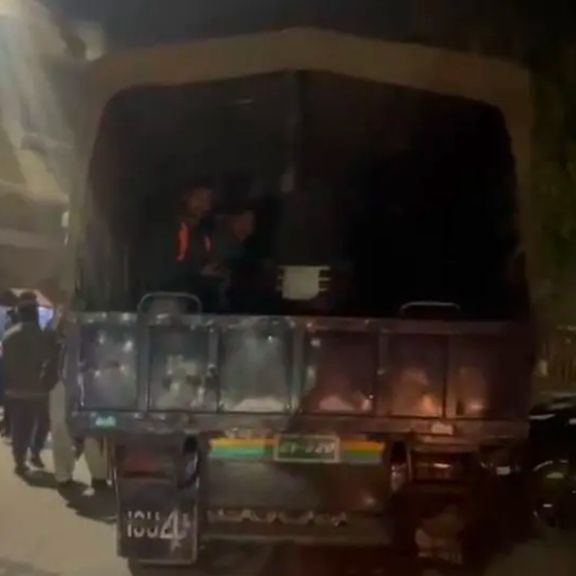
Afghan refugees in Islamabad, Pakistan, alleged that the country's police have intensified the detention of refugees after a few days.

Afghan refugees in Islamabad, Pakistan, alleged that the country's police have intensified the detention of refugees after a few days.
According to the migrants, police have arrested Afghan migrants since Tuesday in different areas of Islamabad, including Barakahu.
Sources from Islamabad's Barakahu area said on Thursday, January 30, that Pakistani police "intensified" searches of migrant homes at 9am and arrested a number of undocumented migrants, including women and children.
An Afghan refugee who was held in police custody for an hour told Afghanistan International that police had "beaten up" the arrested women. A female migrant who was trying to contact her family was seized by the police officials and severely beaten after a verbal altercation, she said.
Another refugee sent videos to Afghanistan International and said that the Islamabad police arrested a number of migrants, including his brother, from the Mandi Mor area of the city on Wednesday evening and transferred them to Haji Camp in Rawalpindi.
He said that the Pakistani police slapped him because of the filming. According to the woman, Pakistani police have also arrested migrants who had UNHCR cards with them.
Pakistani police have intensified arrests of Afghan refugees in the cities of Islamabad and Rawalpindi for the past month. These arrests had decreased in the past week and have intensified again in the last two days.


David Martinon, the former French ambassador to Afghanistan, has stated that the Taliban has turned Afghanistan into an "Islamic North Korea".
Martinon added that he is not optimistic about a change in the situation in Taliban-dominated Afghanistan in the short term.
In an interview with a newspaper about the documentary "The Collapse of Kabul", Martinon said that the Taliban is in full control of Afghanistan today and there is no serious internal opposition against it except for ISIS-K, which is a bloodthirsty group.
The documentary is an adaptation of David Martinon's book titled "The 15 Days That Transformed Kabul".
The French diplomat, who is now France's ambassador to South Africa, added that the Taliban's opponents, including Ahmad Massoud, are facing difficulties.
In a part of the interview, he said, "The Taliban has created fear inside the country. They are cruel and have made women's living conditions even more difficult. Women no longer have access to public spaces, education and medical education. Even in their homes, they are not allowed to have windows facing out. There is no better description of this situation of women and girls as domestic slavery."
He considered the fall of Kabul not only a defeat for the democratic international community, but also for the Afghan political class, adding, "After 20 years of efforts and investment, Afghanistan has not been able to achieve independence and stability."
Martinon also recalled the difficult days before the withdrawal from Kabul and said that the French embassy team had carried out the evacuation operations accurately and quickly in anticipation of the fall of the government.
He described tough decisions, such as opening the embassy doors to rescue hundreds of Afghans at risk, as one of the most critical moments of his mission.
The French-titled documentary "Kabul Chaos", written and directed by Thomas Brémond, David Périssère, Nils Montel & Myriam Weil, recounts the events of Martinon and his team's three-year mission in Kabul until their departure in August 2021.
The documentary, which was made using various archives and interviews, is scheduled to be broadcast on January 31.
David Martinon said that Afghanistan has been plunged into darkness under Taliban rule and has an uncertain future, but he still hopes that one day the French diplomatic mission in Afghanistan will be resumed.

Following the suspension of US aid, the Taliban administration has informed all government employees that the payment of their monthly salaries has been suspended for three months.
This is the latest move by the Taliban to curb the pressure instigated after the cut off of US aid to Afghanistan.
Three employees of various government departments of the Taliban have informed Afghanistan International that the authorities have officially informed them that their salaries will not be paid in the next three months.
The Taliban has also banned logistical procurement.
Immediately after entering the White House, US President Donald Trump suspended all foreign aid, including sending money to Afghanistan, for three months.
The suspension of US aid has disrupted Afghanistan's relative economic stability, leaving the Taliban confused in the face of financial challenges, including a sharp devaluation of the Afghani.
The US State Department said on Sunday that the US government should focus more on its national interests.
"President Trump has made it clear that if foreign aid does not benefit the American people, the country will no longer blindly distribute money," the department's statement said. "Reviewing foreign aid is a moral duty of the government."
Abdul Latif Nazari, the Taliban's deputy minister of economy, said that following the suspension of US aid to Afghanistan, the activities of 50 international aid organisations in 28 provinces of the country have been suspended. Abdul Latif Nazari called on the countries of the world to separate humanitarian aid from political issues.
He said that the reason for the halt of the work of these organisations was the suspension of aid from the United States of America.
The suspension of US aid has caused volatility in Afghanistan's foreign exchange market.
Until recently, one dollar was traded at 69 afghanis in the Kabul foreign exchange market, but now one dollar has crossed the 80 afghani mark.

Following the suspension of US aid and the devaluation of the Afghani, the Taliban's prime minister made it mandatory to use the Afghani currency in transactions. Previously, the Taliban had banned the use of foreign currencies.
The Taliban's prime minister's office said in a statement, "No one can transfer more than $5,000 through airports and more than $500 through land borders."
The Taliban has also banned the entry of foreign currencies into Afghanistan and banned the transfer of dollars abroad.
The Taliban has also once again emphasised on preventing the smuggling of currency, gold, and historical artifacts.
In a statement issued by the Taliban's Prime Minister's Office on Monday, January 27, it was stated that violators will be imprisoned from 10 days to one year, depending on the amount of foreign currency transfers.
According to this order, the transfer of $1 million is considered to be one year in prison, and for lesser amounts, for every $100,000, one month in prison.
The statement also said that the money and gold seized from the "violators" will be kept in the Central Bank of Afghanistan until the Prime Minister's decision is made.
In recent days, with the sharp decline in the value of the Afghani currency against the dollar, the Central Bank offered millions of dollars to the market, and the group also closed the foreign exchange markets to control the price.
However, the value of the Afghani currency continues to depreciate against the dollar.
After the suspension of US aid, the dollar against the Afghani crossed the 80 Afghani mark.
This comes as a while ago, one dollar was traded at 69 afghanis in the Kabul foreign exchange market.

After his visit to Kabul, Iran’s Foreign Minister Abbas Araghchi said that Iran's national interests are tied to many Afghan issues.
Araghchi added that given the challenges in Afghanistan, dialogue and interaction with the Taliban are necessary.
Abbas Araghchi had travelled to Kabul on Sunday morning, January 26, along with a political and economic delegation, and met with the Taliban's prime minister, foreign, and defence ministers.
This was the first visit of the Islamic Republic's foreign minister to Kabul since the Taliban's return to power in August 2021.
In a meeting with Taliban officials, Araghchi stressed that a new chapter in relations between the Islamic Republic and Afghanistan will begin.
After his visit to Kabul, Abbas Araghchi called the Persian speakers rights, border security, security inside Afghanistan, security of Shiites, security of merchants, narcotics, terrorist groups and ISIS "very important challenges".
The Islamic Republic's domestic media reported on Wednesday, January 29, that Abbas Araghchi told reporters on the sidelines of the cabinet meeting, "Our national interests are tied to these issues, and it is natural that we should have dialogue and interaction."
The Foreign Minister added that regardless of the level of Iran's relations with Afghanistan politically and whether the necessary identification has been made or not, resolving these issues through dialogue and diplomacy is a necessity.
The Jomhouri-e Eslami newspaper, however, criticised Araghchi's visit to Afghanistan, calling the Taliban a "backward" group. The newspaper referred to the Taliban as a "rebellious, violent, and backward" group that lacks domestic legitimacy and acceptance.
Amid the criticism, the Islamic Republic's ambassador to Afghanistan announced that Abbas Araghchi's visit to Kabul does not mean recognition of the Taliban government.

Sources confirmed to Afghanistan International that the Taliban's intelligence services have arrested two clerics who are critical of the group, Mahmood Hassan and Abdul Qadir Qant.
Earlier, in a meeting in Kabul, the two clerics strongly criticised the Taliban's monopoly of power, especially the Kandahar Taliban faction, and called for the formation of an inclusive government.
The Council for the Support of Jihadi and Islamic Values held a conference in Kabul on Monday, January 27. Mahmood Hassan, a member of the council and former head of the Hajj and Religious Affairs Department in Panjshir province, said at the meeting that the Taliban had monopolised power. He emphasised that in addition to Mullah Hibatullah Akhundzada, 12 Taliban cabinet ministers are from Kandahar province.
Sources said that the Taliban's intelligence agency arrested the two clerics on Tuesday, January 28.
In contact with his family, Mahmood Hassan confirmed that he is in Taliban custody.
Relatives of Qant also told Afghanistan International that the Taliban had arrested him.
Mahmood Hassan had strongly urged Taliban leaders not to confine power to Kandahar. He called on the Taliban to end the monopoly of power and include representatives of other provinces and ethnic groups in power.
The council member said, "We heard that 12 ministers, including Amir al-Momineen Mullah Hibatullah Akhundzada, are from Kandahar. This is not justice. This is not fairness and equality. Give power to the tribes and people of Afghanistan in the true sense of the word, whether it is a ministry, a directorate or an administration."
Abdul Qadir Qant, another member of the council, was also present at the ceremony. He is from Chal district of Takhar province, and was previously arrested by the Taliban.
Their criticism of the Taliban has been widely welcomed by users on social media.