Taliban Embassy In Islamabad Seeks More Funds To Strengthen Lobbying In Pakistan
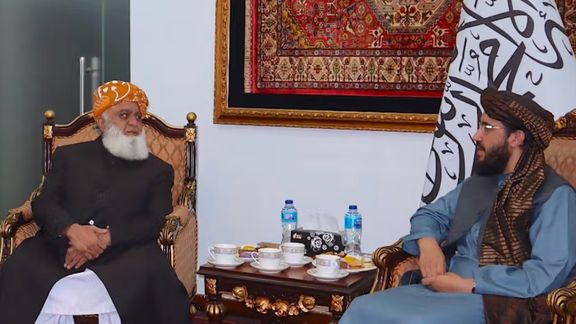
Leaked Taliban documents reveal that the group’s embassy in Islamabad has requested over $36,000 to strengthen its lobbying efforts in Pakistan.
According to the documents, the embassy asked the Taliban’s Foreign Ministry to allocate $3,000 per month for lobbying activities and for "reflecting the realities of Afghan society in the media space" of the host country.
These letters are among thousands of leaked Taliban documents, recently published by an anonymous hacker group.
One of the leaked documents from the Taliban’s Foreign Ministry includes a letter from the embassy in Islamabad, requesting a higher lobbying budget.
Sardar Ahmad Shakib, the Taliban’s chargé d'affaires in Islamabad, wrote that the previously allocated $2,500 per month was insufficient and needed to be increased.
In March 2024, Shakib informed the Foreign Ministry that the embassy had spent $8,500 on lobbying during the third and fourth quarters of 2023. He also stated that a confidential report on the expenditure had been shared with the ministry’s leadership.
In December 2023, the Taliban’s chargé d'affaires in Islamabad wrote to the Foreign Ministry under the subject "Request for Increased Lobbying Funds", stating that in previous years, the embassy had received $10,000 per month for similar activities.
The letters highlight the Taliban’s strategic focus on maintaining relations with the host country and engaging with international figures and institutions. They argue that additional funds are necessary to support diplomatic objectives, cultural interactions, and Afghanistan’s media representation.
While the embassy did not provide specific details on how the funds would be used, its ambassador in Pakistan frequently meets with diplomats and representatives from regional and Western countries, many of whom do not formally recognise the Taliban government.
The Afghan embassy in Islamabad is regarded as one of Afghanistan’s most profitable diplomatic missions, generating significant revenue through document verification for Afghan migrants, trade relations, and visa issuance.
Despite these earnings, the Taliban embassy maintains that its current budget is insufficient and continues to seek additional financial support.
According to the documents, the embassy asked the Taliban’s Foreign Ministry to allocate $3,000 per month for lobbying activities and for "reflecting the realities of Afghan society in the media space" of the host country.
These letters are among thousands of leaked Taliban documents, recently published by an anonymous hacker group.
One of the leaked documents from the Taliban’s Foreign Ministry includes a letter from the embassy in Islamabad, requesting a higher lobbying budget.
Sardar Ahmad Shakib, the Taliban’s chargé d'affaires in Islamabad, wrote that the previously allocated $2,500 per month was insufficient and needed to be increased.
In March 2024, Shakib informed the Foreign Ministry that the embassy had spent $8,500 on lobbying during the third and fourth quarters of 2023. He also stated that a confidential report on the expenditure had been shared with the ministry’s leadership.
In December 2023, the Taliban’s chargé d'affaires in Islamabad wrote to the Foreign Ministry under the subject "Request for Increased Lobbying Funds", stating that in previous years, the embassy had received $10,000 per month for similar activities.
The letters highlight the Taliban’s strategic focus on maintaining relations with the host country and engaging with international figures and institutions. They argue that additional funds are necessary to support diplomatic objectives, cultural interactions, and Afghanistan’s media representation.
While the embassy did not provide specific details on how the funds would be used, its ambassador in Pakistan frequently meets with diplomats and representatives from regional and Western countries, many of whom do not formally recognise the Taliban government.
The Afghan embassy in Islamabad is regarded as one of Afghanistan’s most profitable diplomatic missions, generating significant revenue through document verification for Afghan migrants, trade relations, and visa issuance.
Despite these earnings, the Taliban embassy maintains that its current budget is insufficient and continues to seek additional financial support.
Albert Khorev, Russia’s ambassador to Pakistan, has voiced Moscow’s concerns over the rise in terrorist activities in Pakistan and reaffirmed Russia’s commitment to support Islamabad in countering these threats.
Khorev stated that Russia stands in solidarity with Kabul’s counterterrorism efforts and is prepared to provide necessary assistance too.
Speaking to TASS News Agency, he emphasised, "We reaffirm our commitment to strengthening constructive cooperation with Pakistan and Afghanistan."
However, the Russian diplomat did not provide specific details regarding the nature of Russia’s assistance to Pakistan and the Taliban in combatting terrorism.
Khorev stressed that resolving security issues in the border regions between Pakistan and Afghanistan remains the primary responsibility of both nations. However, he also highlighted that Russia and Pakistan are currently engaged in effective counterterrorism cooperation.
As part of these efforts, he pointed to the joint counterterrorism military exercises conducted by Pakistan and Russia in October 2024.
The Pakistan Army announced in October 2024 that it had conducted a two-week joint military exercise with Russia’s armed forces in Khyber Pakhtunkhwa province, aimed at enhancing counterterrorism capabilities.
Pakistan has consistently claimed that Tehreek-e-Taliban Pakistan (TTP) maintains safe havens inside Afghanistan. The Pakistan Army has also accused Afghan nationals of involvement in terrorist activities.
On Saturday, the Pakistan Army reported that an Afghan national, Luqman Khan Nusrat, was killed during a counterterrorism operation in North Waziristan. In an official statement, the military asserted that "such incidents highlight the role of Afghan nationals in terrorist activities within Pakistan."
The Pakistan Army has repeatedly urged the Taliban to honour its commitments and prevent terrorist groups from using Afghan soil to launch attacks in Pakistan.
The Afghanistan Freedom Front (AFF) has claimed responsibility for an attack on a Taliban convoy in Takhar province on Saturday evening, resulting in the deaths of three Taliban members and injuries to two others.
In a statement, the AFF stated that its forces targeted a convoy of Taliban intelligence vehicles on the outskirts of Taloqan city.
Local sources told Afghanistan International that an explosion was heard near the Taliban’s Directorate of Agriculture in Taloqan. Reports suggest that a Taliban Ranger vehicle was struck in the attack.
On Sunday, the AFF issued a statement asserting that Taliban forces had been ambushed while returning from the villages of Ganj Ali Beig, Bolak Urta Boz, and Post Khor, where they had allegedly harassed local residents.
As is customary, the Taliban has not yet commented on the attack in Takhar.
The AFF also shared a video of the attack on social media platform X, further reinforcing its claim of responsibility.
Mohammad Essa Sani, the Taliban’s Minister of Public Works, has informed the Chinese ambassador in Kabul that the review process for the Wakhan Corridor has been completed, with design work currently underway.
Sani emphasised that Afghanistan is fully prepared to commence practical work on the Afghan-Trans railway project, a key infrastructure initiative aimed at boosting regional connectivity.
Strategic Discussions on Wakhan Corridor and Afghan-Trans Railway
During a meeting with the Chinese ambassador on Saturday, discussions focused on the Wakhan Corridor and the Afghan-Trans project. A statement from the Ministry of Public Works noted that both sides had agreed to continue cooperation and engage in further dialogue regarding the corridor’s development.
The Wakhan Corridor, situated in the Pamir Mountains of Badakhshan, is a strategic passage connecting Afghanistan with China, Tajikistan, and Pakistan. It serves as Afghanistan’s only land link to China’s Xinjiang region.
The Taliban have repeatedly underscored the importance of constructing a road through the Wakhan Corridor to enhance trade and connectivity with China. However, Chinese officials have expressed security concerns, which have so far delayed the project’s implementation.
Progress on Afghan-Trans Railway Project
In addition to discussing the Wakhan Corridor, Sani reaffirmed Afghanistan’s full readiness to proceed with the Afghan-Trans railway project. This initiative involves the construction of a 537-kilometre railway, linking Uzbekistan, Afghanistan, and Pakistan. It is regarded as a key corridor for trade and transportation, facilitating the movement of goods between Central Asia, South Asia, Russia, and Europe.
Uzbekistan’s Minister of Transport previously stated that construction on the project is set to begin this year. The Uzbekistan Transport Design and Research Institute has estimated the project’s cost at over $4.6 billion, while Pakistan has projected the cost at $8.2 billion.
Gurbanguly Berdimuhamedov, the President of Turkmenistan, has directed officials to expedite the construction of the Turkmenistan-Afghanistan-Pakistan-India (TAPI) gas pipeline. During a cabinet meeting, Berdimuhamedov stressed that the project must progress swiftly in 2025.
He further highlighted that prioritising the energy sector would significantly enhance Turkmenistan’s oil and gas capacity.
TAPI Pipeline: A Major Regional Project
The TAPI pipeline, one of the largest regional energy projects, spans 1,814 kilometres, including 214 kilometres in Turkmenistan, 774 kilometres in Afghanistan, and 826 kilometres in Pakistan.
The pipeline is designed to transport 33 billion cubic metres of gas annually from the Galkynysh field in southern Turkmenistan, passing through the Afghan cities of Herat and Kandahar, as well as Quetta and Multan in Pakistan, before terminating in Fazilka, India.
Progress and Future Prospects
Muhammad Murad Amanov, head of the TAPI project, previously stated that construction is advancing rapidly, with six kilometres of the gas pipeline already completed in Afghanistan.
Practical work on the TAPI project in Afghanistan commenced on 11 September 2024, with the presence of officials from both the Taliban and Turkmenistan.
The Taliban administration claims that Afghanistan will earn $400 million annually from the project, citing it as a key economic initiative for the region.
Imangali Tasmagambetov, Secretary-General of the Collective Security Treaty Organisation (CSTO), has labelled Afghanistan as a potential source of terrorism and drug trafficking threats to Central Asia.
He stated that the CSTO’s decision to reinforce Tajikistan’s border with Afghanistan stems from concerns over the risk of terrorism spreading into the region.
Speaking on Friday during the fourth meeting of parliamentary committee heads from CSTO member states, Tasmagambetov underscored that the adoption of a targeted interstate programme to strengthen the Tajik-Afghan border reflects a shared understanding among member states regarding potential security threats to Central Asia.
According to a CSTO press release, he highlighted that terrorism, extremism, and drug trafficking primarily originate from Afghan territory and urged closer collaboration among the Parliamentary Assembly of CSTO member states to safeguard regional security.
The CSTO, a regional security alliance, comprises Russia, Armenia, Belarus, Kazakhstan, Kyrgyzstan, and Tajikistan as permanent members.
Afghanistan Remains a Key Concern for CSTO Leadership
On 30 January, Andrey Serdyukov, head of the CSTO Joint Staff, also identified Afghanistan as a significant security threat to the region. He warned that Afghanistan remains the primary source of instability, radical ideology, terrorism, and drug trafficking in Central Asia.
The Taliban administration, however, has consistently denied the presence of terrorist groups in Afghanistan, rejecting such allegations from international bodies and regional security organisations.