Uzbekistan Seizes Over 600 Kilograms Of Afghan-Origin Drugs
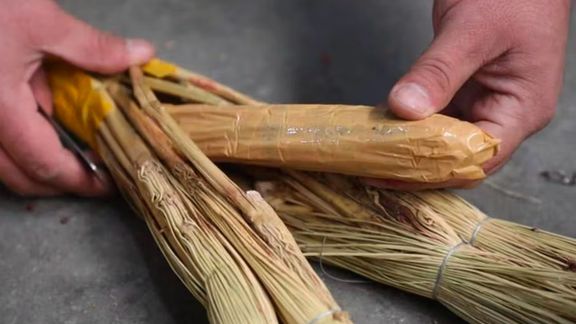
Uzbekistan’s National Security Service (NSS) has reported the seizure of 600 kilograms and 12 grams of narcotics, valued at approximately $16.5 million, originating from Afghanistan.

Uzbekistan’s National Security Service (NSS) has reported the seizure of 600 kilograms and 12 grams of narcotics, valued at approximately $16.5 million, originating from Afghanistan.
According to officials, smugglers attempted to conceal the drugs inside bundles of brooms in an effort to transport them into Uzbekistan.
On Monday, Uzbek media outlets, citing NSS officials, confirmed that hundreds of kilograms of hashish were discovered at the customs checkpoint in the Surkhandarya region, which borders Afghanistan.
Authorities stated that the smuggling attempt was thwarted and that investigations are currently underway.
According to the NSS report, a suspicious truck was intercepted while attempting to cross the border. The vehicle was carrying 13.5 tonnes of brooms, raising concerns among customs officials.
Upon inspection, Uzbek authorities discovered that the truck contained 180 bags and 22,500 individual brooms. Reports indicate that drugs had been hidden within nearly 3,000 broom bundles to evade detection.
Initial assessments by Uzbek officials estimate the black market value of the seized narcotics at over $16.5 million.
Authorities continue to investigate the origins of the shipment and the smuggling network behind the operation, as concerns grow over drug trafficking from Afghanistan into Central Asia.

Pat Harrigan, a Republican representative in the U.S. Congress, has expressed full confidence that the U.S. will return to Afghanistan in the future, criticising the manner of the U.S. withdrawal and arguing that the exit has condemned future generations of Americans to conflict.
Harrigan, a former senior commander in the U.S. Special Forces, spoke with a Daily Signal reporter on Sunday, 9 February, about the withdrawal from Afghanistan and its long-term implications.
Reflecting on the rapid fall of Afghanistan to the Taliban in 2021, Harrigan cited this event as one of the primary reasons he decided to enter politics and run for Congress.
A close associate of Mike Waltz, National Security Adviser to Donald Trump, Harrigan warned that the U.S. military and political failure in Afghanistan has endangered American national security, particularly in the face of potential adversaries.
“Our politicians and military leaders have failed us. If we’re structurally so weak that we would lose Afghanistan the way that we lost it, we’re just inviting our adversaries to attack us,” he stated.
He further emphasised his commitment to preventing future conflicts, saying “I want to do everything I possibly can here in Washington to deter that next conflict, which I believe is very likely to happen.”
Harrigan also suggested that if Donald Trump had been President in recent years, Russia’s invasion of Ukraine and Hamas’s attack on Israel would not have occurred.
The Biden administration has faced persistent criticism from Republican politicians and U.S. veterans regarding its handling of the Afghanistan withdrawal.
President Donald Trump has repeatedly blamed Joe Biden and Kamala Harris for what he describes as an unsuccessful U.S. exit from Afghanistan. However, Biden has consistently defended his decision, arguing that ending the two-decade war was necessary.

The Taliban Supreme Court has announced that local courts in Ghazni and Uruzgan provinces publicly flogged five individuals, including one woman, on charges of “extramarital sexual relations” and “murder.”
According to the statement, each of the accused received 39 lashes and was sentenced to prison terms ranging from one to three and a half years.
The Taliban court confirmed that the punishments were carried out on Monday in Jaghori district of Ghazni province and Khas Uruzgan district.
As per the ruling, two individuals received three and a half years’ imprisonment, another was sentenced to one and a half years, while the remaining person received a one-year prison term.
The Taliban described the public flogging as part of the implementation of “Islamic Sharia law.”
Since returning to power, the group has routinely carried out public punishments across Afghanistan, including floggings, amputations, and executions, often drawing international condemnation from human rights organisations.

A coalition of U.S. veterans has urged the Biden administration to resume the relocation process for eligible Afghan refugees, calling for an exemption from former President Donald Trump’s executive order suspending refugee admissions.
In a letter addressed to the U.S. Secretaries of State, Homeland Security, and Defense, the coalition highlighted the urgent need to relocate Afghan allies, many of whom worked alongside U.S. forces during the war in Afghanistan.
According to Reuters, Shawn VanDiver, head of the AfghanEvac coalition, wrote to U.S. Secretary of State Marco Rubio, warning that failing to relocate Afghan allies could undermine trust in the United States and weaken local support for U.S. forces in future conflicts.
In the letter, VanDiver argued that not exempting Afghan refugees from Trump’s order would send a dangerous message to adversaries such as ISIS, suggesting that the United States abandons its allies in times of need.
A copy of the letter was also sent to U.S. Secretary of Defense Pete Hegseth, a veteran of the Afghanistan war, and U.S. Secretary of Homeland Security Kristi Noem.
VanDiver urged senior members of Trump’s cabinet to allow Afghan refugees to be resettled, despite the broader suspension of refugee admissions.
On his first day in office, Trump issued an executive order halting the U.S. refugee admissions programme, effectively freezing the resettlement of thousands of displaced individuals, including Afghans awaiting relocation.
According to the AfghanEvac coalition, approximately 3,000 Afghan refugees remain stranded in camps in Qatar and Albania, while an estimated 50,000 others are stuck in Pakistan and other countries, awaiting approval to enter the United States.
Despite the ongoing suspension, Trump granted an exemption last Friday allowing a group of white South African refugees to be relocated to the United States, a decision that has sparked debate over the prioritisation of refugee resettlement policies.

Mike Waltz, the U.S. National Security Adviser under Donald Trump, has accused the Taliban of interfering in United Nations contracts, asserting that American taxpayers do not want their money funnelled through this channel.
In an interview with NBC News on Sunday, Waltz claimed that the Taliban dictate who secures and who is denied UN contracts, significantly influencing the distribution of international aid.
Waltz’s remarks come in the wake of former U.S. President Donald Trump’s decision to suspend humanitarian aid to Afghanistan. Trump’s team, along with Republican representatives in Congress, have repeatedly claimed that the Taliban have benefited from international assistance over the past three years.
The U.S. Secretary of State under the Biden administration previously acknowledged that out of the $3 billion in U.S. financial aid, the Taliban may have received approximately $10 million through various channels.
Waltz confirmed that Afghanistan has received over $3 billion in humanitarian aid in the past three years and criticised the UN’s oversight of the distribution process. He highlighted that contracting companies play a major role in determining how U.S. aid is allocated through the UN, arguing that the Taliban exert significant influence in selecting these contractors.
He stated “I don’t think the American people support $3 billion-plus going to the Taliban through a series of UN contractors, allowing them to dictate who benefits and who is punished on the ground.”
Waltz insisted that evidence backs his claims, telling NBC News “We have documented evidence after documented evidence that this is happening. We don’t want studies and commissions. The President wants action, and that’s what he’s getting.”
Additionally, Waltz criticised the U.S. Agency for International Development (USAID), which is now integrated into the State Department, alleging that it has failed to effectively utilise U.S. financial aid and that its assistance has not served American interests.
Taliban Prisoner Exchange Before Trump’s Inauguration
In a separate remark, Waltz highlighted the success of the new U.S. administration in securing the release of American prisoners from Taliban captivity, arguing that the Biden administration had failed in this regard.
A day before Donald Trump’s inauguration, two American citizens, Ryan Corbett and William McEntee, were released in exchange for a Taliban prisoner, returning to the United States after a prolonged period of captivity.

Zabihullah Mujahid, the Taliban spokesperson, has responded to recent remarks by the Secretary-General of the Collective Security Treaty Organisation (CSTO), regarding terrorist threats and drug trafficking originating from Afghanistan.
Mujahid asserted that a substantial budget is required to effectively combat drug smuggling, adding that while the Taliban has taken measures within its capacity, a unilateral effort is insufficient. He also reiterated the Taliban’s stance that no terrorist groups are present in Afghanistan.
Earlier, Imangali Tasmagambetov, the CSTO Secretary-General, labelled Afghanistan as a source of potential terrorist threats and drug trafficking for Central Asia.
Tasmagambetov stated that the CSTO’s decision to reinforce the Tajikistan-Afghanistan border was driven by the risk of terrorism and narcotics smuggling spreading into the region.
Speaking on Friday, during the fourth meeting of parliamentary committee heads from CSTO member states, he underscored that the adoption of a targeted interstate programme to strengthen the Tajik-Afghan border reflected a shared understanding among CSTO members regarding security threats in Central Asia.
He further emphasised that the primary sources of terrorism, extremism, and drug trafficking originate from Afghanistan.
On Monday, in an interview with Taliban-controlled Radio Television Afghanistan, Mujahid dismissed the CSTO’s concerns over terrorism and drug smuggling.
However, he acknowledged the complexity of tackling the issue, stating “The CSTO must understand that preventing [drug trafficking] cannot be done unilaterally and requires a large budget.”
He also called for greater regional cooperation in combating drug smuggling networks.
Last year, Zabihullah Mujahid admitted that drug trafficking from Afghanistan was still ongoing, citing the existence of multiple smuggling routes and the continuation of the transfer of stored narcotics reserves.
Despite Taliban claims of counter-narcotics efforts, concerns persist among neighbouring countries and international organisations regarding Afghanistan’s role in global drug production and trafficking.
