• العربية
  • پښتو
  • فارسی
Brand
  • Afghanistan
  • Sport
  • Markets
  • Afghanistan
  • Sport
  • Markets
  • Theme
  • Language
    • العربية
    • پښتو
    • فارسی
  • Afghanistan
  • Sport
  • Markets
All rights reserved for Volant Media UK Limited
volant media logo

Taliban Claims Kunduz Suicide Attack Originated Outside Afghanistan
Feb 12, 2025, 17:22 GMT+0

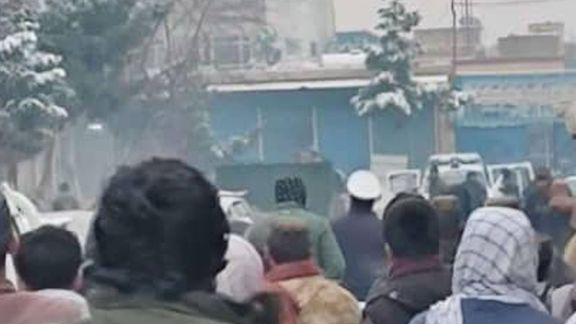
The Taliban’s Ministry of Interior has claimed that recent attacks in Afghanistan originate from outside the country, following a suicide bombing in Kunduz that left several dead.

Abdul Mateen Qani, spokesperson for the ministry, stated that findings and evidence suggest the perpetrators of such attacks “have roots beyond Afghanistan’s borders.”

“They organise their evil acts from outside,” Qani said, without providing further details. While he did not specify any country or group, he emphasised that the Taliban would identify and punish those responsible for the Kunduz attack.

The suicide bombing occurred on Tuesday at the entrance of the Kabul Bank branch in Kunduz.

ISIS later claimed responsibility, asserting that “hundreds of people, including Taliban security commanders,” were killed.

However, the Taliban’s Ministry of Interior reported a lower death toll, stating that eight people, including Taliban members and civilians, were killed.

Local sources told Afghanistan International that at least 18 people were killed and 14 others injured, with most victims belonging to the Taliban’s army and police forces.

According to reports, the suicide bomber targeted Taliban forces who were waiting to collect their salaries at the bank entrance.

The attack bears similarities to past Taliban operations against Afghan security forces.

In 2017, a suicide bomber detonated an explosives-laden vehicle near the Kabul Bank gate in Helmand, killing 29 people and injuring 60 others. The Taliban had claimed responsibility for that attack.

A report by Afghanistan International revealed that between 2002 and 2020, the Taliban carried out approximately 1,196 suicide attacks in Afghanistan, with most bombers trained by the Haqqani Network.

Most Viewed

Gold Mine Tensions Escalate As Taliban Arrest Commanders’ Relatives
1

Gold Mine Tensions Escalate As Taliban Arrest Commanders’ Relatives

2

Central Asian Security Hinges On Stability In Afghanistan, Says Kyrgyz President

3

Taliban Minister Meets Shia Figures, Says All Sects Are Respected

4

Afghan Families Selling Children As Poverty Deepens, Reports BBC

5

Iran Plans To Broaden Energy & Water Cooperation With Taliban

•
•
•

More Stories

Taliban Cannot Join Regional Economy Without Russia’s Support, Says Moscow’s Envoy

Feb 12, 2025, 15:42 GMT+0

Dmitry Zhirnov, Russia’s Ambassador to Afghanistan, has stated that the Taliban cannot fully integrate into regional and global economic relations without Moscow’s assistance.

Zhirnov emphasised that Afghanistan needs economic development and expanded foreign trade, and that the Taliban recognise Russia’s support as a crucial factor in achieving these goals.

According to Zhirnov, the Taliban view Russia as a key economic partner.

Earlier, Agroexport, a subsidiary of Russia’s Ministry of Agriculture, announced that Afghanistan was the largest importer of Russian flour in 2024. The data revealed that Afghanistan imported $80 million worth of Russian flour, double the amount from 2023.

The Russian ambassador also noted that Afghanistan exports chromite, rubies, and emeralds to Russia, though he did not specify the volume of these exports.

Zhirnov highlighted Russia’s effective relations with the Taliban, stating in an interview with RIA Novosti that Moscow and Kabul have significantly intensified their contacts, with negotiations progressing effectively.

Referring to recent visits by Russian officials to Kabul and Taliban representatives to Moscow, he described the discussions as constructive and ongoing.

Earlier, Zamir Kabulov, the Russian President’s Special Envoy for Afghanistan, announced that Moscow aims to establish a Russia-Taliban bilateral working group in spring 2025.

Kabulov explained that, since the Taliban have not yet been officially recognised, this working group will replace the Intergovernmental Commission on Economic Cooperation, serving as a temporary platform for bilateral economic engagement.

Afghanistan Drops To 165th Place in Global Corruption Rankings

Feb 12, 2025, 14:21 GMT+0

Afghanistan has fallen to 165th place out of 180 countries in the 2024 Corruption Perceptions Index, according to a report by Transparency International.

The annual index, which assesses public sector corruption worldwide, ranks Denmark, Finland, and Singapore as the least corrupt nations, securing the top three positions with the highest scores.

Transparency International stated that corruption levels worldwide remain alarmingly high, with efforts to combat the issue largely failing.

In 2024, Afghanistan scored 17, placing it at rank 165—a three-place decline from the previous year, once again positioning the country among the most corrupt nations globally.

The Corruption Perceptions Index (CPI) for 2024 was released on Tuesday, with South Sudan ranking at the bottom of the list, scoring just 8 points.

The Corruption Perceptions Index scores countries on a scale from 0 (highly corrupt) to 100 (very clean). In 2023, Afghanistan had a score of 20, ranking 162nd. In 2022, the country scored 24, placing 150th.

Among Afghanistan’s neighbouring countries, the rankings for 2024 are as follows. Pakistan ranks 140th, with a score of 27. Iran ranks 147th, with a score of 25.

The continued decline in Afghanistan’s ranking reflects ongoing governance challenges and lack of anti-corruption measures, raising concerns about transparency and accountability under the Taliban administration.

Fifth Vienna Conference On Afghanistan To Take Place Next Week

Feb 12, 2025, 13:11 GMT+0

The fifth round of the Vienna Conference for a “Free and Democratic Afghanistan” is set to convene on Tuesday and Wednesday next week in the Austrian capital.

The Vienna Process will bring together dozens of political groups, politicians, and civil society activists to discuss Afghanistan’s future.

In a statement issued on Wednesday, the Vienna Process announced that participants will focus on Afghanistan’s post-Taliban future and explore political alternatives.

According to the statement, more than 50 major political groups and a number of prominent Afghan figures are expected to attend the conference.

The fourth Vienna Conference took place on 24 June 2024. Organisers have stated that the upcoming session will prioritise political unity among political, civil, and military groups.

Since the fall of the previous Afghan government, the Vienna Process has emerged as the most significant platform for bringing together political and military groups opposed to the Taliban.

The statement further emphasised that the fifth conference will be held in an open political space, allowing participants to transparently discuss viable solutions to overcome the ongoing crisis in Afghanistan.

Removing Taliban From Terrorist List Will Be A Lengthy Process, Says Russian Official

Feb 12, 2025, 11:10 GMT+0

Andrey Rudenko, Russia’s Deputy Foreign Minister, has stated that the process of temporarily suspending the Taliban from Russia’s list of terrorist organisations will take considerable time.

Addressing the possibility of formally recognising the Taliban, he emphasised that Moscow will not act hastily.

On 28 December 2024, Russian President Vladimir Putin signed a decree amending certain laws, allowing for the temporary suspension of a group’s terrorist designation through a Supreme Court decision.

Rudenko told Interfax news agency that this mechanism applies to the Taliban, but reiterated that the process will take time.

The Russian Supreme Court designated the Taliban as a terrorist organisation on 14 February 2003, effectively banning its activities in the country.

While Russia, like other nations, does not officially recognise the Taliban government, it has nevertheless handed control of Afghanistan’s embassy in Moscow to the group and continues to maintain diplomatic and economic relations with them.

Currently, Jamal Nasir Gharwal serves as the Taliban’s chargé d’affaires in Moscow, having been officially approved by Russia’s Foreign Ministry in April 2022.

In his Monday interview with Interfax, Rudenko clarified that upgrading the Taliban’s diplomatic representation in Moscow to ambassadorial level is not a possibility in the near future.

Meanwhile, Zamir Kabulov, Russia’s Special Envoy for Afghanistan, previously announced that Moscow plans to establish a Russia-Taliban Joint Working Group in Spring 2025.

Kabulov explained that, as the Taliban has not yet been formally recognised, the new working group will replace the Intergovernmental Commission on Economic Cooperation, serving as an interim mechanism for bilateral engagements.

Taliban Generates Significant Revenues From Afghan Embassies In Iran & Pakistan

Feb 12, 2025, 10:11 GMT+0

Leaked documents from the Taliban’s Foreign Ministry reveal that Afghan embassies and consulates in Iran and Pakistan transfer substantial monthly funds to the group, making them a key financial source for the Taliban’s sanctioned administration.

According to one of the leaked letters, the Taliban’s Foreign Ministry requested $1 million from the Afghan Consulate in Zahedan, Iran.

A series of internal communications, published by a hacker group and reviewed by Afghanistan International, highlight significant financial exchanges between the Taliban’s Foreign Ministry and its overseas diplomatic missions.

One letter, dated 15 January 2025, just five days before Donald Trump’s inauguration as U.S. President, shows that the Taliban Foreign Ministry formally requested $1 million from the Afghan Consulate in Zahedan.

Another document indicates that the Taliban’s embassy in Tehran transferred 7 million Afghanis to the Taliban Foreign Ministry’s account at Afghanistan’s central bank. However, the timeframe for collecting this sum remains unclear.

The leaked records further highlight the substantial monthly revenues generated by the Afghan embassy in Islamabad. Between June and September 2023, the embassy earned over $700,000, a figure excluding its operational expenses.

Additionally, a letter from the Afghan Consulate in Quetta states that during the second quarter of 2023, the office generated approximately $130,000 in revenue.

While these documents do not provide a complete financial picture of Taliban-controlled diplomatic missions, they underscore their importance as revenue sources for the regime.

The Taliban has sought control over more Afghan diplomatic missions abroad, not only to gain political leverage but also to increase its foreign currency reserves.

A significant portion of the revenue from Taliban-run embassies and consulates in Iran and Pakistan comes from:” visa issuance, passport renewals and egal document verification.

With at least 6 million Afghan migrants in Iran and over 3 million in Pakistan, the Afghan embassies in these countries are among the most profitable.

Additionally, Afghanistan’s trade relations with Iran and Pakistan surpass those with any other regional country, further boosting the Taliban’s diplomatic revenues.