• العربية
  • پښتو
  • فارسی
Brand
  • Afghanistan
  • Sport
  • Markets
  • Afghanistan
  • Sport
  • Markets
  • Theme
  • Language
    • العربية
    • پښتو
    • فارسی
  • Afghanistan
  • Sport
  • Markets
All rights reserved for Volant Media UK Limited
volant media logo

Afghanistan’s Instability Affects Neighbouring Countries, Warns Russian FM

Feb 13, 2025, 16:38 GMT+0

Russian Foreign Minister Sergey Lavrov has expressed concerns over Afghanistan’s deteriorating security situation, warning that instability in the country poses risks for its neighbours.

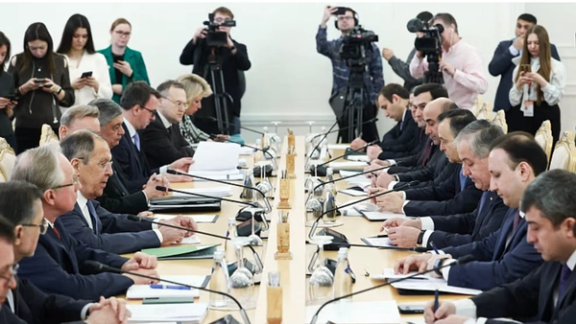
Speaking on Thursday during a meeting in Moscow with Tajik Foreign Minister Sirojiddin Muhriddin, Lavrov stated that the fragile security situation in Afghanistan has repercussions for neighbouring states, particularly Russia and Tajikistan.

The meeting was also attended by Zamir Kabulov, Russian President Vladimir Putin’s Special Envoy for Afghanistan.

According to Russia Today, Lavrov told his Tajik counterpart that the situation in Afghanistan remains difficult, and this instability echoes across its neighbouring Central Asian countries, including Tajikistan.

Lavrov emphasised that it is in the interests of both Russia and Tajikistan to continue working within multilateral frameworks to ensure regional security.

He also revealed that Moscow and Dushanbe are collaborating to enhance the operational effectiveness of Russia’s 201st Military Base in Tajikistan, which is one of Russia’s largest military installations outside its borders.

Lavrov’s remarks come at a time when suicide attacks in Afghanistan have been on the rise, further fuelling concerns about regional security threats.

One of the latest attacks occurred on Thursday when a suicide bomber targeted the Taliban’s Ministry of Urban Development and Housing in Kabul.

Two credible sources in Kabul confirmed to Afghanistan International that Arsala Kharoti, the Taliban’s Deputy Minister for Finance and Administration, was injured in the attack.

Another suicide bombing took place in Kunduz just two days earlier. On Tuesday, a suicide bomber detonated explosives outside the Kabul Bank office, where Taliban military personnel and government employees had gathered to collect their salaries.

Additionally, Khalil-ur-Rahman Haqqani, a senior Taliban official, was killed in a suicide attack inside the Ministry of Refugees building in Kabul.

ISIS has claimed responsibility for these recent attacks, increasing concerns about the group’s growing presence and operations in Afghanistan.

Most Viewed

Gold Mine Tensions Escalate As Taliban Arrest Commanders’ Relatives
1

Gold Mine Tensions Escalate As Taliban Arrest Commanders’ Relatives

2

Central Asian Security Hinges On Stability In Afghanistan, Says Kyrgyz President

3

Taliban Minister Meets Shia Figures, Says All Sects Are Respected

4

Iran Plans To Broaden Energy & Water Cooperation With Taliban

5

Russia-Afghanistan Trade Reaches $500 Million, Says Deputy PM Overchuk

•
•
•

More Stories

HRW Commends Survivors’ Brave Testimonies On Sexual Violence In Taliban Prisons

Feb 13, 2025, 15:18 GMT+0

Human Rights Watch has praised the extraordinary bravery of Afghan women who have spoken out about sexual violence and abuse in Taliban prisons, as revealed in a recent investigative report by Afghanistan International.

Heather Barr, Associate Director of the Women’s Rights Division at Human Rights Watch highlighted the courage of survivors who have come forward despite facing deep social stigma, stating "The fact that women are coming forward to talk about these violence anyway is an extraordinary testament to their courage."

She further stressed the urgent need for stronger mechanisms to document and preserve evidence of such crimes in Afghanistan to ensure accountability for survivors.

Afghanistan International recently published an investigative report exposing widespread sexual abuse and harassment of women detainees in Taliban prisons.

Reacting to the report, Barr noted that sexual violence remains underreported globally due to deep-rooted social stigma. However, in Afghanistan, she said, the issue is even more severe.

"In Afghanistan, that is particularly acute problem—not only do victims face enormous stigma, but the Taliban has also dismantled the services and parts of the justice system that might have provided assistance to these victims," she explained.

The abolition of the Afghanistan Independent Human Rights Commission and the Ministry of Women’s Affairs has left victims of sexual violence without any protective mechanisms or avenues for seeking justice.

Barr urged international and domestic institutions to take urgent action to support survivors, particularly in evidence collection and justice mechanisms.

At least ten women who were interviewed separately by Afghanistan International reported being subjected to sexual violence or harassment while in Taliban custody.

Among them eight women stated they were raped by Taliban officials, and two others reported that Taliban interrogators filmed and photographed their naked bodies during questioning.

Some victims revealed that their assaults were recorded on mobile phones by prison guards, while others reported that hidden surveillance cameras had been installed in their cells, monitored by the Taliban’s prison administration.

Richard Bennett, the UN Special Rapporteur on Human Rights in Afghanistan, confirmed that he is aware of the issue and is actively investigating it.

Meanwhile, Ahmad Zia Saraj, former head of Afghanistan’s National Directorate of Security (NDS), acknowledged that during his tenure, security cameras were installed in detention centres such as Directorate 40, Directorate 90, and Kabul’s intelligence facilities.

He clarified that these cameras were installed at the request of the international community, with oversight from UNAMA, the International Committee of the Red Cross (ICRC), and the U.S. Embassy, to ensure detainees were not subjected to torture by Afghan intelligence personnel.

However, Saraj stated that international access to these surveillance systems has now been cut off, and it remains unclear whether the cameras are still operational under Taliban control.

He warned that the Taliban is using these tactics to psychologically break female detainees and silence them through fear and intimidation.

The revelations in Afghanistan International's report have intensified calls for urgent international intervention, as concerns grow over the systematic use of sexual violence in Taliban detention centres.
Taliban Orders Suspension Of Political Programmes On Afghan Media

Feb 13, 2025, 14:13 GMT+0

The Taliban has ordered private media outlets across Afghanistan to halt the broadcasting of political programmes, further restricting press freedom in the country.

According to sources from Afghanistan International, the directive was issued to media executives on Thursday, 13 February, with the ban set to remain in effect until further notice.

In addition, the Taliban has warned media outlets that any violation of this directive will result in severe consequences.

Taliban officials are scheduled to meet with media representatives on Saturday, but it remains unclear how long the prohibition on political content will last.

Since regaining power in August 2021, the Taliban has systematically imposed strict limitations on media operations and freedom of expression.

Over the past two years, their media policies have included the closure of independent outlets, the arrest of journalists, and stringent censorship of news reports.

The latest ban on political programming marks yet another measure in the Taliban’s ongoing crackdown on press freedom, raising concerns about the further deterioration of independent journalism in Afghanistan.

World Radio Day: Taliban To Support Media Outlets That Adhere To Its Policies

Feb 13, 2025, 13:03 GMT+0

The Taliban’s Ministry of Information and Culture has stated that it will only support media outlets that operate in accordance with the group’s policies, as part of its broader control over Afghanistan’s press and broadcasting sector.

In a message marking World Radio Day, Habib Ghufran, spokesperson for the ministry, announced that since the Taliban’s return to power, the ministry has granted broadcasting licenses to 33 radio stations, all of which comply with the group’s media regulations.

He further stated that there are 234 radio stations currently operating across Kabul and other provinces.

According to Ghufran, all active radio stations in Afghanistan must operate in line with Taliban policies, as well as the broadcasting guidelines issued by the Ministry of Information and Culture.

Speaking to Afghanistan’s National Radio and Television, now under Taliban control, Ghufran added that the ministry provides support programmes for radio stations that align with its policies.

UNESCO recognises 13 February as World Radio Day, acknowledging the significance of radio as a key medium for communication and public awareness.

However, since seizing power in August 2021, the Taliban has imposed extensive restrictions on the media and journalists, shutting down or suspending numerous independent outlets.

In one of the latest crackdowns, the Ministry of Information and Culture announced on 4 February that it had suspended the operations of Radio Begum, citing violations of broadcasting regulations.

Taliban Shuts Two Kabul Bank Branches In Herat Over ISIS Attack Fears

Feb 13, 2025, 11:45 GMT+0

Sources have informed Afghanistan International that the Taliban shut down two Kabul Bank branches in Herat on Thursday due to fears of a potential ISIS suicide attack.

Individuals who had gathered at the bank to collect their salaries were informed that the branches had been closed due to security threats.

According to information obtained by Afghanistan International, the Taliban evacuated two Kabul Bank branches in Darwaza-e-Khosh and Gorda Park-e-Taraqi in Herat.

Although Taliban officials have not issued an official statement, sources confirmed that an emergency security alert was declared at both bank branches, and civilians were instructed to vacate the premises.

The Taliban’s fear of a suicide bombing at the banks follows a suicide attack on the Ministry of Urban Development and Housing in Kabul on Thursday morning.

Two credible sources in Kabul confirmed to Afghanistan International that Arsala Kharoti, the Taliban’s Deputy Minister for Finance and Administration, was injured in the attack.

Additionally, a suicide bombing targeted a Kabul Bank branch in Kunduz two days earlier.

On Tuesday, 11 February morning, a suicide bomber detonated explosives outside the Kabul Bank branch in Kunduz, where Taliban military personnel and government employees had gathered to collect their salaries.

The escalation of ISIS attacks has led to increased security concerns, prompting the Taliban to take preventive measures in major cities across Afghanistan.

Taliban Deputy Minister Severely Injured In Kabul Suicide Bombing

Feb 13, 2025, 10:53 GMT+0

Arsala Kharoti, the Taliban’s Deputy Minister for Finance and Administration at the Ministry of Urban Development and Housing, has been seriously injured in the suicide bombing at the ministry’s headquarters on Thursday.

Two credible sources in Kabul confirmed that Kharoti was transferred to Emergency Hospital for treatment, with his condition reported as critical.

Reports indicate that the attack resulted in at least two deaths and three injuries.

The Taliban’s Ministry of Interior has confirmed the suicide bombing inside the Ministry of Urban Development and Housing. However, the Taliban has yet to comment on Kharoti’s condition.

According to Mohammad Kamal Afghan, spokesperson for the Taliban’s Ministry of Urban Development and Housing, the suicide bomber attempted to enter the ministry but was intercepted by security forces at the entrance.

Afghan stated that one person was killed and three others were injured in the explosion.

As of now, no group has claimed responsibility for the attack. However, ISIS has previously taken responsibility for similar attacks targeting Taliban officials.

The Ministry of Urban Development and Housing is located in the Third Macroryan area of Kabul.