• العربية
  • پښتو
  • فارسی
Brand
  • Afghanistan
  • Sport
  • Markets
  • Afghanistan
  • Sport
  • Markets
  • Theme
  • Language
    • العربية
    • پښتو
    • فارسی
  • Afghanistan
  • Sport
  • Markets
All rights reserved for Volant Media UK Limited
volant media logo

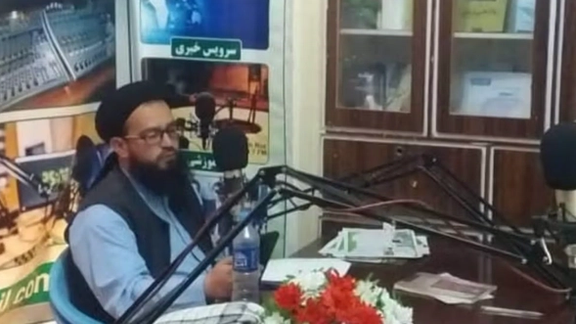
World Radio Day: Taliban To Support Media Outlets That Adhere To Its Policies

Feb 13, 2025, 13:03 GMT+0

The Taliban’s Ministry of Information and Culture has stated that it will only support media outlets that operate in accordance with the group’s policies, as part of its broader control over Afghanistan’s press and broadcasting sector.

In a message marking World Radio Day, Habib Ghufran, spokesperson for the ministry, announced that since the Taliban’s return to power, the ministry has granted broadcasting licenses to 33 radio stations, all of which comply with the group’s media regulations.

He further stated that there are 234 radio stations currently operating across Kabul and other provinces.

According to Ghufran, all active radio stations in Afghanistan must operate in line with Taliban policies, as well as the broadcasting guidelines issued by the Ministry of Information and Culture.

Speaking to Afghanistan’s National Radio and Television, now under Taliban control, Ghufran added that the ministry provides support programmes for radio stations that align with its policies.

UNESCO recognises 13 February as World Radio Day, acknowledging the significance of radio as a key medium for communication and public awareness.

However, since seizing power in August 2021, the Taliban has imposed extensive restrictions on the media and journalists, shutting down or suspending numerous independent outlets.

In one of the latest crackdowns, the Ministry of Information and Culture announced on 4 February that it had suspended the operations of Radio Begum, citing violations of broadcasting regulations.

Most Viewed

Gold Mine Tensions Escalate As Taliban Arrest Commanders’ Relatives
1

Gold Mine Tensions Escalate As Taliban Arrest Commanders’ Relatives

2

Central Asian Security Hinges On Stability In Afghanistan, Says Kyrgyz President

3

Taliban Minister Meets Shia Figures, Says All Sects Are Respected

4

Iran Plans To Broaden Energy & Water Cooperation With Taliban

5

Russia-Afghanistan Trade Reaches $500 Million, Says Deputy PM Overchuk

•
•
•

More Stories

Taliban Shuts Two Kabul Bank Branches In Herat Over ISIS Attack Fears

Feb 13, 2025, 11:45 GMT+0

Sources have informed Afghanistan International that the Taliban shut down two Kabul Bank branches in Herat on Thursday due to fears of a potential ISIS suicide attack.

Individuals who had gathered at the bank to collect their salaries were informed that the branches had been closed due to security threats.

According to information obtained by Afghanistan International, the Taliban evacuated two Kabul Bank branches in Darwaza-e-Khosh and Gorda Park-e-Taraqi in Herat.

Although Taliban officials have not issued an official statement, sources confirmed that an emergency security alert was declared at both bank branches, and civilians were instructed to vacate the premises.

The Taliban’s fear of a suicide bombing at the banks follows a suicide attack on the Ministry of Urban Development and Housing in Kabul on Thursday morning.

Two credible sources in Kabul confirmed to Afghanistan International that Arsala Kharoti, the Taliban’s Deputy Minister for Finance and Administration, was injured in the attack.

Additionally, a suicide bombing targeted a Kabul Bank branch in Kunduz two days earlier.

On Tuesday, 11 February morning, a suicide bomber detonated explosives outside the Kabul Bank branch in Kunduz, where Taliban military personnel and government employees had gathered to collect their salaries.

The escalation of ISIS attacks has led to increased security concerns, prompting the Taliban to take preventive measures in major cities across Afghanistan.

Taliban Deputy Minister Severely Injured In Kabul Suicide Bombing

Feb 13, 2025, 10:53 GMT+0

Arsala Kharoti, the Taliban’s Deputy Minister for Finance and Administration at the Ministry of Urban Development and Housing, has been seriously injured in the suicide bombing at the ministry’s headquarters on Thursday.

Two credible sources in Kabul confirmed that Kharoti was transferred to Emergency Hospital for treatment, with his condition reported as critical.

Reports indicate that the attack resulted in at least two deaths and three injuries.

The Taliban’s Ministry of Interior has confirmed the suicide bombing inside the Ministry of Urban Development and Housing. However, the Taliban has yet to comment on Kharoti’s condition.

According to Mohammad Kamal Afghan, spokesperson for the Taliban’s Ministry of Urban Development and Housing, the suicide bomber attempted to enter the ministry but was intercepted by security forces at the entrance.

Afghan stated that one person was killed and three others were injured in the explosion.

As of now, no group has claimed responsibility for the attack. However, ISIS has previously taken responsibility for similar attacks targeting Taliban officials.

The Ministry of Urban Development and Housing is located in the Third Macroryan area of Kabul.

Taliban Confirms Suicide Bombing At Ministry Of Urban Development In Kabul

Feb 13, 2025, 09:31 GMT+0

The Taliban’s Ministry of Interior has confirmed that the explosion on Thursday inside the Ministry of Urban Development and Housing was a suicide attack.

Local sources told Afghanistan International that the blast was powerful, causing significant destruction.

A spokesperson for the Ministry of Urban Development and Housing told local media that the suicide bomber attempted to enter the ministry.

According to Mohammad Kamal Afghan, Taliban security forces neutralised the attacker at the ministry’s entrance, but the explosion resulted in one fatality and three injuries.

The ministry is located in the Third Macroryan area of Kabul.

This marks the second suicide bombing targeting the Taliban within three days.

On Tuesday, 11 February, a suicide bomber detonated explosives outside the Kabul Bank office in Kunduz, where Taliban military personnel and government employees had gathered to collect their salaries.

Medical sources at Kunduz Regional Hospital confirmed to Afghanistan International that 18 bodies and 14 wounded individuals were transported to the facility.

ISIS later claimed responsibility for the Kunduz attack.

Suicide operations have been a key Taliban tactic over the past two decades, with the group carrying out hundreds of deadly attacks against the previous Afghan government and international forces, resulting in the deaths of thousands of civilians.

Despite gaining control of Afghanistan, the Taliban has continued to maintain its suicide bombing units, raising concerns over its long-term security strategy and counterterrorism measures.

Taliban Claims Kunduz Suicide Attack Originated Outside Afghanistan

Feb 12, 2025, 17:22 GMT+0

The Taliban’s Ministry of Interior has claimed that recent attacks in Afghanistan originate from outside the country, following a suicide bombing in Kunduz that left several dead.

Abdul Mateen Qani, spokesperson for the ministry, stated that findings and evidence suggest the perpetrators of such attacks “have roots beyond Afghanistan’s borders.”

“They organise their evil acts from outside,” Qani said, without providing further details. While he did not specify any country or group, he emphasised that the Taliban would identify and punish those responsible for the Kunduz attack.

The suicide bombing occurred on Tuesday at the entrance of the Kabul Bank branch in Kunduz.

ISIS later claimed responsibility, asserting that “hundreds of people, including Taliban security commanders,” were killed.

However, the Taliban’s Ministry of Interior reported a lower death toll, stating that eight people, including Taliban members and civilians, were killed.

Local sources told Afghanistan International that at least 18 people were killed and 14 others injured, with most victims belonging to the Taliban’s army and police forces.

According to reports, the suicide bomber targeted Taliban forces who were waiting to collect their salaries at the bank entrance.

The attack bears similarities to past Taliban operations against Afghan security forces.

In 2017, a suicide bomber detonated an explosives-laden vehicle near the Kabul Bank gate in Helmand, killing 29 people and injuring 60 others. The Taliban had claimed responsibility for that attack.

A report by Afghanistan International revealed that between 2002 and 2020, the Taliban carried out approximately 1,196 suicide attacks in Afghanistan, with most bombers trained by the Haqqani Network.
Taliban Cannot Join Regional Economy Without Russia’s Support, Says Moscow’s Envoy

Feb 12, 2025, 15:42 GMT+0

Dmitry Zhirnov, Russia’s Ambassador to Afghanistan, has stated that the Taliban cannot fully integrate into regional and global economic relations without Moscow’s assistance.

Zhirnov emphasised that Afghanistan needs economic development and expanded foreign trade, and that the Taliban recognise Russia’s support as a crucial factor in achieving these goals.

According to Zhirnov, the Taliban view Russia as a key economic partner.

Earlier, Agroexport, a subsidiary of Russia’s Ministry of Agriculture, announced that Afghanistan was the largest importer of Russian flour in 2024. The data revealed that Afghanistan imported $80 million worth of Russian flour, double the amount from 2023.

The Russian ambassador also noted that Afghanistan exports chromite, rubies, and emeralds to Russia, though he did not specify the volume of these exports.

Zhirnov highlighted Russia’s effective relations with the Taliban, stating in an interview with RIA Novosti that Moscow and Kabul have significantly intensified their contacts, with negotiations progressing effectively.

Referring to recent visits by Russian officials to Kabul and Taliban representatives to Moscow, he described the discussions as constructive and ongoing.

Earlier, Zamir Kabulov, the Russian President’s Special Envoy for Afghanistan, announced that Moscow aims to establish a Russia-Taliban bilateral working group in spring 2025.

Kabulov explained that, since the Taliban have not yet been officially recognised, this working group will replace the Intergovernmental Commission on Economic Cooperation, serving as a temporary platform for bilateral economic engagement.