10th Afghanistan Future Thought Forum Concludes In Doha

Sultan Barakat, Head of the Center for Conflict and Humanitarian Studies in Doha, announced the conclusion of the 10th “Afghanistan Future Thought Forum” in Doha.

Sultan Barakat, Head of the Center for Conflict and Humanitarian Studies in Doha, announced the conclusion of the 10th “Afghanistan Future Thought Forum” in Doha.
In a post on X, he noted that the meeting, chaired by Afghan women rights activists, Fatima Gailani, was attended by 40 participants who focused on discussing the challenges facing Afghanistan.
Barakat stated that despite their differences, all participants unanimously rejected any return to war. As part of the Intra-Afghan Dialogue, he previously helped facilitate a meeting between 45 Afghan political and civil activists and a Taliban delegation on 20 October 2020 in Qatar.
On Saturday, Barakat further stated on his X account that during a session held from 12 to 14 February, 40 influential Afghans from various political and ethnic groups, both from within and outside Afghanistan, deliberated on the country’s pressing challenges. Key topics included efforts to lift the Taliban’s ban on girls’ education and the state of Afghanistan’s economy, particularly in light of the suspension of aid by the Trump administration.
He also mentioned that the forum had presented its proposals to Qatari diplomats, and Qatar has agreed to review them.
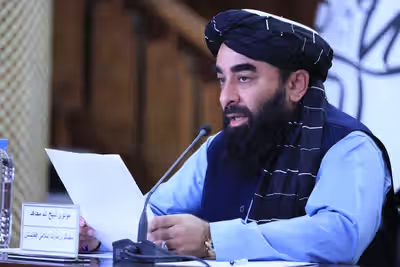

Shafqat Ali Khan, spokesperson for Pakistan’s Ministry of Foreign Affairs, has identified the presence of Tehrik-e-Taliban Pakistan (TTP) sanctuaries in Afghan territory as a key issue straining relations between Pakistan and the Taliban.
Speaking at a press conference on Friday, Khan stated that Pakistan has raised this concern with the Taliban and insists that the matter must be resolved before any meaningful bilateral cooperation can be achieved. He emphasised that while Afghanistan is a neighbouring country, the existence of TTP safe havens on its soil continues to hinder regional stability and economic potential.
Khan warned that the long-term prospects for cooperation and the overall welfare of both nations will remain compromised unless the issue of TTP sanctuaries is addressed. He noted that this matter is at the forefront of Pakistan’s ongoing dialogue with the Taliban.
Earlier, Prime Minister Shehbaz Sharif reiterated Pakistan’s expectation that the Taliban should actively collaborate with Islamabad in the fight against terrorism rather than contribute to its proliferation. Pakistan has consistently accused the Taliban of providing support and shelter to militant groups opposing Islamabad, particularly the TTP, allegations that the Taliban have repeatedly dismissed as baseless.

Despite earlier indications that the Taliban might be removed from its list of terrorist organisations, Russia has so far kept the group on its list, citing unresolved security concerns.
In late December 2024, President Vladimir Putin signed a law permitting the temporary suspension of terrorist groups’ activities. This legislation allows Russian courts to conditionally remove organisations such as the Taliban from the terrorist list. However, no such action has been taken regarding the Taliban to date.
Russia’s Deputy Foreign Minister, Andrey Rudenko, recently explained that the process of suspending the Taliban’s designation is time-consuming, reflecting Moscow’s cautious approach. The delay appears to be driven primarily by security considerations rather than legal obstacles.
In related developments, Russia’s Ambassador to Pakistan highlighted Islamabad’s growing alarm over rising terrorist activities. In an interview with TASS, he reaffirmed Moscow’s support for Pakistan in its counterterrorism efforts and stressed the need for stronger cooperation with Afghanistan.
Although Russia has established diplomatic ties with the Taliban and even transferred control of the Afghan embassy in Moscow to them, it has yet to officially recognise the group. This measured stance is shaped by regional security threats, particularly from ISIS-Khorasan.
Russian Foreign Minister Sergey Lavrov recently discussed Afghanistan’s security situation with his Tajik counterpart, expressing concerns over the expanding influence of ISIS-K in northern Afghanistan. Additionally, Russia’s UN envoy warned that American weapons left in Afghanistan could pose a serious global security threat.
While Russia remains open to economic and diplomatic engagement with the Taliban, it is unlikely to remove the group from its terrorist list until all security threats are fully addressed.

The hacker group TalibLeaks has revealed significant cybersecurity vulnerabilities within Taliban-controlled agencies, disclosing that the password used by the Taliban’s cybersecurity chief was “12345678.”
In an interview with Afghanistan International, TalibLeaks claimed that hacking into Taliban ministries is “very easy” and that exposing such data serves as a warning to the group, emphasising that the Taliban cannot conceal its operations.
TalibLeaks reported that various Taliban factions operate independently in the digital realm, resulting in widely varying cybersecurity standards. The group noted that while the Taliban leader Hibatullah Akhundzada’s faction is more difficult to infiltrate—largely due to its reliance on paper-based communication rather than digital platforms—the Haqqani Network maintains relatively robust security, a strength attributed more to its minimal use of the internet than to advanced protective measures.
With over a decade of cybersecurity experience, TalibLeaks asserted that penetrating most Taliban ministries remains remarkably simple. The exposure of the cybersecurity chief’s email password, “12345678,” serves as a prime example. The hacker group also claimed to have repeatedly infiltrated Taliban servers, at times discovering evidence of previous breaches by other hackers.
Leaked documents indicate that TalibLeaks has gained access to the emails of numerous Taliban officials and government employees. Although the Taliban’s Ministry of Telecommunications has acknowledged that documents from dozens of Taliban-run agencies have been leaked, the group has not commented on the extent of the breach or the security vulnerabilities exposed by TalibLeaks.

Fawzia Koofi, a prominent women’s rights activist and former member of the Afghan parliament, has announced her invitation to speak at the upcoming Munich Security Conference.
Koofi is scheduled to deliver a speech on Afghanistan’s role in international and regional policies and will participate in a panel discussion on the essential role of female leadership in promoting peace and development in international relations.
The conference will take place from 14 to 16 February.
At last year’s event, foreign ministers from 12 countries issued a joint statement condemning the Taliban for excluding women from society and political decision-making, warning that such systematic gender-based abuse could amount to crimes against humanity.
The statement, released on the second day of the conference, was endorsed by the foreign ministers of Albania, Andorra, Belgium, Bulgaria, Canada, France, Germany, Kosovo, Liechtenstein, Mongolia, the Netherlands, and Romania, who described the situation in Afghanistan as one of the worst human rights crises in the world.
In response, Taliban spokesperson Zabihullah Mujahid dismissed the foreign ministers’ remarks as baseless propaganda, asserting that the rights of all citizens, including women, are respected in Afghanistan, and that people enjoy security in terms of life, property, dignity, and mental well-being.
This year’s Munich Security Conference will focus on global security challenges, environmental security, the state of the international order, and regional conflicts and crises. Additionally, Bloomberg reported on 6 February that former President Trump’s strategy for the Russia-Ukraine conflict will be presented at the conference.
On the sidelines of the event, JD Vance, US Vice President , is scheduled to meet with Ukrainian President Volodymyr Zelensky on Friday, 14 February.
Zelensky has warned that if Ukraine’s NATO accession plan is not realised, Kyiv will require further assistance from the United States to bolster its military capabilities.

The Ministry of Foreign Affairs of Pakistan has announced that the leaders of Türkiye and Pakistan have reaffirmed their commitment to a peaceful and stable Afghanistan.
According to the statement released on Friday, 14 February, both nations emphasised the importance of establishing an inclusive government that upholds human rights, particularly for women and girls, and prioritises the fight against terrorism in Afghanistan. The statement also underscored the need to continue providing humanitarian aid to the Afghan people.
During a two-day official visit to Islamabad, the Turkish President was warmly received by senior Pakistani officials. In discussions with Turkish President Recep Tayyip Erdoğan, Pakistan’s Prime Minister Shehbaz Sharif stressed that Islamabad expects the Afghan Taliban to collaborate in combating terrorism, rather than facilitating its proliferation. Sharif also voiced concerns regarding the activities of terrorist groups in Afghanistan, warning that the country should not become a safe haven for extremist elements.
The statement further revealed that Türkiye and Pakistan urged the Taliban leadership to take decisive measures against terrorism, specifically targeting groups such as ISIS and Tehreek-e-Taliban Pakistan (TTP), both of which are subject to United Nations Security Council sanctions.
Despite maintaining close ties with the Afghan Taliban—accepting their diplomats and engaging in political and economic relations—the Taliban government continues to impose significant restrictions on women’s rights, including access to employment, education, and other fundamental freedoms. International and Islamic bodies have previously called on the Taliban to lift these restrictions; however, the group has persisted in enforcing them.