• العربية
  • پښتو
  • فارسی
Brand
  • Afghanistan
  • Sport
  • Markets
  • Afghanistan
  • Sport
  • Markets
  • Theme
  • Language
    • العربية
    • پښتو
    • فارسی
  • Afghanistan
  • Sport
  • Markets
All rights reserved for Volant Media UK Limited
volant media logo

Taliban Turning Afghanistan Into A ‘Social Dungeon For Women, Says Germany

Mar 4, 2025, 17:30 GMT+0

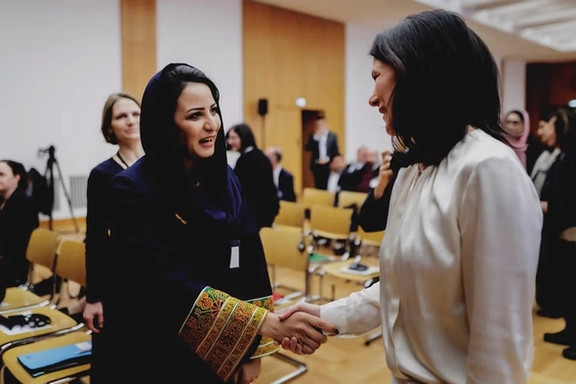
The German Foreign Ministry has stated the Taliban transforming Afghanistan into a “social dungeon” for women and girls, citing their escalating restrictions on female participation in public life.

On Tuesday, 4 March, the ministry released images of a meeting in Berlin between German Foreign Minister Annalena Baerbock and a group of Afghan female activists. Referring to the Taliban’s oppressive policies, the ministry wrote on its X page: “Walling up windows, erasing women’s public images: The Taliban are building a social dungeon for Afghan women & girls.”

The German Foreign Ministry reaffirmed its commitment to listening to Afghan women’s voices and consulting with Afghan civil society activists regarding human rights violations in the country.

138 Taliban Decrees Against Women Since January

Meanwhile, Afghan and international civil society organisations issued a joint statement on Tuesday, referencing a report by the US Institute of Peace that revealed the Taliban has issued 138 decrees against women and girls since 31 January 2025. These decrees, the statement noted, have resulted in the systematic exclusion of women from public life and imposed severe discrimination.

The statement praised an initiative by Australia, Canada, Germany, and the Netherlands, urging the Taliban to halt violations of the Convention on the Elimination of All Forms of Discrimination Against Women (CEDAW). It suggested that this initiative could pave the way for legal action against the Taliban at the International Court of Justice (ICJ).

Calls for Justice and Accountability

Afghan and international civil society groups also welcomed virtual and in-person consultations with Afghanistan’s human rights community and emphasised the need for continued, inclusive, and meaningful dialogue. They called for urgent accountability and justice to address the worsening women’s rights crisis in Afghanistan.

The statement underscored that Afghan women and girls must be recognised as “agents of change” and included in evidence collection, case documentation, strategic communications, and future legal proceedings related to their rights.

International Condemnation of Taliban Policies

In September 2024, the foreign ministers of Germany, Australia, Canada, and the Netherlands issued a declaration condemning the Taliban’s grave and systematic human rights violations, particularly their gender-based discrimination against women.

A group of nations, including Albania, Belgium, Iceland, Malaysia, Morocco, Panama, Sierra Leone, and Slovenia, has backed the joint declaration, reinforcing international pressure on the Taliban to uphold women’s rights in Afghanistan.

Most Viewed

Taliban Order Cut To Residential Fibre-Optic Internet In Kabul, Say Sources
1

Taliban Order Cut To Residential Fibre-Optic Internet In Kabul, Say Sources

2

Taliban Besieged TOLOnews Offices After Journalist Detentions, Say Sources

3

Taliban Leader Adviser Arrested In Kandahar Over Alleged Bribery

4

Exiled Media Watchdog Urges UN, EU To Seek Release Of Journalists Held By Taliban

5

Pakistani Envoy Urges Taliban to Take Practical Action Against Militants

•
•
•

More Stories

Clashes Between Pakistani Forces & Taliban In Torkham Displace Thousands

Mar 4, 2025, 15:36 GMT+0

Ongoing clashes between Pakistani security forces and Taliban fighters at the Torkham border crossing have displaced thousands of local residents, officials and locals report.

A Pakistani official stated that approximately 15,000 people have fled their homes and taken refuge in the city of Landi Kotal.
According to sources, Taliban border guards opened fire without prior warning, targeting government buildings and civilians, triggering widespread panic.

Impact on Local Communities

Ali Shinwari, a Pakistani resident, told Reuters “The tensions between the two countries and the continuous closure of the border have created multiple problems for people in the border area. Many are poor and rely on border-related businesses.”

He added that since the Torkham crossing’s closure, tribal families in a nearby city have been hosting dozens of their displaced relatives.

Border Closure and Casualties

Pakistani officials, speaking anonymously, stated that the Torkham border crossing has been closed since 21 February due to a dispute over the Taliban’s construction of a new checkpoint.

On Monday, the Taliban’s Ministry of Interior announced that one of their fighters had been killed and two others injured. Pakistani security officials confirmed that one of their soldiers had also been wounded.

Pakistan’s Dawn newspaper reported on Tuesday that at least six security personnel and two civilians had been injured. Additionally, one civilian reportedly suffered a fatal heart attack amid gunfire and the ensuing chaos.

Trade Disruptions and Economic Losses

Torkham is the main transit route for passengers and goods between landlocked Afghanistan and Pakistan. According to Pakistan’s Ministry of Foreign Affairs, trade between the two countries exceeded $1.6 billion in 2024.

Yousaf Afridi, head of the Chamber of Commerce and Industries in Pakistan’s Khyber Pakhtunkhwa province, where Torkham is located, stated that the closure of the crossing has stranded 5,000 trucks carrying essential goods, causing at least $15 million in losses.

Clashes In Torkham: Taliban Shelling Destroys Mosque In Pakistan

Mar 4, 2025, 14:31 GMT+0

Intense clashes between Taliban and Pakistani forces at the Torkham border have resulted in the destruction of a mosque on Pakistani soil, reportedly due to Taliban shelling.

According to local sources, mortars fired by Taliban forces damaged the mosque’s walls and interior, leaving it in ruins. The mosque was reportedly struck on Monday night, following Taliban gunfire directed towards Pakistan.

Images obtained by Afghanistan International show that the mosque’s walls and interior courtyard have been completely destroyed.

Ongoing Clashes and Casualties

The clashes between Taliban border forces and Pakistani troops began on Sunday night, 2 March, continuing until 11:00 AM on Monday. After a brief pause, the fighting resumed later that night.

Reports indicate that both sides have deployed light and heavy weaponry during the confrontation. The Taliban’s Ministry of Interior confirmed that during the clashes, one Taliban fighter was killed, and two others were injured. However, independent sources suggest the Taliban suffered at least three fatalities.

Tensions Over the Torkham Border Crossing

Torkham, one of the two main trade crossings between Afghanistan and Pakistan, has been closed for over a week due to a dispute over the Taliban’s construction of a new checkpoint.

Tensions between the Taliban and Pakistan have escalated in recent months over border control, security concerns, and trade restrictions, leading to repeated clashes at key border points.

Taliban Criticises UN, Accuses UNAMA Of Being Unsuccessful In Afghanistan

Mar 4, 2025, 12:47 GMT+0

Taliban spokesperson Zabihullah Mujahid has accused the United Nations Assistance Mission in Afghanistan (UNAMA) of publishing negative and inaccurate reports on the country’s situation.

Mujahid claimed that UNAMA’s reports have created a negative perception of Afghanistan within the United Nations, disregarding the country’s progress, achievements, and security improvements.

On Tuesday, 4 March, Taliban-controlled Radio Television Afghanistan (RTA) released an audio recording of Mujahid in which he strongly criticised UNAMA’s activities in Afghanistan. He accused the UN mission of exaggerating minor issues while deliberately highlighting negative aspects of the situation.

The Taliban spokesperson further asserted that UNAMA’s reports neither benefit Afghanistan nor the UN, declaring that the mission has not been “successful” in fulfilling its role in the country.

Context and UNAMA’s Mandate

The Taliban’s criticism comes ahead of an address by Roza Otunbayeva, the head of UNAMA, to the UN Security Council on 10 March regarding the situation in Afghanistan.

Last year, the UN Security Council extended UNAMA’s mandate until 17 March 2025, underscoring the mission’s continued role in monitoring and reporting on Afghanistan’s political, humanitarian, and security situation.

Afghan Jihadi Leader Urges Taliban To Form Islamic Council To Elect Next Leader

Mar 4, 2025, 11:18 GMT+0

During his visit to Iran, Afghan jihadi leader Abdul Rab Rasul Sayyaf urged the Taliban to establish a Shurā-ye Ḥall wa ‘Aqd, a council composed of “those who are qualified to unbind and to bind”—also described as “the people who loosen and bind”—instead of holding elections.

This council, a concept in Sunni Islamic governance, refers to a body of qualified individuals empowered to appoint or depose a ruler (such as a caliph) on behalf of the Muslim community.

Sayyaf argued that the Taliban lacks legitimacy and insisted that representatives of the people must be involved in selecting a leader. Speaking to Iran’s IRAF News Agency, he stated that the council should be composed of representatives from districts and provinces to elect Afghanistan’s leader.

He emphasised that if a leader were chosen through this process, the people would pledge allegiance to them, but he criticised the Taliban for not adopting this approach.

Criticism of the Taliban’s Legitimacy

Sayyaf pointed to the 1990s government of former Afghan President Burhanuddin Rabbani, which, he said, was formed through a similar council with a religious foundation. He added that the Mujahideen defended Rabbani’s government against the Taliban on this principle, as it had been selected through a legitimate Islamic process.

He asserted that if the Taliban followed the same method, he and his allies would accept its decision—even if they were not part of the council. However, he accused the Taliban of ruling without public support, claiming that their interpretation of Sharia law is flawed and not truly Islamic.

Sayyaf further questioned the Taliban’s legitimacy, stressing that the establishment of an Islamic system requires clear principles and proper mechanisms. He stated “Implementing Sharia is a skill and an expertise.”

Sayyaf’s Political Background and Call for Peace

Despite advocating for the Shurā-ye Ḥall wa ‘Aqd, Sayyaf has been deeply involved in Afghanistan’s electoral system over the past two decades. He was twice elected as a member of parliament from Kabul and ran in the 2014 presidential elections, though he did not win.

Reaffirming his commitment to peace, Sayyaf stated that he has always urged the Taliban that “war is not the solution.” However, he claimed that the Taliban has never been willing to negotiate and suggested that even groups engaged in armed resistance are not opposed to peace. He also noted that anti-Taliban factions abroad have achieved greater unity and coordination.

Warm Reception in Iran

Sayyaf expressed gratitude for Iran’s hospitality and explained why he had not visited the country in the past 50 years. He revealed that, after receiving medical treatment in India, he travelled to Iran and had been living in Turkiye for the past three and a half years.

Who Is to Blame for the Fall of the Republic?

Addressing the collapse of Ashraf Ghani’s government, Sayyaf blamed it on the exclusion of key defenders of the nation, arguing that only the Mujahideen could have defended Afghanistan.

He claimed that Mujahideen commanders were sidelined in recent years, forced into menial jobs rather than being allowed to contribute to national security.

Sayyaf further revealed that he had personally requested Ashraf Ghani to entrust him with Kabul’s security, but Ghani refused due to political differences with the Mujahideen.

“The Dark Night Will End”

Concluding his interview, Sayyaf delivered a message to the Afghan people: “The dark night will end, and morning lies ahead.”

During his visit to Iran, Sayyaf also met with Iranian officials. In recent months, Iran has intensified its engagement with Afghan political figures and opposition groups against the Taliban. Recently, several IRGC commanders met with leaders of the National Resistance Council for the Salvation of Afghanistan in Ankara.
Iran Deports 1,800 Undocumented Afghans Daily, Says Official

Mar 4, 2025, 10:12 GMT+0

Gholam Hossein Mozaffari, the governor of Khorasan Razavi province in Iran, announced on Tuesday that approximately 1,800 undocumented Afghan migrants are deported from the border each day. He also noted that between 2,000 and 3,000 Afghans legally enter Iran daily.

During a visit to a migrant camp in Mashhad, Mozaffari highlighted concerns over Afghan migrants who enter Iran with valid permits but remain in the country after their visas expire.

He stressed that even legal migration requires careful regulation, stating that Afghans entering Iran should have a clear purpose. “If they are coming for work, they must obtain a work visa. If they are visiting as tourists, they should arrive as part of an organised tour or group,” he added.

Speaking to Iranian media, Mozaffari expressed hope that Afghanistan’s social and economic conditions would improve, reducing the need for migration.

He also emphasised Iran’s interest in fostering economic opportunities at the Afghan border to encourage joint investments. “Our goal is to create employment opportunities in border areas so that Afghan workers entering Iran can reside there instead of migrating further into the country,” he stated.