UN Pledges Continued Support For Afghan Women & Girls Ahead Of Women’s Day
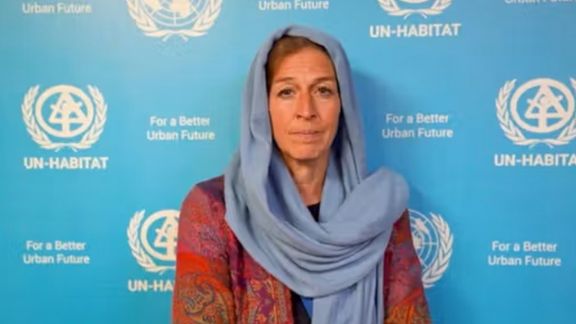
On the eve of 8 March, International Women’s Day, UN-Habitat has reaffirmed its commitment to empowering women and girls in Afghanistan.

On the eve of 8 March, International Women’s Day, UN-Habitat has reaffirmed its commitment to empowering women and girls in Afghanistan.
The organisation’s representative in Afghanistan emphasised that the UN stands in solidarity with Afghan women, continually supporting their rights and inclusion.
In a video message, Stephanie Loose, UN-Habitat’s representative, stated: “We stand in solidarity with Afghan women and girls, reaffirming our commitment to their rights, inclusion, and empowerment.”
Loose highlighted the UN’s efforts to improve living conditions across both urban and rural areas in Afghanistan. She pointed to several programmes implemented by UN-Habitat, noting that a better home, a safer neighbourhood, and improved access to essential services—such as water, education, and health—have a profound impact on the lives of Afghan women and girls.
This commitment comes amid growing concerns over the deteriorating situation for women and girls in Afghanistan, who continue to face systemic discrimination that has worsened over time. Earlier, a group of Afghan women protesters in Pakistan criticised the ongoing conditions and demanded that the voices of women and girls be heard.


Sources have confirmed to Afghanistan International that Taliban forces and Pakistani border guards clashed once again on Wednesday, 5 March, at Torkham. Neither Pakistani nor Taliban officials have yet commented on the incident.
Images from the clash show both sides targeting one another’s positions. Reports indicate that Taliban forces have destroyed a Pakistani military outpost, further escalating tensions in the region. Videos circulating on social media reveal Taliban forces employing heavy artillery to attack Pakistani military posts.
Following the closure of the Torkham border crossing on 22 February, clashes between Taliban forces and Pakistani soldiers have recurred, with both sides utilising heavy weaponry. A spokesperson for the Taliban Ministry of Interior confirmed that one of their fighters was killed and two others injured during the recent clashes.
The Torkham crossing has now been closed for 13 consecutive days, with reports stating that thousands of trucks carrying goods and fresh produce are stranded on both sides of the border. Despite several rounds of talks between officials from both sides aimed at ending the fighting and reopening Torkham, negotiations have so far been unsuccessful.

The United Nations Regional Centre for Sustainable Development Goals (SDGs) for Afghanistan and Central Asia will be established in Almaty, Kazakhstan’s Presidential Office announced in a statement.
Kazakh President Kassym-Jomart Tokayev stated that the centre would serve as a key platform for coordinating international efforts in the region.
According to the statement released on Tuesday, 5 March, the UN General Assembly has adopted a resolution approving the establishment of the centre, with the consensus of 152 countries.
The Kazakh presidency described the resolution’s adoption as a major achievement in the country’s foreign policy.
President Tokayev also expressed gratitude to all the nations that supported the resolution’s approval.

Three journalists, including a Shamshad TV reporter, were injured by Pakistani forces’ gunfire while covering the ongoing clashes between Taliban and Pakistani troops at the Torkham border, Shamshad TV reported on Wednesday.
In a statement, Shamshad confirmed that Hedayat Shah Hedayat, a Shamshad TV reporter, along with two other local journalists, sustained injuries from mortar fire launched by Pakistani forces.
Local Taliban officials in Nangarhar confirmed the injuries and stated that among the wounded were a Pajhwok News Agency reporter and a Radio Hurriyat journalist.
Taliban authorities further reported that the injured journalists had been transferred to a hospital for treatment.
On Wednesday, Taliban and Pakistani forces clashed once again at Torkham. Footage circulating on social media shows both sides exchanging heavy fire, targeting each other’s positions.
As of now, no official details have been released regarding potential casualties from the clashes.
Sources told Afghanistan International that the conflict at Torkham is still ongoing, with tensions remaining high at the strategic border crossing.

Hamid Noori, the police chief of Zahedan in Iran’s Sistan and Baluchestan province, has announced that Iranian security forces have arrested 486 Afghan migrants as part of a social security enhancement initiative.
He stated that the detainees had been handed over to the relevant authorities for deportation.
Speaking to the media on Wednesday, Noori emphasised that the detention and deportation of undocumented migrants remain a top priority for security forces in Sistan and Baluchestan. He added that the initiative aims to “increase public safety and citizen satisfaction.”
Earlier, Ali Akbar Habibifar, police chief of Zabol in Sistan and Baluchestan, reported that security forces had detained 172 undocumented Afghan migrants over the past week. He confirmed that they had also been transferred to the relevant authorities for deportation.
This comes as the Iranian government has intensified its crackdown on Afghan migrants in recent months. Under new regulations, renting homes to undocumented migrants or employing them has been criminalised.
Despite these restrictive measures, Iran has deported more than 1.2 million Afghan migrants back to Afghanistan this year alone.

On Tuesday night, former U.S. President Donald Trump announced in his first speech to Congress that the mastermind behind the August 26, 2021, suicide attack at the Abbey Gate entrance of Kabul Airport had been captured with Pakistan’s assistance.
Following Trump’s announcement, Kash Patel, Director of the Federal Bureau of Investigation (FBI), stated that on Tuesday night, 4 March (U.S. time), the FBI, the Department of Justice, and the CIA successfully extradited one of the terrorists responsible for the killing of 13 American service members at Abbey Gate during the chaotic U.S. withdrawal from Afghanistan.
Suspect Identified as ISIS-K Operative Mohammad Sharifullah
According to Axios, citing sources, the suspect has been identified as Mohammad Sharifullah, also known as “Jafar”.
The report states that Sharifullah was a member of ISIS-K and was accused of planning and coordinating the attack at Abbey Gate, which resulted in the deaths of at least 170 Afghan civilians and 13 U.S. service members.
Axios further reported that Sharifullah is expected to arrive in the United States on Wednesday, where his court hearing will be held publicly.
CIA and Pakistan’s Role in the Capture
U.S. officials revealed that after John Ratcliffe was confirmed as CIA Director in January, Trump ordered him to prioritise the capture of those responsible for the Abbey Gate attack. In his first communication with General Asim Malik, head of Pakistan’s ISI, Ratcliffe raised this issue.
Officials further stated that the CIA had been tracking Sharifullah for an extended period but only recently acquired precise intelligence on his whereabouts. This intelligence was shared with Pakistan’s security agencies, leading to his capture by a special unit near the Pakistan-Afghanistan border.
Reports indicate that ten days ago, after U.S. officials were informed of Sharifullah’s arrest, Ratcliffe and FBI Director Kash Patel contacted Pakistan’s intelligence chief from CIA headquarters to discuss his extradition.
According to the report: “Since then, the CIA, the Department of Justice, and the FBI have worked together on his extradition, with Ratcliffe, Patel, and Attorney General Pam Bondi personally involved.”
On Tuesday night, Trump publicly thanked Pakistan for assisting in Sharifullah’s capture.
Kash Patel, in a post on social platform X, stated that with this arrest, justice for “American heroes and their families” is one step closer.
Neither Trump nor Patel disclosed the suspect’s identity in their statements.
As of now, Pakistani officials have not commented on the matter.
This development follows a previous claim by U.S. officials in April 2023 that the Taliban had killed an ISIS-K leader responsible for the Kabul Airport attack. While the Biden administration confirmed the leader’s death, it did not disclose his identity.