• العربية
  • پښتو
  • فارسی
Brand
  • Afghanistan
  • Sport
  • Markets
  • Afghanistan
  • Sport
  • Markets
  • Theme
  • Language
    • العربية
    • پښتو
    • فارسی
  • Afghanistan
  • Sport
  • Markets
All rights reserved for Volant Media UK Limited
volant media logo

India & Taliban Colluding To Destabilise Pakistan, Claims Pak Newspaper
Mar 16, 2025, 10:27 GMT+0

The Pakistani newspaper Express Tribune has accused the Taliban and India of conspiring to undermine Pakistan’s security.

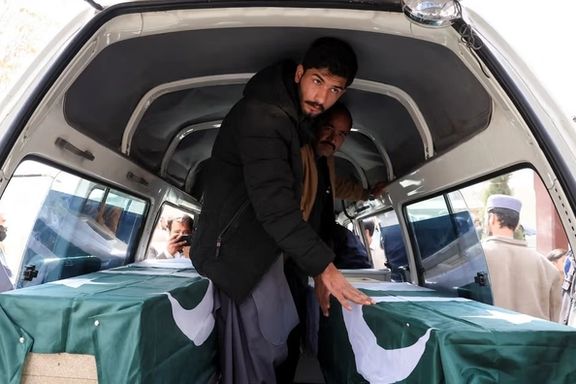
Referring to the recent attack on a train in Balochistan, the newspaper claimed that the Taliban are acting in line with India’s strategy to legitimise Baloch separatists.

On Saturday, Express Tribune published an article titled “Kabul-Delhi Nexus”, stating: “It is no secret that Afghanistan and India are in cahoots, and have a vested agenda to nurse by bleeding and destabilising Pakistan.”

The newspaper, known for its alignment with the Pakistani military, described the train attack in Balochistan as an “intelligence failure.” It urged Islamabad to expose what it called “open-and-shut complicity” at diplomatic forums.

However, the publication criticised the international community for ignoring Pakistan’s complaints. It questioned why Pakistan’s evidence of foreign involvement in terrorism was not being acknowledged by the United Nations and other global powers.

While Islamabad claims to be a victim of terrorism, both India and the Taliban accuse Pakistan of using militant groups as proxies. India has long labelled Pakistan as a state sponsor of terrorism. In recent years, the Taliban, once closely aligned with Islamabad, have made similar allegations. Taliban officials claim that Pakistan uses ISIS to advance its regional influence.

Taliban spokespersons have previously stated that ISIS has bases in Pakistan’s Balochistan province.

Earlier, a spokesperson for the Pakistani military accused the Taliban and India of planning the Jaffar Express attack from Afghan soil. The Taliban, however, rejected these claims and urged Pakistan to stop “blaming Afghanistan for its own failures.”

Meanwhile, Pakistan’s Minister of Railways, Hanif Abbasi, warned on Saturday that those responsible for terrorist acts, whether inside Pakistan or fleeing to Afghanistan and other countries, would not be spared.

Speaking at a press conference in Lahore, Abbasi stressed the need to investigate the resurgence of terrorism in Pakistan. He also warned that the China-Pakistan Economic Corridor (CPEC) was being targeted by international forces seeking to weaken Pakistan’s growing economic strength.

Most Viewed

Pakistan Hosts Regional Meet On Afghanistan Without Taliban
1

Pakistan Hosts Regional Meet On Afghanistan Without Taliban

2

Taliban Ignore Afghanistan’s Interests By Backing Militants, Says Pakistan Army Chief

3

Taliban Delegation Travels To Russia To Facilitate Medicine Imports

4

Germany’s Interior Minister Defends Deportations To Afghanistan

5

United Nations Delivers Education Kits To Four Million Afghan Children

•
•
•

More Stories

Taliban Transfers Detained British Couple To Maximum Security Prison

Mar 16, 2025, 09:30 GMT+0

Sarah Entwistle, the daughter of a detained British couple in Afghanistan, has said that the Taliban has moved her parents to a maximum security prison and separated them.

Peter Reynolds, 79, and his wife Barbie, 75, were arrested by the Taliban on 2 February while returning to their home in Bamiyan.

Entwistle has expressed deep concern over her parents' health condition and described their detention as "cruel." She told The Sunday Times that the Taliban has informed her mother that she cannot see her husband. She added that her father has been taken to an undisclosed location in a heavily guarded prison, and his health has "deteriorated significantly."

She fears that her father suffers from a chest infection, an eye infection, and severe digestive issues due to poor nutrition. Without immediate access to essential medication, she believes his life is in grave danger.

Entwistle claimed that her father has been beaten and shackled during his detention. She called for the immediate release of her parents, saying, "Our desperate appeal to the Taliban is that they release them to their home, where they have the medication he needs to survive."

She added that her family, including her three brothers, has learned that male prisoners in Taliban custody receive three meals a day, while female inmates are given only one.

The Daily Mail previously reported that the couple was arrested for "teaching parenting skills to Afghan mothers." However, the Taliban claimed they were detained due to a "misunderstanding" over allegedly holding fake Afghan passports. The Sunday Times also suggested they were arrested for conducting a course that trained women in maternal skills.

Entwistle refuted the allegations, stating that her parents had official permission for their programme. She also noted that her mother was the first woman to receive a certificate of appreciation from the Taliban.

Earlier, The Telegraph quoted sources suggesting that the Haqqani network detained the British couple as a "political move" to exert international pressure on Taliban leader Hibatullah Akhundzada.

The Taliban’s Ministry of Interior confirmed the arrest on 26 February. Abdul Mateen Qani, the ministry's spokesperson, said authorities were investigating the case and would work to release the British nationals "as soon as possible."

The couple has been running Rebuild, an organisation in Afghanistan that provides educational training for businesses, schools, and non-governmental groups.

The Daily Mail previously reported that the Taliban had searched their home to determine whether Peter and Barbie were involved in religious proselytisation.

Their children stated that their parents married in Kabul in 1970 and have lived in Afghanistan for 18 years.

Flynn Holds NRF Leader’s Book In Meeting With FBI Director

Mar 15, 2025, 14:13 GMT+0

Michael Flynn, former National Security Adviser to Donald Trump, shared a photo on X of his meeting with FBI Director Kash Patel, in which he is seen holding the book by Ahmad Massoud.

The book In the Name of My Father: Struggling for Freedom in Afghanistan, written by the leader of the National Resistance Front (NRF), discusses the Afghan people’s fight for freedom. It focuses on the NRF’s resistance against the Taliban and other extremist groups. Massoud presents his views on democracy, human rights, and the necessity of opposing authoritarian and terrorist forces.

Flynn, a retired U.S. Army officer, briefly served as Trump’s National Security Adviser in 2017. He resigned after 22 days following revelations about his contacts with Russian Ambassador Sergey Kislyak and for providing misleading information to then-Vice President Mike Pence.

His name later surfaced in Robert Mueller’s investigation into Russian interference in the 2016 US elections. However, in November 2020, Trump granted him a presidential pardon.

Despite his resignation, Flynn remains active in U.S. politics and media. He continues to be a prominent figure among Trump supporters and frequently comments on national security and foreign policy issues.

Trump’s Draft Travel Ban Targets 43 Countries, Including Afghanistan

Mar 15, 2025, 12:39 GMT+0

US media reports that Donald Trump’s administration is considering imposing broad travel restrictions. The plan, if implemented, would ban citizens from 10 countries, including Afghanistan, from entering the United States.

The New York Times first reported that the proposed ban could affect 43 countries. Sources told Reuters that the restrictions would be less extensive than those imposed during Trump’s first presidency. However, internal government memos indicate that the list could still change before being finalised.

The draft proposal divides the affected nations into three categories. The “Red List” includes 11 countries whose citizens would be completely banned from entering the US The “Orange List” features 10 nations whose citizens would face strict travel restrictions but not a complete ban. The “Yellow List” includes 22 countries given 60 days to improve their immigration security or risk stricter measures.

The ban closely resembles Trump’s 2017 travel restrictions, which initially barred entry from eight countries. That policy was later modified and upheld by the US Supreme Court in 2018.

On 20 January 2025, Trump signed an executive order tightening security screening for foreign nationals. The order mandates that government agencies submit a list of countries requiring full or partial travel suspensions by 21 March. The move is part of Trump’s broader immigration agenda, a key priority of his second term.

If enacted, the ban could have major consequences for immigration, diplomacy, and the economies of affected nations. Critics argue that the policy is discriminatory, while Trump’s supporters view it as necessary for national security.

It remains unclear whether those already holding US visas or Green Cards will be exempt. The recent revocation of a Syrian-Palestinian student’s residency status has raised concerns about the broader impact of the policy.

Many of the targeted nations are Muslim-majority or developing countries. However, some inclusions, such as Bhutan and Russia, have raised questions. Venezuela’s placement on the list may also complicate recent US diplomatic efforts with Caracas.

When Joe Biden took office in 2021, he revoked Trump’s previous travel ban, calling it a “stain on our national conscience.” However, Trump has argued that such measures are essential for protecting the US from security threats. His latest executive order claims that the policy will prevent individuals with extremist ideologies or those seeking to exploit US immigration laws from entering the country.

Taliban Welcomes Border Agreement Between Tajikistan & Kyrgyzstan

Mar 15, 2025, 11:02 GMT+0

The Taliban’s Ministry of Foreign Affairs has welcomed the recent border agreement between Tajikistan and Kyrgyzstan. The ministry described the deal as a positive step toward regional stability and economic growth.

The presidents of Tajikistan and Kyrgyzstan signed the agreement to demarcate their shared border. The disputed border had long been a source of tension between the two nations.

In a statement on Saturday, the Taliban’s Foreign Ministry praised the agreement for strengthening mutual trust. The ministry called it an important move for peace and cooperation in the region. The statement added that resolving disputes through dialogue contributes to economic development and regional stability.

The Taliban reaffirmed their support for peace and regional cooperation. They expressed hope that the agreement would open a new chapter of lasting peace in Central Asia.

On Thursday, 13 March, Kyrgyz President Sadyr Japarov and Tajik President Emomali Rahmon signed the border demarcation agreement. Following the deal, two border checkpoints that had been closed since 2021 were reopened. Direct flights between Bishkek, Dushanbe, and Khujand resumed on 14 March.

President Japarov called the agreement a “historic event” and said it would be welcomed by both nations and the international community. He emphasised that the deal was a major step toward enhancing security and sustainable development in Central Asia.

Tajikistan and Kyrgyzstan share a nearly 1,000-kilometre border. One-third of it had been disputed, leading to violent clashes in recent years. In September 2022, a confrontation between Tajik and Kyrgyz border forces left 24 Kyrgyz citizens dead and 87 others injured.

Taliban Has Not Acted Against IMU, Says Research Report

Mar 15, 2025, 10:10 GMT+0

A new report by the research institute ACAPS has highlighted several issues affecting relations between the Taliban and Uzbekistan.

The report states that the Taliban has not taken decisive action against the Islamic Movement of Uzbekistan (IMU), which operates in Afghanistan. Uzbekistan considers the IMU a national security threat.

In April 2023, the Commonwealth of Independent States (CIS), which includes Uzbekistan, raised concerns about the presence of terrorist groups in Afghanistan. A joint CIS statement warned that organisations such as ISIS, al-Qaeda, the East Turkistan Islamic Movement, Tehreek-e-Taliban Pakistan, the Balochistan Liberation Army, Jundallah, Jaish al-Adl, Jamaat Ansarullah, and the IMU continue to pose a serious threat to regional and global security.

The ACAPS report, published on Friday, also noted Uzbekistan’s concerns over the Taliban’s construction of the Qosh Tepa water canal in northern Afghanistan. The Taliban has invested heavily in the project, which diverts water from the Amu River to Balkh, Jowzjan, and Faryab provinces.

ACAPS warned that disputes over the Amu River’s water management could escalate once the canal is completed. In September 2023, Uzbek President Shavkat Mirziyoyev warned that the canal could alter Central Asia’s water balance. He stated that Afghanistan, as a new consumer, has no obligations toward neighbouring countries.

The report also discussed the Taliban’s demand for the return of Afghan military helicopters taken to Uzbekistan and later transferred to the United States. Uzbek media previously reported that seven Black Hawk helicopters, originally used by the former Afghan army, were sent to the U.S. The Pentagon determined they could be repurposed.

Following the transfer, the Taliban’s Ministry of Defence condemned the move as “unacceptable” and called on the U.S. to return the helicopters to Afghanistan.