• العربية
  • پښتو
  • فارسی
Brand
  • Afghanistan
  • Sport
  • Markets
  • Afghanistan
  • Sport
  • Markets
  • Theme
  • Language
    • العربية
    • پښتو
    • فارسی
  • Afghanistan
  • Sport
  • Markets
All rights reserved for Volant Media UK Limited
volant media logo

Berlin Plans One More Charter Flight for Afghan Refugees

Mar 18, 2025, 16:15 GMT+0

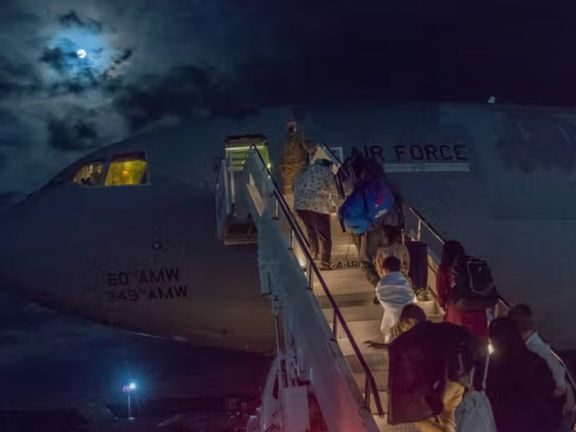
German media, citing the German Interior Ministry, reported that Berlin will arrange only one more charter flight for Afghan refugees. A ministry spokesperson confirmed that no new commitments for refugee acceptance have been made.

On Tuesday, March 18, reports revealed that the Interior Ministry had informed Leif-Erik Holm, a representative of the nationalist AfD party, about the plan.

Heiko Teggatz, head of the German Federal Police Union, voiced concerns about resettlement programs. He claimed that NGOs were encouraging Afghans to participate and advising them on ways to mislead authorities.

The Interior Ministry reiterated that no new refugee acceptance promises had been made. A ministry spokesperson stated that ongoing resettlement programs include support for local staff and at-risk individuals under the human rights framework.

Criticism of Germany’s refugee policy has increased following the recent transfer of 287 Afghans on two flights from Islamabad to Berlin.

The German government has not clarified whether additional flights will be arranged for the 2,800 Afghan refugees still waiting to enter the country.

Most Viewed

Pakistan Hosts Regional Meet On Afghanistan Without Taliban
1

Pakistan Hosts Regional Meet On Afghanistan Without Taliban

2

Taliban Ignore Afghanistan’s Interests By Backing Militants, Says Pakistan Army Chief

3

Taliban Delegation Travels To Russia To Facilitate Medicine Imports

4

Germany’s Interior Minister Defends Deportations To Afghanistan

5

United Nations Delivers Education Kits To Four Million Afghan Children

•
•
•

More Stories

Over 600,000 Afghan Refugees Reside in Iran’s Razavi Khorasan

Mar 18, 2025, 14:54 GMT+0

The Islamic Republic News Agency (IRNA) has reported that at least 600,000 Afghan refugees, both documented and undocumented, are living in Razavi Khorasan province.

According to the report, 396,000 of these refugees hold valid residence documents, including refugee cards, work permits, and passports. However, at least 200,000 Afghan refugees in the province lack legal documentation. IRNA estimates that this number could rise to 300,000.

The report noted that Afghan migration to Razavi Khorasan increased significantly after the Taliban took power in 2021. By mid-2023, around 400,000 documented Afghan refugees were residing in Mashhad, the province’s capital.

Iranian authorities have also recorded the daily return of 300 to 350 undocumented Afghan refugees from Razavi Khorasan to Afghanistan.

In recent months, Iran has intensified restrictions on Afghan migrants. Authorities have banned them from employment and renting homes in several cities, further increasing the pressure on Afghan refugees living in the country.

Taliban Enforces New Media Restrictions In Kandahar, Bans Women’s Voices On Radio

Mar 18, 2025, 12:57 GMT+0

The Afghanistan Journalists Center (AFJC) has reported that the Taliban has imposed new media restrictions in Kandahar. According to a directive issued by the Taliban’s Directorate of Information and Culture, broadcasting women’s voices on the radio is now “absolutely forbidden.”

The directive also orders all radio stations to refer to Taliban leader Hibatullah Akhundzada as the “Esteemed Amir al-Mu’minin, may Allah protect him.” Additionally, media outlets must refer to the Taliban government as the “Islamic Emirate.”

The restrictions extend beyond content regulations. Advertisements for medicine, cosmetic products, and healthcare services are now banned unless officially approved by the Directorate of Public Health. Radio employees traveling within Kandahar for reporting or programming purposes must also obtain prior authorisation from the Directorate of Information and Culture.

The AFJC condemned the new measures, calling them an escalation in the Taliban’s suppression of independent media. “Until now, no media outlet in Kandahar or any other province had been officially and publicly required to refer to the Taliban leader with such formal titles,” the organisation stated.

Previously, media outlets in Kandahar could still air some content featuring women, especially programmes produced in Kabul. However, with this new directive, Kandahar has become the second province, after Helmand, where the Taliban has officially banned women’s voices in the media.

Kandahar lacks local television networks. The national television station that once operated there was shut down and converted into a radio station due to Taliban-imposed restrictions on broadcasting living being images.

The AFJC denounced the latest measures, describing them as further proof of the Taliban’s increasing crackdown on press freedom in Afghanistan.
Taliban Urges UN Mission To Avoid ‘Unnecessary Concerns’ Over Afghanistan

Mar 18, 2025, 11:32 GMT+0

Zabihullah Mujahid, spokesperson for Taliban leader Hibatullah Akhundzada, has called on the United Nations Assistance Mission in Afghanistan (UNAMA) to refrain from creating “unnecessary concerns” about the country.

His statement follows the UN Security Council’s decision to extend UNAMA’s mandate for another year.

Mujahid accused UNAMA of using isolated issues to spread “propaganda against Afghanistan” and claimed it was becoming a “tool for hostile circles.” He urged the mission to focus on strengthening the Taliban’s relations with the United Nations and other countries.

He also called on UNAMA to support efforts to lift international sanctions on the Taliban, release Afghanistan’s frozen assets, and facilitate the group’s recognition at the United Nations.

On Monday, the UN Security Council unanimously approved a resolution extending UNAMA’s mission until March 2026. During the session, several member states expressed concerns over security in Afghanistan, the Taliban’s failure to establish an inclusive government, and continued restrictions on women’s rights.

Pakistan, Taliban Agree To Reopen Torkham Border After Talks, Says Pakistani Media

Mar 18, 2025, 10:10 GMT+0

Pakistan’s Express Tribune reported that the Taliban and Pakistani delegations have agreed to reopen the Torkham border crossing on Tuesday, March 18, following successful negotiations.

Syed Jawad Hussain Kazmi, head of the Pakistani negotiating team, stated that the Taliban agreed to stop “illegal construction” along the border. The second round of talks took place in Torkham, focusing on reopening the critical crossing.

Kazmi, who also leads the Khyber Pakhtunkhwa Chamber of Commerce and Industry, told Express Tribune that both sides agreed that any future border construction would require mutual approval.

A 36-member Pakistani delegation, including clerics, tribal leaders, and business representatives, met with a 25-member Afghan delegation in Torkham. This was the second jirga in two weeks aimed at resolving the border closure. A week earlier, a 57-member Pakistani jirga also met with Taliban representatives, calling for a ceasefire and reopening the crossing.

Pakistani media reported that the first round of talks failed due to the Taliban’s refusal to halt border post construction.

The Torkham crossing, a key trade and travel route, has been closed for 25 days. The closure followed a border clash on February 21, when Taliban and Pakistani forces exchanged fire over the construction of a Taliban outpost and the installation of a road sign by Pakistan at the zero-point border. Pakistan then shut the crossing to passengers and trade.

Thousands of travelers remain stranded on both sides, and businesses have suffered heavy losses. A Pakistani official told Express Tribune that the closure has cost Pakistan’s treasury an estimated $72 million.

Taliban Announces Military Modernisation, Plans To Upgrade Advanced Weapons

Mar 18, 2025, 09:25 GMT+0

Fasihuddin Fitrat, Chief of Staff of the Taliban Army, has announced plans to equip Taliban forces with advanced weaponry and modern military equipment. He stated that strengthening the so-called “Islamic Army” is not intended to provoke conflict with neighbouring countries.

The Taliban government remains under strict economic and military sanctions, raising questions about the source of its modern weaponry. Since taking control of Afghanistan in 2021, the group has seized American arms left behind in the country. Former U.S. President Donald Trump has publicly urged the Taliban to return these weapons.

On Monday, Fitrat said the main goal of modernising the Taliban’s military is to protect Afghanistan’s borders and uphold Islamic values. “We do not seek war or conflict with neighbouring countries or the world,” he said. “We prefer dialogue and reconciliation.”

However, he warned that any force challenging the Taliban would face a response similar to that experienced by past superpowers. His remarks referenced the defeats of British, Soviet, and U.S. forces in Afghanistan.

His comments come amid rising tensions between the Taliban and Pakistan. Islamabad has signalled its willingness to target militant groups inside Afghan territory, further straining relations.

Despite Fitrat’s announcement, there is no confirmation that the Taliban has entered negotiations with any country to acquire modern arms. With many senior Taliban officials still on the United Nations’ blacklist, it remains unclear which nation would supply weapons to the group.