• العربية
  • پښتو
  • فارسی
Brand
  • Afghanistan
  • Sport
  • Markets
  • Afghanistan
  • Sport
  • Markets
  • Theme
  • Language
    • العربية
    • پښتو
    • فارسی
  • Afghanistan
  • Sport
  • Markets
All rights reserved for Volant Media UK Limited
volant media logo

Taliban Hosts Turkish Clerics In Northern Jowzjan Province

Apr 12, 2025, 13:28 GMT+1

The Taliban-appointed governor’s office in Jowzjan province has announced the arrival of a delegation of Turkish clerics in Sheberghan, aimed at fostering stronger ties between religious scholars from Afghanistan and Turkiye.
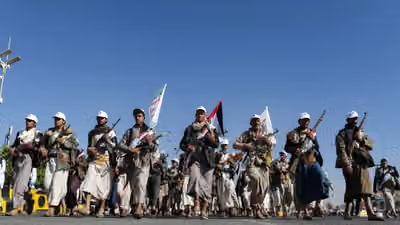
In an official statement, the Taliban said the Turkish delegation was taken to visit two prominent places in the region: Abu Sulaimani Jowzjani seminary and Dasht-e Leili. The latter holds deep symbolic significance for the Taliban, as it is believed to be the site of mass graves containing the remains of Taliban fighters killed in the 1990s.

In November 2024, the Taliban revealed plans to fence off the Dasht-e Leili grave site and build a mosque on the grounds, framing the move as a tribute to what they call “martyrs.” The group continues to accuse forces loyal to the National Islamic Movement of Afghanistan, then commanded by Abdul Rashid Dostum—now in exile in Turkiye—of responsibility for the so-called Dasht-e Leili massacre, allegations that Dostum has consistently denied.

The Turkish clerical delegation also met with Gol Haidar Shafaq, the Taliban-appointed governor of Jowzjan, to discuss avenues for enhancing religious cooperation between the two nations.

Governor Shafaq described the visit as a meaningful step toward reinforcing Islamic values and strengthening religious and diplomatic ties between Afghanistan and Turkiye.

Most Viewed

Nearly 23,000 Militants Operating In Afghanistan, Says Russian Security Chief
1

Nearly 23,000 Militants Operating In Afghanistan, Says Russian Security Chief

2

Taliban Issue New Family Law Rules On Marriage & Divorce

3

Afghanistan Instability Is A Direct Regional Security Threat, Says Russia

4

UN Funding Should Support Trump Policy Goals, Says US

5

Pakistan Dismisses Taliban Denial Over Bannu Police Attack

•
•
•

More Stories

CSTO Chief, Tajik President Discuss Strengthening Afghan Border Security

Apr 12, 2025, 11:26 GMT+1

Imangali Tasmagambetov, Secretary-General of the Collective Security Treaty Organisation (CSTO), met with Emomali Rahmon, President of Tajikistan, on Friday, 11 April, in Dushanbe to discuss measures aimed at enhancing border security with Afghanistan.

According to a statement released by the CSTO, the discussions focused in particular on the Targeted Interstate Programme — a joint initiative by CSTO member states designed to strengthen the security of Tajikistan’s southern border. The border with Afghanistan is considered a critical front in regional counterterrorism and stability efforts.

During his visit, Tasmagambetov also held separate talks with Emomali Sobirzoda, Tajikistan’s newly appointed Minister of Defence, to further address security collaboration.

The CSTO Secretary-General had earlier announced that the border reinforcement initiative would begin in 2025 and would consist of specific strategic measures aimed at safeguarding the interests and security of CSTO member countries. The programme is structured in three phases and will be implemented over a five-year period.

In parallel with these high-level talks, joint Russian-Tajik military exercises were conducted near the Afghan border in recent days. The drills, held at a military training ground in Tajikistan, focused on combat readiness and counterterrorism operations in mountainous terrain. The Russian Ministry of Defence reported that the exercise involved the deployment of Orlan-10 drones, tanks, artillery units, and Mi-24 attack helicopters.

Taliban Minister’s Remarks On Non-Muslims Spark Concern Among Afghan Sikhs & Hindus

Apr 12, 2025, 10:25 GMT+1

A representative of the Afghan Sikh and Hindu diaspora in the United Kingdom has expressed deep concern over recent remarks made by Khalid Hanafi, the Taliban’s Minister for the Propagation of Virtue and the Prevention of Vice, labelling them as offensive and inflammatory.

Harbans Singh, speaking to Afghanistan International, condemned the minister’s statements, made just days before the Sikh and Hindu festival of Vaisakhi. Hanafi reportedly claimed that non-Muslims, including Hindus and Sikhs, are “worse than animals,” a comment that has drawn sharp criticism from religious minorities.

Singh stressed that no one has the right to insult another religion and warned that such rhetoric could further endanger the small number of Sikhs and Hindus who remain in Afghanistan. He added that these comments could compel many to leave the country altogether due to fears for their safety and religious freedom.

Hanafi, known for his hardline stance, plays a central role in enforcing the Taliban’s restrictive social decrees, particularly those targeting women. In a previous speech, he asserted that God has given Muslims a special status due to their commitment to promoting virtue and preventing vice.

US Ends Temporary Protected Status For Thousands Of Afghans & Cameroonians

Apr 12, 2025, 09:31 GMT+1

The United States Department of Homeland Security (DHS) has announced the termination of Temporary Protected Status (TPS) for thousands of nationals from Afghanistan and Cameroon, placing them at risk of deportation in the coming months.

According to DHS Assistant Secretary for Public Affairs Tricia McLaughlin, Secretary of Homeland Security Kristi Noem has determined that current conditions in Afghanistan and Cameroon no longer warrant an extension of TPS.

As a result, approximately 14,600 Afghan nationals and 7,900 Cameroonian nationals—previously eligible under the programme—are expected to lose their protection from deportation by May and June respectively.

TPS is a form of humanitarian relief granted to individuals from countries facing extraordinary conditions such as armed conflict or environmental disasters. While in effect, it permits recipients to live and work legally in the United States and protects them from removal. The status is typically granted for 6 to 18 months and may be extended depending on conditions in the home country.

The decision to revoke TPS for these nationals is seen as part of a broader tightening of immigration policies under the administration of President Donald Trump. In total, more than 22,000 individuals from Afghanistan and Cameroon could be affected by the move, potentially facing deportation within the next two months.

The development has drawn concern from human rights groups and immigration advocates, who argue that returning individuals to regions still experiencing instability could place lives at risk.

Iran Deepens Influence In Afghanistan: Senior Officials Attend Friday Prayers In Herat

Apr 11, 2025, 16:55 GMT+1

The Iranian Embassy in Kabul has confirmed the attendance of the Deputy Foreign Minister for Economic Diplomacy, along with the Iranian Ambassador to Afghanistan, at Friday prayers held at the Herat Grand Mosque.

According to the embassy, the high-level delegation from the Islamic Republic of Iran participated in the prayers as part of a broader visit aimed at strengthening ties with local authorities and expanding Tehran’s influence in western Afghanistan.

The presence of senior Iranian officials at one of Herat’s most prominent religious sites signals a calculated diplomatic move to engage with the Taliban administration and bolster relations with provincial leaders in Herat and other neighbouring regions along the Iranian border.

Earlier, Iranian media reported that a delegation comprising the Deputy Foreign Minister, the Director General for South Asia at the Ministry of Foreign Affairs, the Deputy Minister of Roads and Urban Development, and the Governor of South Khorasan Province had arrived in Herat on Thursday.

During their visit, the delegation is scheduled to tour Herat’s industrial park, the Khaf-Herat railway project, and the Rozanak railway station. In addition, meetings are planned with the Taliban’s governor in Herat, other senior officials of the group, and representatives of the private sector. These engagements aim to assess Herat’s economic landscape and explore opportunities to enhance cross-border trade and infrastructure cooperation.

This diplomatic outreach comes as the Islamic Republic continues the construction of a border wall along parts of the Afghan-Iranian frontier, citing ongoing concerns related to security threats, drug trafficking, and unauthorised border crossings.

Despite persistent apprehensions over the Taliban’s governance and regional security, Iran has stepped up its diplomatic engagement with the group. This includes a recent visit by Iran’s Foreign Minister to Kabul for direct talks with senior Taliban leaders.

Taliban Leader Allocates $9 Million For Pakistani Religious Seminaries

Apr 11, 2025, 15:29 GMT+1

Taliban Supreme Leader Hibatullah Akhundzada has directed $9 million from Afghanistan’s new fiscal budget to support religious seminaries in Pakistan, a source close to the Taliban leadership revealed to Afghanistan International.

The funds, earmarked for madrasas in Pakistan’s border provinces of Balochistan, Sindh, and Punjab, were ordered by Akhundzada despite the Taliban administration facing a severe financial shortfall.

According to the source, Akhundzada instructed Finance Minister Mohammad Nasir Akhund and Central Bank Governor Noor Ahmad Agha to facilitate the allocation.

The decision follows the Taliban’s approval of the 1403 (2024/25) national budget, though specific figures were not disclosed. For comparison, the 1401 (2022/23) budget totalled 231 billion Afghanis, with 203 billion for operational costs and 27.9 billion for development projects.

Amid the budget constraints, the Taliban has mandated a 12 percent staff reduction across all ministries and suspended pension payments to retirees, triggering public discontent.

Nevertheless, Akhundzada’s prioritisation of Pakistani madrasas underscores the Taliban’s deep ideological ties to these institutions, many of which educated its leaders and fighters and continue to serve as recruitment hubs. Senior Taliban officials frequently visit these seminaries and maintain strong connections with them.

The move comes as Afghanistan grapples with profound economic, political, and human rights challenges under Taliban rule. The United Nations estimates that approximately 23 million Afghans require humanitarian assistance. Last year, the World Food Programme provided emergency food aid and cash to nearly 12 million people, with a focus on women and girls facing acute hunger.