• العربية
  • پښتو
  • فارسی
Brand
  • Afghanistan
  • Sport
  • Markets
  • Afghanistan
  • Sport
  • Markets
  • Theme
  • Language
    • العربية
    • پښتو
    • فارسی
  • Afghanistan
  • Sport
  • Markets
All rights reserved for Volant Media UK Limited
volant media logo

Taliban Shifts Stance On TTP, Says Pakistani Delegation After Kabul Visit

Apr 17, 2025, 10:24 GMT+1

The Afghan Taliban have shown a notable shift in their position towards the Tehreek-e-Taliban Pakistan (TTP), according to a visiting Pakistani delegation that recently concluded a visit to Kabul.

As reported by The Express Tribune, this marks a significant development in bilateral ties following months of strained relations between the two neighbours.

Members of the Pakistani delegation observed that, for the first time, the Taliban appeared to be taking Islamabad’s security concerns seriously. “Everyone in the delegation noted a change in the Afghan Taliban’s stance towards the TTP,” a member of the visiting team told The Express Tribune.

While the delegation did not disclose specific actions taken by the Taliban, they described the overall response as “positive,” suggesting that the Taliban authorities are beginning to act on Pakistan’s longstanding demands. “Let’s see the outcome of those steps in the coming days. At least, they have shown seriousness,” the official added.

Sources attribute this apparent shift in approach to multiple factors, including Afghanistan’s deteriorating economic conditions, the continued suspension of US aid, and increasing diplomatic pressure from Pakistan.

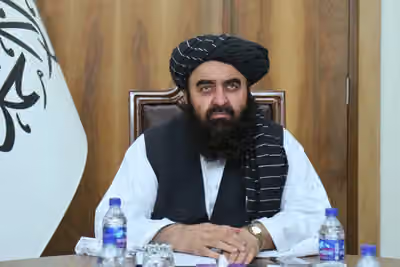
The Pakistani delegation visited Kabul on Wednesday, 16 April, where they held meetings with senior Taliban officials. Pakistan’s Special Representative for Afghanistan, Mohammad Sadiq, met with Taliban acting Foreign Minister Amir Khan Muttaqi and participated in the 7th round of the Afghanistan–Pakistan Joint Coordination Committee. The meeting was held privately, behind closed doors.

Senior Taliban military leaders, including Deputy Minister of Defence Mullah Abdul Qayyum Zakir, were also present at the talks. Upon returning to Islamabad, Mohammad Sadiq described the discussions as vital for addressing “sensitive and strategic matters.”

In a statement posted to his X (formerly Twitter) account, Sadiq wrote: “Regular and sustained engagement through such mechanisms is essential to ease tensions, dispel doubts, and strengthen mutual understanding in bilateral ties.”

Both sides reportedly agreed to refrain from using provocative language or engaging in public blame games — a move seen as a step towards deescalating tensions.

This was the first meeting of the Joint Coordination Committee in over 15 months. The last round took place in Islamabad but was suspended amid worsening tensions over the Taliban’s alleged harbouring of TTP elements.

Pakistan has consistently urged the Taliban to prevent the TTP from operating within Afghan territory and launching cross-border attacks. The Taliban, for their part, have publicly denied the presence of TTP fighters on Afghan soil.

Coinciding with the Pakistani delegation’s visit to Kabul, a high-level Taliban delegation led by Industry and Commerce Minister Nooruddin Azizi travelled to Islamabad. The group included officials from the ministries of foreign affairs, finance, agriculture, refugees, administrative affairs, and civil aviation.

The primary aims of the Taliban delegation’s visit were to address trade barriers, extend the Afghanistan–Pakistan Transit Trade Agreement, and discuss the status of Afghan refugees residing in Pakistan.

Most Viewed

Taliban Issue New Family Law Rules On Marriage & Divorce
1

Taliban Issue New Family Law Rules On Marriage & Divorce

2

UN Funding Should Support Trump Policy Goals, Says US

3

Pakistan Dismisses Taliban Denial Over Bannu Police Attack

4

Taliban Governors, Intelligence Chiefs Hold Security Meet In Northern Afghanistan

5

China, Qatar Discuss Taliban-Pakistan Tensions & Regional Stability

•
•
•

More Stories

Norwegian Diplomat Advises Taliban On Strengthening Ties With Europe, Group Claims

Apr 17, 2025, 09:18 GMT+1

A senior Norwegian diplomat has reportedly discussed expanding the Taliban’s diplomatic engagement with European nations, according to a statement released Wednesday by the Taliban’s Ministry of Refugees and Repatriation.

Per Albert Ilsaas, the Chargé d'Affaires at the Norwegian embassy for Afghanistan, met with Taliban Deputy Prime Minister Abdul Kabir and offered guidance on deepening the group's ties with Europe, the ministry said.

The statement claimed that Ilsaas considered certain Taliban actions “noteworthy” and described the direct relationship between Norway and the Taliban as “important.” He also reportedly underscored the importance of resolving disputes through dialogue.

Ilsaas “referred to the opening of the Afghan embassy in Norway, emphasised the need to address existing issues in order to strengthen and build trust in diplomatic relations between Kabul and European countries,” the ministry said.

The Norwegian envoy also criticised the forced deportation of Afghan migrants from Pakistan and pledged that Norway would continue humanitarian aid to Afghanistan through international organisations.

In the meeting, Kabir also condemned Pakistan’s deportation of Afghan nationals, calling it “a violation of all principles,” and urged the international community to support a long-term resolution to Afghanistan’s ongoing migration crisis.

Norway has maintained limited contact with the Taliban since the group took power in August 2021. Although the Norwegian government has criticised the Taliban’s restrictions on women, it has continued to engage diplomatically and has accepted a Taliban-appointed diplomat.

Recently, Oslo accepted Najibullah Sherkhan, a Taliban envoy, as First Secretary of the Afghan Embassy and issued him a one-year diplomatic residence permit. Consular services for Afghan citizens in Norway officially resumed on 24 March, according to the Taliban’s Ministry of Foreign Affairs.

Shortly after assuming his post, Sherkhan replaced the embassy’s signage with one reflecting the Taliban’s flag colours and removed the phrase “Islamic Republic.”

The Afghan embassy in Norway had been closed since September 2024. Prior to its closure, it was operated by diplomats from the former Afghan government. Youssof Ghafoorzai, the last ambassador under the previous administration, announced the conclusion of his four-and-a-half-year mission that same month.

Taliban Kill Teen In Ghazni Province, Detain 12 Relatives After Alleged Attack

Apr 16, 2025, 17:35 GMT+1

Local sources in Jaghori district, Ghazni province, report that Taliban fighters have killed a teenage boy and detained at least 12 of his relatives, including several school students, following an alleged attack on the district administrative building.

According to sources speaking to Afghanistan International, the teenager, identified as Mahdi, was shot dead by Taliban forces last Wednesday near the Jaghori district centre. His body was later handed over to his family with instructions to bury him quietly and without funeral prayers.

Taliban officials in the area have yet to comment on the incident. However, local elders summoned by the group were told that Mahdi was killed for allegedly launching an armed attack on the district office, and for reportedly planning a larger assault. The Taliban claimed Mahdi and another individual opened fire on the district compound before fleeing. One was shot dead, and the other allegedly escaped.

Contrary to these claims, several local sources maintain that Mahdi was merely riding past the district office on a motorcycle when he failed to stop at a Taliban checkpoint. He was shot and killed on the spot, according to eyewitnesses. Photographs seen by Afghanistan International show visible gunshot wounds on his body.

Following the incident, the Taliban reportedly detained 12 of Mahdi’s classmates and relatives—most of them students—and transferred them to a prison facility in Ghazni city.

In a broader crackdown, sources also report that the Taliban have instructed residents to report any unfamiliar visitors to the district. Additionally, local money transfer agents have been ordered to provide Taliban intelligence with full details of remittances received from abroad.

The incident has sparked fear and anger in the community, though no official condemnation has yet been issued by human rights organisations or international observers.

Taliban Summons Uruzgan Residents To Witness Public Flogging Of 15

Apr 16, 2025, 16:41 GMT+1

The Taliban’s Directorate of Information and Culture in Uruzgan has issued a public notice inviting residents to witness the public flogging of 15 individuals at the Tarinkot stadium on Thursday morning.

The group claims the accused are being punished for committing “various criminal offences,” although no specific charges have been disclosed.

The Taliban has explicitly banned spectators from carrying smartphones or video cameras to the event, warning that violators will face punishment. The authorities have not provided any transparency regarding the legal proceedings or evidence presented against the accused.

This follows a similar incident on 12 April, when the Taliban publicly flogged 13 people, including five women, in the provinces of Jowzjan and Khost. According to the group’s courts, two women in Darzab district of Jowzjan were punished for alleged extramarital relations and fleeing home. In Khost, two men and one woman were convicted of extramarital sex, while six men and two women were flogged for alleged “illicit relationships.”

Despite ongoing international condemnation of corporal punishment and torture, the Taliban continues to carry out public lashings as a tool of intimidation. The group’s Supreme Court provides no details regarding the judicial process, the presence of defence lawyers, or whether fair trials were conducted.

International organisations have repeatedly raised concerns over the absence of due process and fair trial standards in Afghanistan under Taliban rule.

Rights Group Urges Europe To Reassess Immigration Cases Of Taliban Lobbyists

Apr 16, 2025, 15:36 GMT+1

The Human Rights Activists Union (HRAU) has raised alarm over what it describes as a surge in lobbying efforts by individuals attempting to "whitewash and legitimise the Taliban regime" across Western countries.

The organisation has specifically called on European nations—particularly Germany—to thoroughly and seriously review the immigration files of those suspected of lobbying on behalf of the Taliban.

In a statement released on Tuesday, HRAU expressed deep concern over “a new phase of targeted and organised movements abroad aimed at the soft occupation of Afghanistan’s diplomatic missions by Taliban appointees.”

The union warned that individuals presenting themselves as journalists, analysts, or civil society activists are engaging in covert lobbying for the Taliban. According to HRAU, these individuals operate under the guise of media, civil, or seemingly neutral activities while actively working to sanitise the image of a regime it described as “misogynistic, ethnocentric, and a blatant violator of human rights.”

HRAU highlighted that some of these so-called activists freely travel to Kabul and even participate in ceremonies glorifying the Taliban’s “suicide brigades.” It alleged that such actors are working in direct coordination with Taliban officials to manipulate public perception of the current situation in Afghanistan.

The group issued a strong appeal to international human rights bodies, independent media, and European governments—most notably the German federal government—to take swift and firm action. It urged authorities to “Thoroughly review the immigration cases of certain individuals and, by enforcing legal and regulatory restrictions, prevent their political and propaganda abuses on European soil, in order to curb the spread of extremism.”

This statement comes amid reports that the Taliban has taken control of several Afghan diplomatic missions across Europe. In an apparent attempt to project a peaceful and modern image to the international community, the Taliban has allowed influencers—including YouTubers, celebrities, and even adult film stars—to visit Afghanistan and post content promoting the country as safe and welcoming.

Many of these social media personalities—particularly women—share photos and videos from various Afghan provinces. However, such portrayals stand in stark contrast to the domestic reality, where Afghan women and girls remain banned from many public and recreational spaces, such as the popular Band-e Amir National Park.

Taliban Rejects UNAMA’s Call To End Executions As ‘Intolerable Insult To Islamic Law’

Apr 16, 2025, 13:31 GMT+1

The Taliban’s Ministry of Foreign Affairs has reacted the United Nations Assistance Mission in Afghanistan (UNAMA) for urging an end to the use of capital punishment, calling the request “an insult to Islamic rulings, irresponsible, and intolerable.”

In a statement released on Wednesday, the ministry asserted that the implementation of the death penalty is an integral and non-negotiable part of Islamic Sharia law. It called on UNAMA to refrain from issuing similar criticisms in the future.

The ministry confirmed that four individuals were executed in the provinces of Badghis, Nimruz, and Farah after what it described as a “thorough judicial process.” It claimed the cases passed through three levels of court proceedings and that the accused had access to legal defence throughout all stages.

The Taliban warned UNAMA that public criticism of Sharia-based rulings contradicts the mission’s role and constitutes behaviour that the group considers “intolerable.” The statement added that the Taliban views the enforcement of Sharia punishments, including the death penalty, as a religious obligation.

Citing what it called the “proven effectiveness” of capital punishment in ensuring justice and maintaining social order, the Taliban defended its use of executions as a means of upholding Islamic legal principles.

The comments follow a statement by UNAMA condemning the execution of four men by the Taliban across three provinces. Two of the men were executed publicly in Qala-e-Naw, the capital of Badghis; another in Zaranj, Nimruz; and one in the city of Farah.

UNAMA said the executions violated the fundamental right to life and called on the Taliban to impose an immediate moratorium on the death penalty in Afghanistan.

The executions have drawn widespread condemnation from international human rights organisations and several governments.