Taliban Arrest Afghan-Canadian Activist Nadima Noor
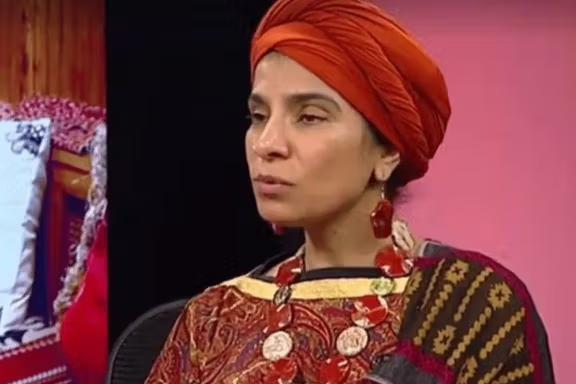
The Taliban have arrested Nadima Noor, an Afghan-Canadian social media activist, according to sources who spoke to Afghanistan International on Wednesday.
The Taliban have arrested Nadima Noor, an Afghan-Canadian social media activist, according to sources who spoke to Afghanistan International on Wednesday.
Noor is reportedly being held at Directorate 40 of the Taliban’s intelligence agency. The reason for her detention has not been disclosed. This marks the second time Noor has been arrested by the Taliban, following a previous detention and subsequent release in early 2022.
Known for her outspoken presence online, Noor last posted a video message on 9 February 2025, in which she appealed to the Taliban to show compassion towards the Afghan people.
In the video, she said "My dear. I feel sorrow for my people and for you, which is why I say these things. When you go around in your Rangers, don’t point your weapons at the people like that... Tomorrow, that same gun might fire back at you. If you win the hearts of the people, love between us and you will grow."
Noor heads a charitable organisation that supports girls’ education in Afghanistan. She returned to the country from Canada in 2019 and has since been engaged in advocacy and humanitarian work.
Her arrest comes amid an ongoing pattern of Taliban repression targeting women’s rights activists, human rights defenders, journalists, and former security personnel of the previous Afghan republic. Many have reportedly been detained, tortured, or have disappeared without a trace.
Pakistan’s Foreign Minister, Mohammad Ishaq Dar, announced on Thursday that he will soon travel to Kabul as part of Islamabad’s efforts to normalise relations with neighbouring countries.
Speaking at a joint press conference with Hungary’s Foreign Minister in Islamabad, Dar said his upcoming trip to Afghanistan would aim to strengthen diplomatic engagement between the two countries. Pakistani media have reported that the visit is expected to take place on Saturday, 19 April.
This will mark Dar’s first visit to Kabul since assuming the role of foreign minister, and the second by a Pakistani foreign minister since the Taliban’s return to power in August 2021.
Previously, former Foreign Minister Shah Mahmood Qureshi travelled to Kabul in October 2021, shortly after the Taliban takeover. In November 2022, then-Deputy Foreign Minister Hina Rabbani Khar also visited Afghanistan for high-level talks.
More than 40 members of the US Congress have called on the State Department to immediately reinstate the country’s refugee admissions programme, which was suspended and defunded at the start of former President Donald Trump’s second term.
Representative Yassamin Ansari announced the appeal on Monday, saying she led the effort and shared a copy of the lawmakers’ letter to Secretary of State Marco Rubio on social media.
“Proud to lead 40+ of my colleagues in calling on Secretary Rubio to reinstate the US Refugee Admissions Programme,” Ansari wrote in a post on X. “People fleeing violence and persecution deserve to be welcomed. This is a promise our nation has made—and one I intend to help fulfil.”
The bipartisan letter described how the abrupt halt to the refugee programme has left tens of thousands of individuals stranded in dangerous conditions abroad. It also noted that many newly arrived refugees in the United States have been deprived of access to vital, life-saving services.
One of the first flights cancelled under the suspension, on the morning of 22 January 2025, included four Afghan child refugees en route to reunite with their parents in Massachusetts. The youngest among them was just seven years old.
The lawmakers argued that the refugee admissions freeze starkly contradicts American values and the nation’s long-standing humanitarian commitments. They criticised the administration’s termination of agreements with resettlement agencies, calling it a deliberate attempt to dismantle the US refugee infrastructure.
According to the letter, as of 15 April 2025, more than 22,000 refugees who have passed all required security and medical screenings remain in limbo, awaiting resettlement in the US.
The lawmakers further warned that recent decisions by the federal government not only undermine the country's reputation for compassion but also carry broad social and economic consequences.
In their appeal, the signatories demanded that the Trump administration immediately reinstate the refugee admissions programme, rebook cancelled refugee flights, resume cooperation with humanitarian and resettlement organisations, and release frozen funds earmarked for refugee services.
The Taliban’s High Commission for Addressing Migrants’ Issues has reported that a total of 5,136 Afghan migrants were deported from Pakistan on Wednesday, marking one of the largest single-day returns in recent months.
According to the commission, 3,500 individuals crossed back into Afghanistan via the Torkham border in Nangarhar province, while another 1,636 were deported through the Spin Boldak crossing in Kandahar province.
In its statement, the commission detailed that 625 Afghan families were registered upon arrival at Torkham and 303 families at Spin Boldak. Simultaneously, 535 Afghan migrants—comprising 144 families—were deported from Iran and returned to Afghanistan through the Islam Qala border crossing.
To support the returnees, the Taliban-led commission stated it had distributed a total of 6,481,000 Afghanis (AFN) in aid among the returning families.
This follows an earlier announcement by the commission on Tuesday, 15 April, confirming the deportation of 4,339 Afghan nationals from Pakistan—3,235 via Torkham and 1,104 via Spin Boldak.
Meanwhile, the International Organization for Migration (IOM) raised alarms on Wednesday over the rapidly increasing deportations. The organisation stated that over 60,000 Afghan migrants have been deported from Pakistan in the past two weeks alone.
Mutya Izora Maskun, IOM’s Deputy Chief of Mission for Operations, stressed the critical need for immediate humanitarian assistance, noting that many returnees arrive in Afghanistan with almost no belongings and face uncertain futures. “They are tired, scared and extremely vulnerable,” Maskun said.
The IOM has urged the international community to step up support and not remain indifferent to the growing humanitarian crisis facing deported Afghan migrants.
The Afghan Taliban have shown a notable shift in their position towards the Tehreek-e-Taliban Pakistan (TTP), according to a visiting Pakistani delegation that recently concluded a visit to Kabul.
As reported by The Express Tribune, this marks a significant development in bilateral ties following months of strained relations between the two neighbours.
Members of the Pakistani delegation observed that, for the first time, the Taliban appeared to be taking Islamabad’s security concerns seriously. “Everyone in the delegation noted a change in the Afghan Taliban’s stance towards the TTP,” a member of the visiting team told The Express Tribune.
While the delegation did not disclose specific actions taken by the Taliban, they described the overall response as “positive,” suggesting that the Taliban authorities are beginning to act on Pakistan’s longstanding demands. “Let’s see the outcome of those steps in the coming days. At least, they have shown seriousness,” the official added.
Sources attribute this apparent shift in approach to multiple factors, including Afghanistan’s deteriorating economic conditions, the continued suspension of US aid, and increasing diplomatic pressure from Pakistan.
The Pakistani delegation visited Kabul on Wednesday, 16 April, where they held meetings with senior Taliban officials. Pakistan’s Special Representative for Afghanistan, Mohammad Sadiq, met with Taliban acting Foreign Minister Amir Khan Muttaqi and participated in the 7th round of the Afghanistan–Pakistan Joint Coordination Committee. The meeting was held privately, behind closed doors.
Senior Taliban military leaders, including Deputy Minister of Defence Mullah Abdul Qayyum Zakir, were also present at the talks. Upon returning to Islamabad, Mohammad Sadiq described the discussions as vital for addressing “sensitive and strategic matters.”
In a statement posted to his X (formerly Twitter) account, Sadiq wrote: “Regular and sustained engagement through such mechanisms is essential to ease tensions, dispel doubts, and strengthen mutual understanding in bilateral ties.”
Both sides reportedly agreed to refrain from using provocative language or engaging in public blame games — a move seen as a step towards deescalating tensions.
This was the first meeting of the Joint Coordination Committee in over 15 months. The last round took place in Islamabad but was suspended amid worsening tensions over the Taliban’s alleged harbouring of TTP elements.
Pakistan has consistently urged the Taliban to prevent the TTP from operating within Afghan territory and launching cross-border attacks. The Taliban, for their part, have publicly denied the presence of TTP fighters on Afghan soil.
Coinciding with the Pakistani delegation’s visit to Kabul, a high-level Taliban delegation led by Industry and Commerce Minister Nooruddin Azizi travelled to Islamabad. The group included officials from the ministries of foreign affairs, finance, agriculture, refugees, administrative affairs, and civil aviation.
The primary aims of the Taliban delegation’s visit were to address trade barriers, extend the Afghanistan–Pakistan Transit Trade Agreement, and discuss the status of Afghan refugees residing in Pakistan.
A senior Norwegian diplomat has reportedly discussed expanding the Taliban’s diplomatic engagement with European nations, according to a statement released Wednesday by the Taliban’s Ministry of Refugees and Repatriation.
Per Albert Ilsaas, the Chargé d'Affaires at the Norwegian embassy for Afghanistan, met with Taliban Deputy Prime Minister Abdul Kabir and offered guidance on deepening the group's ties with Europe, the ministry said.
The statement claimed that Ilsaas considered certain Taliban actions “noteworthy” and described the direct relationship between Norway and the Taliban as “important.” He also reportedly underscored the importance of resolving disputes through dialogue.
Ilsaas “referred to the opening of the Afghan embassy in Norway, emphasised the need to address existing issues in order to strengthen and build trust in diplomatic relations between Kabul and European countries,” the ministry said.
The Norwegian envoy also criticised the forced deportation of Afghan migrants from Pakistan and pledged that Norway would continue humanitarian aid to Afghanistan through international organisations.
In the meeting, Kabir also condemned Pakistan’s deportation of Afghan nationals, calling it “a violation of all principles,” and urged the international community to support a long-term resolution to Afghanistan’s ongoing migration crisis.
Norway has maintained limited contact with the Taliban since the group took power in August 2021. Although the Norwegian government has criticised the Taliban’s restrictions on women, it has continued to engage diplomatically and has accepted a Taliban-appointed diplomat.
Recently, Oslo accepted Najibullah Sherkhan, a Taliban envoy, as First Secretary of the Afghan Embassy and issued him a one-year diplomatic residence permit. Consular services for Afghan citizens in Norway officially resumed on 24 March, according to the Taliban’s Ministry of Foreign Affairs.
Shortly after assuming his post, Sherkhan replaced the embassy’s signage with one reflecting the Taliban’s flag colours and removed the phrase “Islamic Republic.”
The Afghan embassy in Norway had been closed since September 2024. Prior to its closure, it was operated by diplomats from the former Afghan government. Youssof Ghafoorzai, the last ambassador under the previous administration, announced the conclusion of his four-and-a-half-year mission that same month.
