• العربية
  • پښتو
  • فارسی
Brand
  • Afghanistan
  • Sport
  • Markets
  • Afghanistan
  • Sport
  • Markets
  • Theme
  • Language
    • العربية
    • پښتو
    • فارسی
  • Afghanistan
  • Sport
  • Markets
All rights reserved for Volant Media UK Limited
volant media logo

Taliban Outlines More Details On Plan To Cut Security Personnel

Apr 21, 2025, 10:18 GMT+1

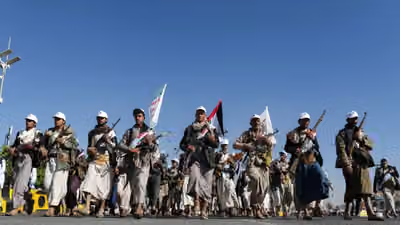
Taliban leader Hibatullah Akhundzada has ordered a 20 percent reduction in the group's security personnel as part of a sweeping downsizing initiative driven by a deepening budget crisis.

The directive prioritises the dismissal of guards and mercenary fighters, placing them at the top of the list for cuts.

Under the plan, 20 percent of staff in Taliban security institutions are to be placed in a state of "active reserve," effectively removing them from duty while maintaining nominal affiliation with the institutions.

In an introduction to the downsizing plan, Akhundzada explained that the decision followed extensive internal consultations and was made in light of “certain important interests.” The directive outlines a tiered system for reductions, with non-professional personnel placed in the third tier, units in stable or threat-free areas in the fourth, and advisors, deputies, and technical experts in the fifth.

The plan also targets individuals recruited after the Taliban’s return to power in 2021, including family members of fallen fighters, households with multiple siblings in service, elderly or disabled individuals, those without clearly defined roles, and absentee personnel.

Additionally, the plan mandates the consolidation of departments with overlapping responsibilities and the elimination of excess staff. It proposes reducing the number of deputies within each office, assigning department heads to take on dual roles to streamline operations.

If these measures fall short of achieving the 20 percent reduction target, further cuts will be made in regions deemed secure and less dependent on active security presence.

Those dismissed as part of the restructuring—whether Taliban fighters, collaborators, family members of deceased members, or recent recruits—will receive a monthly compensation of 5,000 Afghanis. The plan also includes a provision granting reemployment priority to those laid off, should future organisational expansion occur.

In recent days, audio recordings of Taliban fighters have circulated on social media, revealing grievances over the dismissals. Many claimed that frontline guards, who played a critical role in establishing and maintaining the regime’s control, were disproportionately affected by the cuts.

Akhundzada's decision comes amid a continued suspension of international aid, particularly from the United States, and ongoing complaints from government employees regarding unpaid salaries.

Most Viewed

Taliban Ignore Afghanistan’s Interests By Backing Militants, Says Pakistan Army Chief
1

Taliban Ignore Afghanistan’s Interests By Backing Militants, Says Pakistan Army Chief

2

United Nations Delivers Education Kits To Four Million Afghan Children

3

Taliban Renews Call For China To Launch Aynak Copper Mine

4

Taliban Leaders In South-West Hold Security Meet In Kandahar

5

Afghan Deportations Is Strategic Mistake, Says European Parliament Member

•
•
•

More Stories

Kazakh Deputy Prime Minister In Kabul To Sign Economic Agreement With Taliban

Apr 21, 2025, 09:19 GMT+1

Serik Zhumangarin, Deputy Prime Minister of Kazakhstan, arrived in Kabul on Monday, 21 April, leading a high-level delegation for talks with Taliban officials focused on bilateral relations and economic cooperation.

Speaking to reporters upon his arrival, Zhumangarin announced that an economic agreement between Kazakhstan and the Taliban administration would be signed during the visit.

The agreement is expected to be formalised between Zhumangarin and Abdul Ghani Baradar, the Taliban’s Deputy Prime Minister for Economic Affairs.

Among the key issues on the agenda is the proposed Afghan-Trans railway, a project aimed at enhancing regional connectivity and trade.

Zhumangarin described his visit as “special” and highlighted the frequency of bilateral engagements, noting that he meets with Taliban officials at least twice a year.

He also stated that both Kazakh and Taliban delegations have conducted multiple reciprocal visits to Kabul and Astana in recent years.

Afghan Female Footballer Faces Deportation From Germany, Says DW

Apr 20, 2025, 16:47 GMT+1

Germany’s Deutsche Welle has reported that Nazira Khairzad, an Afghan female footballer who fled Afghanistan following the Taliban’s return to power, now faces the risk of deportation to Italy.

Her lawyer is actively working to prevent her separation from her family, who are currently residing with her in Germany.

Khairzad, formerly the goalkeeper for Afghanistan’s national women’s football team, fled the country with her sister in 2021 after the Taliban banned women’s sports. She initially lived alone in Italy for around three years before reuniting with her family in Frankfurt in early 2024.

“When I received the letter telling me I might be sent back to Italy, I was overcome by a deep sense of hopelessness, fear and uncertainty,” she told DW. “I was very sad and shocked. Since then, my mum has lived in constant fear and stress.”

Her family fled Afghanistan separately, and since reuniting in Germany, Khairzad has been rebuilding her life—learning German and returning to football.

Her lawyer, Elke Gabsa, noted that under EU law, “if someone is recognised as a refugee in one country, it is fundamentally impossible to request protection in another EU member state.” However, she argued that forcing Khairzad to leave her dependent family would constitute “a violation of the Universal Declaration of Human Rights.”

Now 21, Khairzad remains hopeful that the court will rule in her favour and allow her to stay in Germany permanently with her family.

Since the Taliban’s return to power, nearly all Afghan female athletes have been forced into exile, as women’s sports are entirely banned under the regime.

Iran Bars Afghan Students With Census Documents From Enrolling In Schools

Apr 20, 2025, 16:09 GMT+1

The Department of Education in Tehran has announced that Afghan migrant students holding census registration documents or “return-to-Afghanistan” papers will no longer be permitted to enrol in Iranian schools for the upcoming 1404 academic year (March 2025 – March 2026).

According to the statement, all Afghan students who possess these specific documents are now officially barred from receiving formal education in the Islamic Republic.

Yousof Baharloo, Director General of Education for Tehran’s counties, issued a directive instructing school administrators not to enrol migrant students with either census registration documents or exit documents. He further advised that the parents of such students should not be referred to the central education office.

Reports indicate that around two million Afghan migrants residing in Iran possess census documentation. While Nader Yarahmadi, Deputy Minister of Interior and Head of the Centre for Foreign Nationals and Migrants Affairs, recently reported that over 610,000 migrant students are currently enrolled in Iranian schools, he did not specify how many of them fall under this restricted category.

Despite the lack of detailed figures, numerous Afghan students have reportedly been denied access to education. This development has sparked concern, particularly among families who migrated to Iran in search of educational opportunities for their children—especially after the Taliban government in Afghanistan imposed a ban on girls’ education beyond primary level.

Iran-Afghanistan Rail Link Sees 60000 Tons Of Cargo In One Year

Apr 20, 2025, 14:00 GMT+1

Mostafa Rezaei, CEO of the Afghanistan Rail Development Consortium, has announced that 60000 tonnes of export and transit goods were transported to Afghanistan over the past year via the Khaf-Herat railway.

Speaking to IRNA, Rezaei stated that during the solar year 1402 (March 2023 – March 2024), 11500 tonnes of goods entered Afghanistan through the Shamtigh rail in Khaf district alone.

Of the total volume, approximately 20000 tonnes comprised railway construction materials, including sleepers, rails, and other infrastructure supplies. The remaining 40000 tonnes included export and transit goods.

Iran’s exports to Afghanistan primarily included cement, chemical fertilisers, and foodstuffs. Transit goods, originating from countries such as China, India, and the United Arab Emirates, consisted of items like soybean meal, iron products, and sugar.

Rezaei noted that the figures reflect a steady increase in rail trade between Iran and Afghanistan, highlighting the growing importance of the Khaf-Herat railway corridor.

The Shamtigh rail and customs crossing was inaugurated in 2020 in Khaf County, located in the southeastern part of Iran’s Razavi Khorasan province, and serves as a key trade gateway between the two nations.

New Polio Vaccination Campaign To Launch Nationwide On Monday

Apr 20, 2025, 12:21 GMT+1

Polio Free Afghanistan has announced the launch of a new nationwide polio vaccination campaign set to begin on Monday, 21 April.

The organisation is urging all families to ensure that children under the age of five receive the vaccine in order to prevent the spread of the disease.

This will be the first nationwide campaign of the year, following a smaller drive conducted across 16 provinces in late January. While the initiative confirmed the launch, it did not specify the duration of the campaign or the number of children targeted for immunisation.

According to official data, Afghanistan recorded 25 polio cases in 2024. So far, only one case has been reported in the first four months of 2025—an encouraging sign of progress in the fight against the virus.

Nonetheless, health experts have voiced concerns over ongoing challenges facing vaccination efforts. These include the ban on female employment in health outreach, significant changes in vaccine delivery methods, and the Taliban’s prohibition of traditional house-to-house vaccination campaigns.

Reports indicate that Taliban leader Hibatullah Akhundzada has restricted vaccination efforts to mosques, eliminating the door-to-door approach that was once key to reaching children in remote areas.

A recent NPR report highlighted that, since the Taliban’s return to power, restrictions have increased on polio eradication initiatives, raising fears that these limitations could reverse the country’s hard-earned gains.