Blast at Peace Meeting in South Waziristan Kills 7, Say Pak Police

At least seven people were killed on Monday following an explosion during a meeting of the local peace committee in South Waziristan, Pakistani police have confirmed.

At least seven people were killed on Monday following an explosion during a meeting of the local peace committee in South Waziristan, Pakistani police have confirmed.
Usman Wazir, a police officer, stated that the blast caused part of the building hosting the meeting to collapse. The identity of the attackers remains unknown, and no group has yet claimed responsibility for the assault.
Further details regarding the incident have not yet been released. South Waziristan is known as a stronghold of the Pakistani Taliban.
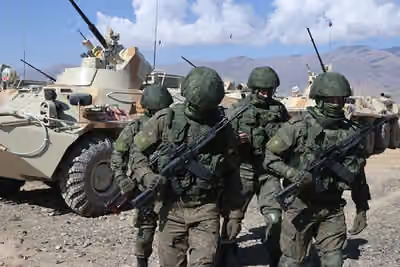
In a separate development on Sunday, Pakistan’s military reported that security forces killed nearly 60 militants attempting to cross the border from Afghanistan into Pakistan.
The International Committee of the Red Cross (ICRC) has warned that over four decades of armed conflict have left Afghanistan highly vulnerable to natural disasters and the impacts of climate change.
In a statement, the ICRC highlighted the severe economic consequences of this vulnerability, noting that the agricultural sector the main source of income for approximately 80 percent of Afghanistan’s population has been one of the hardest hit by extreme climate events, including droughts, unseasonal rainfall, and floods.
According to the Red Cross, more than 14 million Afghans are currently grappling with severe food insecurity.
Katharina Ritz, head of the ICRC’s delegation in Kabul, stated that farmers and communities dependent on agriculture are facing extremely harsh conditions, warning that challenges could further worsen the country’s already fragile food security situation.
In 2024, the Red Cross provided assistance to over 50,000 Afghan farmers by helping them purchase essential items such as seeds, fertilisers, and farming tools to boost their productivity.
The organisation also noted that decades of armed conflict have damaged many irrigation canals across Afghanistan, severely affecting farmers’ ability to preserve their crops. To tackle this issue, the ICRC has been rehabilitating water sources and improving access to secure irrigation for agricultural lands.

The World Health Organization (WHO) has announced that despite considerable progress, more than 100 children in Afghanistan and Pakistan were paralysed by the poliovirus over the past year.
The 13th meeting of the Regional Subcommittee for Polio Eradication and Outbreaks, hosted by the WHO, was held virtually on Sunday. During the session, conflict, humanitarian crises, insecurity, and climate change were identified as major obstacles to polio eradication efforts.
Mansoor bin Ebrahim bin Saad Al-Mahmoud, Qatar’s Minister of Health, stressed that polio remains one of the region’s foremost public health priorities and affirmed that any threat to the health and well-being of children must be eliminated.
In response to the decline in funding for the Global Polio Eradication Initiative and its impact on essential healthcare services, including childhood vaccinations, the WHO has introduced emergency measures to ensure the continuation of critical programme activities in endemic and polio-affected countries.
Health ministers and representatives from Iraq, Saudi Arabia, Palestine, Oman, Pakistan, Qatar, the United Arab Emirates, and Yemen participated in the meeting. Discussions focused on intensifying efforts across the region to reach unvaccinated children and protect them from polio and other preventable diseases.
The subcommittee also issued a statement calling for urgent action to halt the transmission of the wild poliovirus in Afghanistan and Pakistan. It urged member countries, donors, and the international community to sustain their support for these two remaining endemic countries to strengthen polio eradication efforts.

More than 70 percent of Afghan women face difficulties in accessing humanitarian aid, according to a new report by UN Women on the situation of women in Afghanistan.
The report, published on Sunday, 27 April, reviews the gendered dimensions of humanitarian aid in Afghanistan throughout 2024. It identifies the absence of female staff in humanitarian organisations and restrictions on women’s freedom of movement as the primary obstacles.
UN Women states that the Taliban’s stringent regulations including the requirement for a male guardian (mahram) during travel and the enforcement of strict compulsory hijab laws have severely restricted women’s participation in public life.
The report also highlights that the Taliban’s ban on women working for NGOs and UN agencies has drastically reduced women’s and girls’ access to essential services, such as healthcare, education, nutrition, and protection. It notes that the exclusion of women has also weakened community-based responses to humanitarian needs.
Furthermore, the report warns that the ongoing ban on girls’ education continues to perpetuate poverty across the country. According to the findings, only 43% of school-aged girls are currently enrolled in education, and participation among girls aged 13 to 17 is almost non-existent.
Economic pressures on families particularly female-headed households have increased significantly in 2024. The report notes that many families have been forced to adopt desperate coping strategies, such as skipping meals, withdrawing children from school, and resorting to child marriage.
The shortage of female healthcare workers, compounded by Taliban-imposed restrictions on women’s employment, has drastically curtailed women’s access to medical services, contributing to worsening maternal health conditions.
The report further indicates that Afghan women and girls are facing heightened risks of gender-based violence and early marriage, largely due to their exclusion from social decision-making processes.
While organisations led by women could play a pivotal role in supporting women’s rights, the report notes that many have collapsed due to severe funding shortages.
To address these challenges, UN Women recommends hiring more female staff within humanitarian organisations and providing financial support to women-led institutions.

Abdullah Abdullah, the former chairman of Afghanistan’s High Council for National Reconciliation, and Hamid Karzai, former president of Afghanistan, met once again in Kabul on Sunday.
The two veteran political figures refrained from disclosing details about the topics discussed during their meeting. However, the notable presence of Karzai’s daughter, Durkhani, at the gathering attracted considerable public attention.
Hamid Karzai has consistently voiced support for the reopening of girls’ schools and for greater participation of women in society and the economy. Durkhani’s appearance at the meeting prominently seated among a gathering of men and former leaders was seen by some observers as a symbolic gesture. Social media users noted that, amid the Taliban’s restrictions against girls, her presence represented a subtle form of protest.
Durkhani had similarly drawn public and media attention during a meeting with Abdullah in October last year, where she again took a central seat among senior figures.
Abdullah and Karzai are among the few former political leaders who remained in Kabul following the Taliban’s return to power. Although they continue to meet with various segments of society, the Taliban government has not formally recognised their political status, nor do they hold any role in governmental decision-making or advisory processes.
In recent years, Karzai has persistently advocated for the formation of an inclusive government and emphasised the critical importance of women’s education. Abdullah, in contrast, has largely avoided public commentary and continues his activities quietly, outside the spotlight.

Anand Prakash, India’s Special Envoy from the Ministry of External Affairs, met with Taliban Foreign Minister Amir Khan Muttaqi in Kabul ahead of Muttaqi’s planned trip to Qatar.
During the meeting, Muttaqi emphasised the importance of expanding diplomatic and economic relations between Afghanistan and India.
In a statement issued on Sunday, the Taliban’s Ministry of Foreign Affairs highlighted Muttaqi’s call for strengthened ties, noting that Afghanistan offers promising investment opportunities.
The Taliban Foreign Minister invited Indian investors to explore the new economic prospects in Afghanistan and encouraged greater Indian engagement.
Muttaqi also urged India to ease travel between the two countries by restoring regular visa issuance processes for Afghan traders, patients, and students.
According to the Taliban’s statement, Prakash affirmed that India remains committed to providing ongoing assistance to Afghanistan. He also discussed the potential resumption of several infrastructure projects that had been suspended in recent years, adding that “New Delhi is interested in investing in further projects as well.”
Prakash’s visit comes amid rising tensions between India and Pakistan following a recent attack in Kashmir. India has blamed Pakistan-based militant groups for the incident, leading to the suspension of a water-sharing agreement and the closure of the Attari-Wagah trade routes. In response, Pakistan has stated it is prepared to respond to any potential escalation.
