Protest by Farah Customs Workers Turns Violent
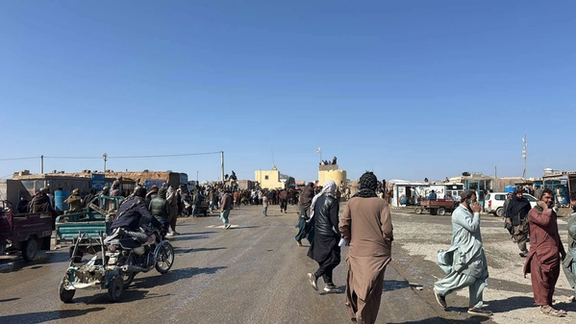
A protest by customs workers at the Mil 78 border crossing in Farah province turned violent after Taliban forces opened fire to disperse demonstrators, sources told Afghanistan International.

A protest by customs workers at the Mil 78 border crossing in Farah province turned violent after Taliban forces opened fire to disperse demonstrators, sources told Afghanistan International.
Local sources said two or three people were wounded in the incident. Taliban officials have not commented.
According to the sources, the workers are employed by the Farah Customs Directorate and are responsible for inspecting vehicles entering Afghanistan from Iran to prevent the smuggling of illegal goods. Their duties include unloading trucks for inspection when necessary and reloading cargo after checks are completed.
The protest began after some workers learned they had been dismissed, while others were informed that their daily wages would be significantly reduced.
In response, the workers closed the customs gate and, during the demonstration, broke the windows of the customs directorate building.


The United Nations Human Settlements Programme (UN-Habitat) has warned that Afghanistan’s cities are on the front lines of the climate crisis, citing steadily rising temperatures and the growing risks associated with rapid urbanisation.
In a post on X on Tuesday, the agency again highlighted the vulnerability of Afghan cities to climate change and stressed the need for urgent climate action in urban areas.
UN-Habitat estimates that by 2060, one in every two people in Afghanistan will be living in cities, while many urban areas remain unprepared for such rapid population growth, according to the United Nations.
The agency said priority should be given to creating safe and sustainable living environments in cities.
Earlier, the United Nations Assistance Mission in Afghanistan (UNAMA) warned that climate change has intensified heatwaves across South and Central Asia, particularly in Afghanistan.
Separately, a recent report by a climate research institute warned of unprecedented global temperature increases this year and their potentially severe consequences, noting that global warming continues to place billions of people at risk.

Pakistan’s special representative for Afghanistan, Sadiq Khan, discussed cross-border militancy and threats posed by armed groups based in Afghanistan during a meeting with Russia’s ambassador in Islamabad.
Khan said on Tuesday in a post on X that he met with Albert Khorev, Russia’s ambassador to Pakistan, and exchanged views on diplomatic efforts to address regional security concerns. Regional security developments were among the main topics discussed.
Amid rising insecurity and violence in Pakistan, Islamabad has accused the Afghan Taliban of harbouring militant groups, particularly Tehreek-e-Taliban Pakistan (TTP). The Taliban have repeatedly denied the allegation.
International organisations have published reports documenting the presence of armed groups in Afghanistan and warning about potential regional security threats linked to their activities.
Earlier, the Collective Security Treaty Organization (CSTO) warned that numerous international extremist and militant groups are operating in Afghanistan. The organisation’s leadership said their presence raises the risk of militancy spreading to neighbouring countries.

The Afghanistan Freedom Front (AFF) said its forces attacked a Taliban checkpoint in Bala Hesar Square in Kunduz on Monday evening, claiming two Taliban members were killed and two others wounded.
Local sources in Kunduz told Afghanistan International that an explosion was reported in Bala Hesar Square around the same time.
The Taliban have not commented on the reported attack.
On Sunday, 15 February, the AFF also claimed responsibility for another attack in Kunduz’s Police District 1, saying two Taliban members were killed and one wounded.
The group has published images it says are from both attacks on its account on X.

Kazakhstan’s Foreign Ministry on Monday hosted a meeting of special representatives from Central Asian countries on Afghanistan, emphasising regional stability and expanded cooperation with Taliban-run Afghanistan.
The meeting was held within the framework of a regional contact group on Afghanistan, according to Kazakhstan’s state news agency.
Yerkin Tokumov, the Kazakh president’s special representative for Afghanistan, expressed support for constructive dialogue and the search for practical avenues of cooperation with the Taliban administration.
Representatives from Kazakhstan, Kyrgyzstan, Tajikistan and Uzbekistan discussed expanding trade and economic cooperation, as well as developing transit and transport corridors through Afghan territory. Regional security issues were also reviewed.
Although no detailed information was released about specific decisions, participants stressed the importance of coordinating Central Asian countries’ efforts to support stability and sustainable development in Afghanistan.
They also called for greater regional coordination to promote long-term stability and economic development in the country.

Taliban authorities in Helmand province have warned that individuals who shave their beards will face what they describe as “sharia-based punishment.”
The new warning is part of the group’s enforcement of its Law on the Propagation of Virtue and Prevention of Vice.
The Taliban’s media office in Helmand said the provincial committee responsible for implementing the law held a meeting to discuss Clause 18 of Article 22, which addresses the “prohibition and reprehensibility of shaving the beard”.
Article 22 of the law states that the group’s morality police are responsible for preventing specified acts considered to be vices. Clause 18 refers to shaving the beard or trimming it shorter than the prescribed length.
According to the statement, the meeting concluded that violators would be identified and subjected to disciplinary punishment under the group’s interpretation of Islamic law.
The Taliban have previously issued warnings to barbers in several provinces, instructing them not to shave or trim customers’ beards.