Taliban in Helmand Sets Punishment For Shaving Beards

Taliban authorities in Helmand province have warned that individuals who shave their beards will face what they describe as “sharia-based punishment.”

Taliban authorities in Helmand province have warned that individuals who shave their beards will face what they describe as “sharia-based punishment.”
The new warning is part of the group’s enforcement of its Law on the Propagation of Virtue and Prevention of Vice.
The Taliban’s media office in Helmand said the provincial committee responsible for implementing the law held a meeting to discuss Clause 18 of Article 22, which addresses the “prohibition and reprehensibility of shaving the beard”.
Article 22 of the law states that the group’s morality police are responsible for preventing specified acts considered to be vices. Clause 18 refers to shaving the beard or trimming it shorter than the prescribed length.
According to the statement, the meeting concluded that violators would be identified and subjected to disciplinary punishment under the group’s interpretation of Islamic law.
The Taliban have previously issued warnings to barbers in several provinces, instructing them not to shave or trim customers’ beards.
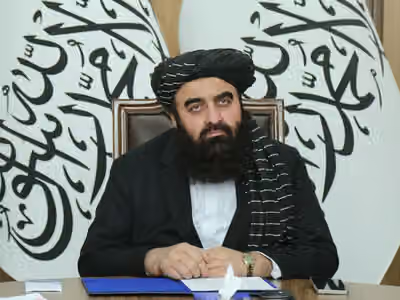
The Taliban have introduced a new uniform for the group's army, selecting an official dress code for forces operating under their Ministry of Defense.
Fasihuddin Fitrat, chief of the Taliban army, described the new uniform as a “symbol of order, unity and solidarity” and urged members of the force to comply with the regulations.
In a press release issued on Monday, the Taliban’s Ministry of Defense said three types of uniforms had been designed for commando, border and “National Islamic Army” forces. The group has added the term “Islamic” to the title of the national army.
Over the past four years, Taliban security forces have taken an inconsistent approach to uniforms. Many Ministry of Defense personnel have been seen wearing uniforms from the former Afghan National Army, while others have operated without official military dress, often wearing traditional clothing.
In recent days, several Taliban-affiliated social media activists have criticised the design and appearance of the new uniforms.
Some of the designs resemble the attire worn by Pakistan’s security forces, particularly in Khyber Pakhtunkhwa province, including shirt-and-trouser styles with long tunics.
During roughly three decades since the group’s emergence in the 1990s, the Taliban did not maintain a formal military uniform.
After returning to power in 2021, the group dissolved much of the former Afghan National Army but retained the administrative structure of the Ministry of Defense and several other ministries with limited changes.

Afghanistan Women’s Rights Watch, in cooperation with the Türkiye-based ARSA Association, says it documented 411 cases of rights violations against women and girls in Afghanistan in 2025, according to the group’s annual report.
As part of the research, the organisation recorded around 300 cases described as “direct violence against women” attributed to the Taliban.
The report, titled From Marginalisation to Erasure, was launched on Saturday, 14 February, in Kayseri, Türkiye, during an event attended by academics, civil society representatives, and Afghan and Turkish women’s rights activists.
The organisation said the findings were compiled from victims’ testimonies as well as multiple credible international documents.
According to the report, at least 76 cases of what it described as “intentional killings” of women and girls were recorded in 2025, though it did not provide details about the perpetrators. The highest number of killings, 16 cases, was reported in Nangarhar province.
The research also documented more than 30 cases of suicide and self-immolation among women and girls over the past year.
At least three cases of sexual violence in Taliban detention centres were recorded, two of them in Balkh province, the report said.
Zakera Hekmat, head of Afghanistan Women’s Rights Watch, said during the event that addressing systematic violence against Afghan women is not only a domestic issue but a global responsibility.
She criticised what she described as the silence and inaction of the international community in response to continuing violations of the fundamental rights of women and girls during four years of Taliban rule, warning that such inaction risks reinforcing policies that exclude women from Afghanistan’s social, educational and political life.
Bulut Reyhanoglu, a Turkish filmmaker and global solidarity ambassador advocating for Afghan women, said the systematic exclusion of Afghan women from public life has created a gender crisis extending beyond Afghanistan’s borders.
He called on the international community to take practical steps beyond diplomatic engagement to protect the fundamental rights of Afghan women, warning that continued silence risks normalising gender-based oppression and discrimination.

The Taliban have instructed teaching hospitals in Afghanistan to prevent male and female medical staff from working together in operating rooms, according to a document obtained by Afghanistan International.
Under the directive, all members of a surgical team must be either entirely male or entirely female, and mixed-gender teams are prohibited. The order states that a patient’s gender will not be considered when assigning surgical staff.
In the document, Ehsanullah Abolfaizan, the Taliban-appointed head of Kabul Medical University, wrote that “the patient’s gender will not be the criterion; rather, during surgery, all personnel must be of the same sex”.
The letter, issued on Tuesday, 10 February, applies to all teaching hospitals. Medical sources in Kabul confirmed the directive to Afghanistan International.
The new order has raised concerns about the ability of Afghanistan’s healthcare system to provide adequate and standard medical services under the single-gender requirement for surgical teams.
Health sector observers say the country lacks sufficient numbers of female medical specialists, which could make implementing the directive difficult.
One specialist doctor said a surgical team typically includes multiple essential personnel, including surgeons, nurses, anaesthesiologists, cleaners, interns and medical trainees.
Another doctor told Afghanistan International that, apart from obstetrics and gynaecology, the number of female specialists in Afghanistan is extremely limited. He said there are only “two or three female neurosurgeons” in the country and “no more than five or six female ear, nose and throat specialists”. He also reported shortages of female specialists in orthopaedics and plastic surgery.
In December 2024, Mullah Hibatullah Akhundzada, the Taliban’s leader, ordered the closure of higher and semi-higher medical education institutions to girls, raising serious concerns in a country already facing a shortage of female healthcare workers.
The Taliban have also kept schools for girls above grade six and universities closed since returning to power in 2021.

The Embassy of Kazakhstan in Uzbekistan says a meeting of the contact group of special representatives for Afghanistan will be held Monday, February 16, in Astana, Kazakhstan’s capital.
The meeting will focus on regional coordination to address Afghanistan’s humanitarian crisis and strengthen economic cooperation with the country.
Beibut Atamkulov, Kazakhstan’s ambassador to Uzbekistan, announced the meeting during talks with Ismatulla Irgashev, the Uzbek president’s special representative for Afghanistan.
According to a statement from the Kazakh Embassy, the two sides discussed prospects for cooperation with Afghanistan in trade, economic and humanitarian sectors, as well as the implementation of investment projects.
Atamkulov expressed appreciation for Uzbekistan’s efforts to support peace and long-term stability in Afghanistan and for its continued humanitarian assistance to the Afghan people. He also stressed the importance of maintaining humanitarian support and gradually integrating Afghanistan into regional trade and economic networks.
Irgashev, for his part, outlined Uzbekistan’s measures to provide humanitarian aid and economic support to Afghanistan. Regional security and stability were also discussed, with both sides expressing readiness to further expand Kazakhstan-Uzbekistan cooperation on Afghanistan-related issues.
Since the Taliban’s return to power, Central Asian countries particularly Uzbekistan and Kazakhstan have adopted a pragmatic, risk-management approach toward Afghanistan. Although neither country has formally recognised the Taliban administration, their official and informal engagement with Kabul has increased significantly.
The contact group, made up of representatives from regional countries, was created to provide a mechanism for implementing decisions related to Afghanistan and strengthening cooperation to address the country’s humanitarian, political and economic challenges.
The first meeting of the Organisation of Islamic Cooperation’s contact group of foreign ministers on Afghanistan was held in New York in late September 2025.

Murtaza Solangi, spokesperson for Pakistan’s president, again criticised the Taliban after reports that the body of a former Afghan serviceman was exhumed from his grave in Uruzgan province.
Solangi reposted a report on X alleging that Taliban members in Uruzgan had dug up the body of a former soldier, beheaded it and desecrated the grave.
“This [is] why I call them brainless beasts,” he wrote.
The Taliban police command in Uruzgan confirmed that on Saturday night the body of Sediqullah, a former member of the previous Afghan government’s security forces, was exhumed from the Martyrs’ Cemetery in Tarinkot.
The former serviceman’s family told Afghanistan International that Taliban forces destroyed his grave in the centre of Uruzgan province on Saturday night and removed his body from the burial site.
Images and videos obtained by Afghanistan International show the grave completely destroyed, with the burial chamber exposed. The footage indicates that the body was removed from the grave.
Solangi previously used similar language to describe the Taliban in response to an Afghanistan International report documenting the killing of 6,660 Afghans over nearly four years under Taliban rule.
