• العربية
  • پښتو
  • فارسی
Brand
  • Afghanistan
  • Sport
  • Markets
  • Afghanistan
  • Sport
  • Markets
  • Theme
  • Language
    • العربية
    • پښتو
    • فارسی
  • Afghanistan
  • Sport
  • Markets
All rights reserved for Volant Media UK Limited
volant media logo

Taliban, Qatari Foreign Ministers Meet To Discuss Diplomatic, Trade Ties

Apr 28, 2025, 16:53 GMT+1

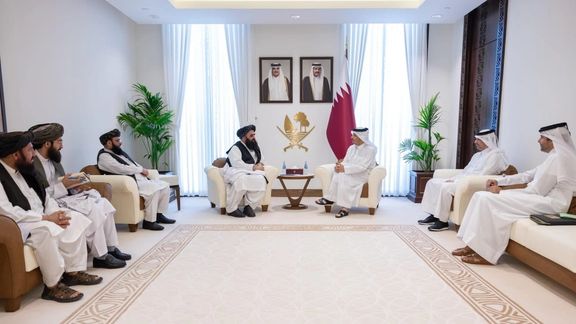
Hafiz Zia Ahmad, spokesperson for the Taliban’s Ministry of Foreign Affairs, announced on Monday that Amir Khan Muttaqi, the group’s foreign minister, met with Sheikh Mohammed bin Abdulrahman Al Thani, Qatar’s foreign minister.

According to Ahmad, the two sides discussed Afghanistan-Qatar bilateral relations, the enhancement of diplomatic and trade ties, and key regional issues during their meeting.

Meanwhile, Qatar’s Ministry of Foreign Affairs, in a statement regarding the talks, said that Al Thani reaffirmed Qatar’s steadfast support for the Afghan people and its ongoing efforts to help achieve security, stability, and a dignified life in Afghanistan.

The Qatari statement noted that discussions focused on developments in Afghanistan and ways to support the Afghan people, but it did not explicitly mention efforts to strengthen diplomatic or commercial ties.

Nevertheless, Ahmad quoted Al Thani as describing Qatar’s relationship with the Taliban as “close and brotherly,” and expressing satisfaction with the group’s expanding relations with regional countries.

The Qatari foreign minister also highlighted the importance of boosting trade relations between the two countries and advocated for consistent and sustained communication between their private sectors.

During the meeting, Muttaqi thanked Qatar for its “official” invitation, describing the country’s role in the Taliban’s “foreign policy” as significant. He praised Qatar’s efforts in facilitating the Taliban’s engagement with the international community.

Muttaqi further emphasised the need to upgrade diplomatic relations and strengthen bilateral ties, proposing that Qatar invest in Afghanistan’s development and commercial opportunities.

Qatar, a key supporter of the Taliban, previously hosted the group’s political office in Doha, which paved the way for the 18-month negotiations between the Taliban and the United States, prior to the collapse of Afghanistan’s former government.

Most Viewed

Taliban Order Cut To Residential Fibre-Optic Internet In Kabul, Say Sources
1

Taliban Order Cut To Residential Fibre-Optic Internet In Kabul, Say Sources

2

Taliban Leader Adviser Arrested In Kandahar Over Alleged Bribery

3

Taliban Besieged TOLOnews Offices After Journalist Detentions, Say Sources

4

Taliban Urges Turkmenistan To Implement 24-Hour Operations At Torghundi Port

5

Exiled Media Watchdog Urges UN, EU To Seek Release Of Journalists Held By Taliban

•
•
•

More Stories

Afghanistan International Reporter Ramin Mazhar Named Journalist Of The Year

Apr 28, 2025, 15:35 GMT+1

Ramin Mazhar, a journalist with Afghanistan International, has been named Afghanistan’s Journalist of the Year at a ceremony held on Monday in Brussels. The award recognises his investigative reporting on sexual assault and abuse within Taliban detention centres.

The Afghanistan Journalists Center announced the five recipients of this year’s award, including four journalists currently working inside Afghanistan: Nasrin Saeedi, Azizullah Wahdat, Mohammad Yousuf Mangal, and Ehsanullah Karimi.

Mazhar’s report was selected by the award jury as one of the top five journalistic works of 2025. His investigation, based on interviews with several men and women formerly detained by the Taliban, exposes the use of sexual violence and abuse as a tool to extract confessions. The report further revealed that detention facilities were reportedly fitted with CCTV cameras, and that Taliban members allegedly recorded instances of assault and abuse on their mobile phones.

Richard Bennett, the United Nations Special Rapporteur on the situation of human rights in Afghanistan, responded to the report, stating he was aware of the allegations and that investigations were underway.

Mazhar, who is also an acclaimed poet, graduated with a degree in Persian language and literature from Kabul University. He has been part of Afghanistan International since its establishment in 2021 and currently works with the network’s investigative reporting unit.

The Afghanistan Journalists Center organises this programme annually, with this year marking the twelfth edition of the awards.

Blast at Peace Meeting in South Waziristan Kills 7, Say Pak Police

Apr 28, 2025, 14:42 GMT+1

At least seven people were killed on Monday following an explosion during a meeting of the local peace committee in South Waziristan, Pakistani police have confirmed.

Usman Wazir, a police officer, stated that the blast caused part of the building hosting the meeting to collapse. The identity of the attackers remains unknown, and no group has yet claimed responsibility for the assault.

Further details regarding the incident have not yet been released. South Waziristan is known as a stronghold of the Pakistani Taliban.

In a separate development on Sunday, Pakistan’s military reported that security forces killed nearly 60 militants attempting to cross the border from Afghanistan into Pakistan.

Over 14 Million Afghans Facing Food Insecurity, Warns ICRC

Apr 28, 2025, 13:25 GMT+1

The International Committee of the Red Cross (ICRC) has warned that over four decades of armed conflict have left Afghanistan highly vulnerable to natural disasters and the impacts of climate change.

In a statement, the ICRC highlighted the severe economic consequences of this vulnerability, noting that the agricultural sector the main source of income for approximately 80 percent of Afghanistan’s population has been one of the hardest hit by extreme climate events, including droughts, unseasonal rainfall, and floods.

According to the Red Cross, more than 14 million Afghans are currently grappling with severe food insecurity.

Katharina Ritz, head of the ICRC’s delegation in Kabul, stated that farmers and communities dependent on agriculture are facing extremely harsh conditions, warning that challenges could further worsen the country’s already fragile food security situation.

In 2024, the Red Cross provided assistance to over 50,000 Afghan farmers by helping them purchase essential items such as seeds, fertilisers, and farming tools to boost their productivity.

The organisation also noted that decades of armed conflict have damaged many irrigation canals across Afghanistan, severely affecting farmers’ ability to preserve their crops. To tackle this issue, the ICRC has been rehabilitating water sources and improving access to secure irrigation for agricultural lands.

Polio Paralysed More Than 100 Children in Afghanistan, Pakistan Last Year

Apr 28, 2025, 11:58 GMT+1

The World Health Organization (WHO) has announced that despite considerable progress, more than 100 children in Afghanistan and Pakistan were paralysed by the poliovirus over the past year.

The 13th meeting of the Regional Subcommittee for Polio Eradication and Outbreaks, hosted by the WHO, was held virtually on Sunday. During the session, conflict, humanitarian crises, insecurity, and climate change were identified as major obstacles to polio eradication efforts.

Mansoor bin Ebrahim bin Saad Al-Mahmoud, Qatar’s Minister of Health, stressed that polio remains one of the region’s foremost public health priorities and affirmed that any threat to the health and well-being of children must be eliminated.

In response to the decline in funding for the Global Polio Eradication Initiative and its impact on essential healthcare services, including childhood vaccinations, the WHO has introduced emergency measures to ensure the continuation of critical programme activities in endemic and polio-affected countries.

Health ministers and representatives from Iraq, Saudi Arabia, Palestine, Oman, Pakistan, Qatar, the United Arab Emirates, and Yemen participated in the meeting. Discussions focused on intensifying efforts across the region to reach unvaccinated children and protect them from polio and other preventable diseases.

The subcommittee also issued a statement calling for urgent action to halt the transmission of the wild poliovirus in Afghanistan and Pakistan. It urged member countries, donors, and the international community to sustain their support for these two remaining endemic countries to strengthen polio eradication efforts.

Over 70 Percent Of Afghan Women Face Barriers To Humanitarian Aid, Says UN

Apr 28, 2025, 10:45 GMT+1

More than 70 percent of Afghan women face difficulties in accessing humanitarian aid, according to a new report by UN Women on the situation of women in Afghanistan.

The report, published on Sunday, 27 April, reviews the gendered dimensions of humanitarian aid in Afghanistan throughout 2024. It identifies the absence of female staff in humanitarian organisations and restrictions on women’s freedom of movement as the primary obstacles.

UN Women states that the Taliban’s stringent regulations including the requirement for a male guardian (mahram) during travel and the enforcement of strict compulsory hijab laws have severely restricted women’s participation in public life.

The report also highlights that the Taliban’s ban on women working for NGOs and UN agencies has drastically reduced women’s and girls’ access to essential services, such as healthcare, education, nutrition, and protection. It notes that the exclusion of women has also weakened community-based responses to humanitarian needs.

Furthermore, the report warns that the ongoing ban on girls’ education continues to perpetuate poverty across the country. According to the findings, only 43% of school-aged girls are currently enrolled in education, and participation among girls aged 13 to 17 is almost non-existent.

Economic pressures on families particularly female-headed households have increased significantly in 2024. The report notes that many families have been forced to adopt desperate coping strategies, such as skipping meals, withdrawing children from school, and resorting to child marriage.

The shortage of female healthcare workers, compounded by Taliban-imposed restrictions on women’s employment, has drastically curtailed women’s access to medical services, contributing to worsening maternal health conditions.

The report further indicates that Afghan women and girls are facing heightened risks of gender-based violence and early marriage, largely due to their exclusion from social decision-making processes.

While organisations led by women could play a pivotal role in supporting women’s rights, the report notes that many have collapsed due to severe funding shortages.

To address these challenges, UN Women recommends hiring more female staff within humanitarian organisations and providing financial support to women-led institutions.