• العربية
  • پښتو
  • فارسی
Brand
  • Afghanistan
  • Sport
  • Markets
  • Afghanistan
  • Sport
  • Markets
  • Theme
  • Language
    • العربية
    • پښتو
    • فارسی
  • Afghanistan
  • Sport
  • Markets
All rights reserved for Volant Media UK Limited
volant media logo

Iran Expresses Concern Over Surge In Methamphetamine Production In Afghanistan

May 12, 2025, 13:17 GMT+1

Hussein Zolfaghari, the Iranian President's representative and Secretary-General of the Anti-Drug Headquarters, has voiced concern over the increasing flow of precursor chemicals for drug production from the West into Afghanistan.

He also highlighted the rising production of methamphetamine in the country, revealing that around 40 tonnes of various types of this drug were seized in Iran last year.

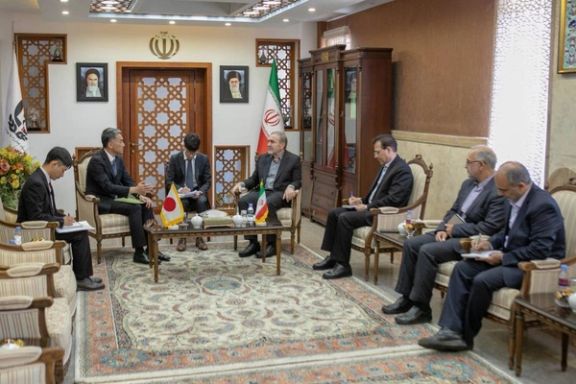
Zolfaghari made these remarks during a meeting on Monday, 22 April, with Tamaki Tsukada, Japan’s ambassador to Iran, where they discussed strategies to combat drug trafficking.

During the meeting, Zolfaghari stressed that the fight against drugs transcends borders, but he noted that many countries have yet to show sufficient commitment to the cause. "All countries must work together to address this issue," he stated.

He expressed concern over the entry of precursor chemicals from the West into Afghanistan and the rising production of methamphetamine there, describing the situation as "extremely complex." Zolfaghari added, "The more we can sever the connections between the producers of psychoactive substances and the countries involved in producing methamphetamine and other drugs, the more successful we will be."

The Iranian official also raised concerns about Western countries’ approach to dealing with drug traffickers in Iran, noting that strong measures against drug smugglers are often seen as human rights violations.

Zolfaghari emphasised that other nations should recognise Iran’s ongoing efforts in tackling the global drug trade.

Previously, Iranian officials had warned that the production of synthetic drugs, such as methamphetamine and "crystal meth," in Afghanistan has been steadily increasing.

French officials have also raised alarms, warning that Afghanistan is becoming a major centre for methamphetamine production, rivaling Southeast Asia and Central Europe. They also expressed concerns over the growing smuggling of methamphetamine produced in both Afghanistan and Türkiye.

Most Viewed

Taliban Order Cut To Residential Fibre-Optic Internet In Kabul, Say Sources
1

Taliban Order Cut To Residential Fibre-Optic Internet In Kabul, Say Sources

2

Taliban Leader Adviser Arrested In Kandahar Over Alleged Bribery

3

Taliban Besieged TOLOnews Offices After Journalist Detentions, Say Sources

4

Exiled Media Watchdog Urges UN, EU To Seek Release Of Journalists Held By Taliban

5

Taliban Urges Turkmenistan To Implement 24-Hour Operations At Torghundi Port

•
•
•

More Stories

Afghan Opposition Group Says UN Plan Sidelines Key Stakeholders, Aids Taliban

May 12, 2025, 11:34 GMT+1

The Afghanistan Freedom Front (AFF) has criticised the United Nations Assistance Mission in Afghanistan (UNAMA) for its latest proposal on the country’s political future, calling it “short-sighted” and a move that risks further marginalising key Afghan stakeholders.

In a statement issued on Sunday, the AFF claimed that the UN’s new framework appears aimed at “whitewashing the Taliban” and would hinder prospects for lasting peace by excluding significant political groups from the process. The group warned that the plan could deepen divisions and repeat the failures of past peace efforts, including the 2001 Bonn Conference.

The UN framework reportedly centres on three main pillars: the formation of an inclusive government, efforts to combat terrorist networks, and the promotion of human rights including the reopening of schools and universities, and the creation of safe working environments for women.

The AFF took particular issue with the narrowing of political engagement to the Doha Process, the “illegitimate Taliban emirate,” and selected representatives of civil society. It argued that such a limited approach undermines the potential for achieving a broad-based and legitimate resolution to Afghanistan’s crisis.

To date, the UN has not held formal talks with Afghan opposition groups such as the AFF or the National Resistance Front (NRF), choosing instead to engage solely with the Taliban. This has drawn criticism from groups who say the UN is sidelining meaningful opposition voices.

The Taliban, for its part, has refused to attend previous UN-hosted summits due to the inclusion of civil society and political opposition groups, insisting that it alone represents Afghanistan in international forums.

The AFF also condemned the Taliban’s stance on elections, its alleged human rights violations, and its reported ties to international terrorist groups. It argued that current peace initiatives especially those based on the Doha framework fail to reflect Afghanistan’s complex political and social realities.

The group warned that any effort to engage with the Taliban while excluding other stakeholders will be ineffective and unsustainable. It called for any normalisation of relations with the Taliban to be made conditional on a series of benchmarks: respect for human rights, the immediate reversal of bans on women’s education and employment, the formation of an inclusive government, and the development of a transitional roadmap leading to a legitimate, elected administration with fair ethnic representation.

The AFF also urged the appointment of a United Nations Special Coordinator for Afghanistan, as mandated by UN Security Council Resolution 2127.

The Taliban has rejected this proposal, claiming that the current UN mission in Afghanistan is adequate and that no additional envoy is necessary.
Built 23000 Religious Seminaries, 269 Schools in 3 Years, Says Taliban

May 12, 2025, 10:27 GMT+1

The Taliban’s Ministry of Education has announced that it has established 269 schools and nearly 23000 Islamic education centres (madrasas) across Afghanistan over the past three years.

According to the ministry, more than 300000 students have enrolled in these institutions during this period. State-run television, now under Taliban control, reported that 22972 religious seminaries have been established since 2021, with over 216000 male and approximately 91000 female students currently studying at these centres.

The ministry also stated that, under orders from Taliban supreme leader Mullah Hibatullah Akhundzada, 420 dormitories were established during the fiscal year 2024–2025 across various provinces. These facilities are reportedly housing more than 21,000 madrasa students.

Based on official data, a total of 1999734 boys and 1489449 girls have been registered in these educational institutions over the past three years.

However, the rapid expansion of Islamic education has raised concerns among analysts and education experts, who warn that such growth may contribute to the spread of the Taliban’s ideological agenda and fuel radicalisation.

This development comes against the backdrop of the Taliban’s continued ban on girls attending secondary schools and universities, a policy in place since their return to power in 2021, which has left thousands of girls without access to formal education.

Taliban Monitoring Social Media, Warns Of Legal Action For ‘Improper’ Use

May 12, 2025, 09:30 GMT+1

The Taliban’s Ministry for the Propagation of Virtue and Prevention of Vice has issued a warning that “improper” use of social media will result in legal consequences, stating that user activity is under active surveillance.

In a statement broadcast on Monday, via state-run Radio Television Afghanistan (RTA), which is now under Taliban control, ministry spokesperson Saif-ul-Islam Khyber declared that no individual or institution is permitted to use social media platforms in ways the group deems inappropriate.

“Social media should be used to disseminate verified news, promote religious and contemporary sciences, foster unity among the Muslim community, and encourage mutual respect,” the statement read. “It must not be a platform for promoting prejudice, disrespect, moral deviation, or intellectual distortion.”

The ministry further noted that it is actively monitoring online content and pursuing legal action against pages, accounts, and networks it accuses of undermining religious beliefs, public morality, and societal values.

The announcement comes amid continued activity by Afghan users posting content the Taliban considers religiously unacceptable or “illegitimate” under its strict interpretation of Islamic principles.

Working To Secure Release Of Former Afghan Lawmaker Held In Kenya, Says Taliban

May 11, 2025, 18:45 GMT+1

Radio Hurriyat, a Taliban-affiliated media outlet, has reported that the group’s Foreign Minister, Amir Khan Muttaqi, has assured the family of former Afghan parliamentarian Zahir Qadir that efforts are under way to address his detention in Kenya.

Citing a reliable source within the Taliban’s Foreign Ministry, the report stated that Muttaqi has tasked the group’s diplomatic missions with engaging the Kenyan government to ensure Qadir’s rights and legal protections are upheld.

Zahir Qadir was arrested on 18 April in Nairobi, Kenya, on charges of “attempted drug trafficking” and “illegal transport of weapons,” reportedly at the request of the United States. A Nairobi court has ordered that he remain in custody while extradition proceedings to the US are prepared.

On 8 May, Qadir’s family announced that his scheduled extradition hearing had been postponed, with a new court date yet to be confirmed.

Meanwhile, Zaker Jalali, an official at the Taliban’s Foreign Ministry, posted on X (formerly Twitter) that Muttaqi had met with members of Qadir’s family and directed the Taliban’s diplomatic mission in Doha to pursue the matter through the Kenyan Embassy.

Jalali added that the Taliban “defend the rights of every Afghan without discrimination.”

Haqqani Meets With Chinese, Pakistani Envoys To Boost Trilateral Cooperation

May 11, 2025, 15:53 GMT+1

Sirajuddin Haqqani, the Taliban’s Minister of Interior, has met with the special envoys of Pakistan and China to discuss the expansion of trilateral political and economic cooperation.

The meeting marks the first time Haqqani has hosted a high-level foreign delegation at the Ministry of Interior following a prolonged public absence.

On Sunday, 11 May, Abdul Mateen Qani, spokesperson for the Taliban’s Interior Ministry, announced that Haqqani held talks with Yue Xiaoyong, China’s Special Envoy for Afghanistan, and Mohammad Sadiq, Pakistan’s Special Envoy, along with their respective delegations.

The discussions reportedly focused on strengthening regional ties through engagement and mutual respect. Haqqani emphasised the Taliban’s view that political and economic cooperation, as well as broader regional understanding, could be fostered through constructive dialogue.

According to Qani, both delegations pledged to convene the sixth trilateral foreign ministers’ meeting in Kabul, as part of the ongoing diplomatic engagement between the Taliban, China, and Pakistan.

The meeting follows a report by the Express Tribune, a Pakistani media outlet, which cited informed sources as saying that during earlier talks with the Taliban’s Foreign Minister, Amir Khan Muttaqi, the parties agreed to limit India’s role in Afghanistan strictly to diplomatic representation.