More Than 800 Afghan Migrant Families Return From Pakistan, Iran, Say Taliban
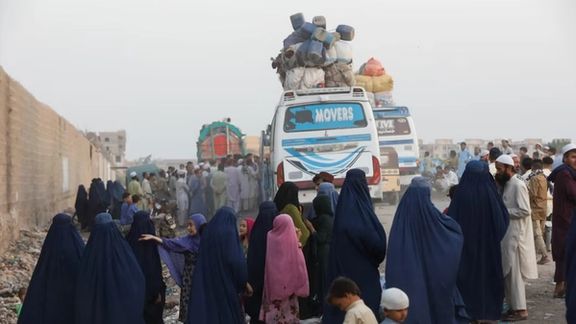
The Taliban-controlled Bakhtar News Agency reported on Tuesday that a total of 808 Afghan families have returned from Iran and Pakistan within the past 24 hours.
The Taliban-controlled Bakhtar News Agency reported on Tuesday that a total of 808 Afghan families have returned from Iran and Pakistan within the past 24 hours.
According to the report, the families entered Afghanistan from Pakistan via the Torkham, Spin Boldak, Angoor Ada, and Bahramcha border crossings.
An additional 447 families reportedly returned from Iran through the Islam Qala border crossing.
In recent months, both Iran and Pakistan have intensified efforts to arrest and deport Afghan migrants, prompting a surge in returns.

The Taliban has prohibited the video recording of Friday sermons in the northern province of Balkh, following a public outcry against the group and a fiery sermon by a prominent cleric condemning ethnic discrimination within the regime.
According to sources, the Taliban’s Directorate for the Propagation of Virtue and Prevention of Vice summoned mosque preachers and clerics around 3 PM on Monday to issue a new directive. The clerics were warned that the recording of sermons was strictly forbidden, under threat of consequences.
This move came after a video emerged of Maulawi Abdul Qahir, the preacher at Rawza Sharif Mosque in Balkh, openly criticising the Taliban’s tribalism and discriminatory practices. In his sermon, Qahir warned that such policies could lead to the collapse of the Taliban regime.
His remarks triggered widespread reaction and protests. Supporters of the cleric reportedly chanted “Death to the Taliban” inside the mosque, prompting a swift and forceful response from Taliban authorities.
Eyewitnesses reported that Ubaidullah, the head of the Directorate for the Propagation of Virtue in Balkh, entered the mosque during the final moments of the sermon accompanied by armed special forces and three military vehicles. They confiscated all video equipment and detained several attendees amid heightened tensions.
The Taliban reportedly intended to arrest Maulawi Abdul Qahir on the spot, but were met with resistance from worshippers. Sources say that while he avoided arrest during the incident, several of his supporters were taken into custody.
Maulawi Abdul Qahir has a history of outspoken criticism against the Taliban. During the group’s Loya Jirga (grand assembly), he condemned their governance style, stating: “You can capture geography with suicide bombers and car bombs, but not the hearts of the people.”
Since reclaiming power in 2021, the Taliban has presented its rule as inclusive and widely supported. However, political and civil institutions remain largely inactive or suppressed, and senior government roles have been monopolised by Taliban members. Clerics and commanders with little to no administrative experience have been appointed to technical and bureaucratic posts.
Independent religious voices like Qahir’s continue to face increasing pressure, with many clerics being arrested, silenced, or forced into exile for their dissent.
The fourth European Union Humanitarian Forum commenced on Monday in Brussels, with a sharp focus on the escalating humanitarian crisis in Afghanistan and its broader regional implications.
A central topic of the forum is the forced return of Afghan migrants from neighbouring Pakistan and Iran.
The European Union stated that the forum aims to provide a comprehensive overview of the regional repercussions of the crisis in Afghanistan, while underscoring the urgent need to address the fundamental needs of the Afghan people.
Mihyung Park, Chief of Mission for the International Organization for Migration (IOM) in Afghanistan, highlighted during the forum that the country is currently grappling with a second wave of mass returns from Iran and Pakistan.
Park reported that Iran is deporting between 2000 to 5000 Afghan migrants daily. In 2023, approximately 1.2 million Afghans returned from Iran, a figure that has since increased to 1.5 million. She noted that roughly 80 percent of those returns are forced deportations.
In regard to Pakistan, Park said deported Afghan migrants are often denied the opportunity to sell or transfer their possessions before expulsion. Many of their belongings are confiscated at the border.
She stressed that returnees whether from Iran or Pakistan arrive in Afghanistan with extremely limited financial resources, no housing, and frequently without official documentation, exacerbating their vulnerability upon return.
Maulawi Abdul Qahir, a prominent cleric in Balkh, delivered a fiery sermon on Friday, 16 May, at the Rawza Sharif Mosque, where he condemned the Taliban for promoting tribalism and ethnic discrimination.
He warned that such practices would lead to the downfall of any Islamic system.
According to local sources, Taliban forces attempted to arrest Maulawi Qahir following the sermon but were met with resistance from worshippers, who chanted "Death to the Taliban" inside the mosque.
Eyewitnesses told Afghanistan International that during the closing moments of the sermon, Maulawi Obaidullah, head of the Taliban’s Directorate for the Propagation of Virtue in Balkh, entered the mosque courtyard accompanied by armed special unit forces and three military vehicles. Tensions escalated as Taliban members confiscated recording devices and detained several attendees amid strong opposition from the congregation.
Maulawi Qahir’s outspoken criticism of Taliban policies is not new. During the Taliban’s Loya Jirga, he openly condemned the group, stating: "Territory can be seized with suicide bombers and car bombs, but not people’s hearts."
His case echoes that of other independent religious scholars who have voiced dissent during nearly four years of Taliban rule. Many such clerics have faced detention, harassment, or have been forced to flee the country.
Among them is Abdul Salam Abed, a well-known cleric who urged Taliban members to disobey their leadership. After denouncing Taliban leaders following a bombing in Kabul, Abed was injured and later sought refuge in Türkiye.
In his final sermon at the Abdul Rahman Grand Mosque, Abed condemned the silence of clerics in the face of Taliban repression: "They fired people from their jobs and we stayed silent. They issued bizarre decrees and we remained silent. We didn’t criticise, hoping they’d improve."
Abed stressed that he could no longer remain quiet while the nation suffered, concluding: "Under the previous regime, everyone was included except the Taliban, and the government still fell. Now it’s only the Taliban, and no one else.”
Sources confirmed to Afghanistan International that Salahuddin Rabbani, Afghanistan’s former Foreign Minister and leader of a faction of the Jamiat-e Islami party, arrived in Tehran on Monday, 19 May.
Rabbani is scheduled to meet with officials from Iran’s Islamic Revolutionary Guard Corps (IRGC) during his visit, sources said.
His visit follows that of Ahmad Massoud, leader of Afghanistan’s National Resistance Front, who was recently hosted by Iranian officials, including representatives of the IRGC and the Iranian Foreign Ministry.
Significantly, Rabbani's arrival coincides with a visit to Tehran by Amir Khan Muttaqi, the Taliban’s acting Foreign Minister, who held discussions with the Iranian President and Foreign Minister on Sunday.
Earlier, sources had reported that Iran had extended invitations to a number of Afghan political figures, including Atta Mohammad Noor, leader of another faction of Jamiat-e Islami, who is also currently visiting Iran.
The Taliban-controlled Ministry of Finance announced on Monday, 19 May, that the World Bank office in Kabul has reopened and started repaying its outstanding debts owed to Afghan logistics and construction companies.
According to the ministry’s official statement, the World Bank owes approximately USD 50 million to several Afghan firms. The bank has begun making direct payments today, starting with USD 10.8 million. The remaining balance of USD 39.11 million is scheduled to be paid in three subsequent instalments, coordinated through the Taliban Ministry of Finance.
The ministry described the repayments as a significant financial development, expressing optimism that this step would pave the way for resuming World Bank-funded development projects in Afghanistan.
These developments follow a period of severe financial hardship for many Afghan contractors, stemming from the withdrawal of foreign military forces and international organisations from the country.
Critics, however, have highlighted that while foreign entities, including the World Bank, are beginning to address their outstanding debts, the Taliban government itself has yet to settle debts owed to local companies for projects completed under the previous Afghan administration. Those obligations remain unpaid to date.