Taliban Flogs Four In Public Punishment In Kapisa, Zabul

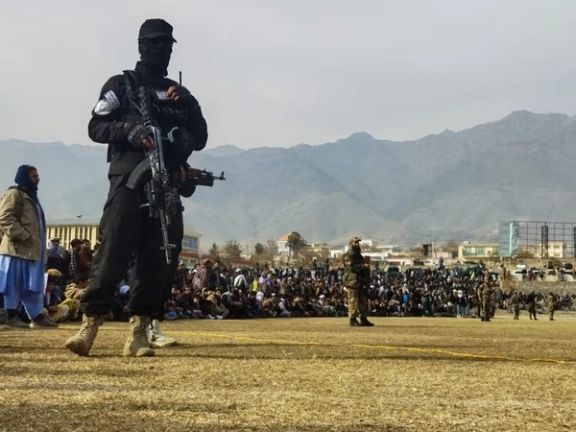
The Taliban Supreme Court said the group publicly flogged four people in the provinces of Kapisa and Zabul in front of local residents.

The Taliban Supreme Court said the group publicly flogged four people in the provinces of Kapisa and Zabul in front of local residents.
The Taliban said the individuals were accused of theft, received between 20 and 35 lashes, and were each sentenced to two years in prison.
The Taliban Supreme Court announced the punishments in separate statements issued on Sunday and Monday.
The Taliban has flogged about 90 people in various provinces across Afghanistan in the past week alone.
Over the past four years, the Taliban have reported the public corporal punishment of citizens almost daily. The group says issuing corporal punishment sentences against defendants constitutes the implementation of Islamic sharia.
The United Nations and other human rights organisations have repeatedly called on the Taliban to stop corporal punishment of citizens, but the group has continued the practice.
International and human rights organisations consider public corporal punishment to be a violation of human dignity. Human rights groups also say the Taliban’s judicial system does not meet recognised legal standards and that defendants are deprived of basic fair-trial rights, including access to legal counsel.

The Taliban’s Ministry of Finance says a complete ban on the import of medicines from Pakistan has taken effect, urging traders to seek alternative supply routes.
Abdul Qayum Nasir, spokesperson for the ministry, told Radio Omid, a Taliban-aligned outlet, that the decision came into force on Monday. He said the authorities would also halt the movement of goods through smuggling routes and warned that those involved in smuggling would be prosecuted, with confiscated goods destroyed.
The ministry had earlier informed traders that they had 19 days to end commercial transactions and trade documentation linked to Pakistan.
The decision follows months of political tensions, border clashes between Pakistani forces and the Taliban, and the closure of key transit routes. Border crossings between Afghanistan and Pakistan have remained largely closed since September.
Abdul Ghani Baradar, the Taliban’s deputy prime minister for economic affairs, previously urged traders to suspend business with Pakistan and identify alternative trade corridors.
The suspension of imports has already affected Afghanistan’s pharmaceutical market. Traders and residents report shortages of several medicines in Kabul, accompanied by rising prices. More than 70 precent of Afghanistan’s medicines were previously imported from Pakistan.
Pharmacists say essential medicines, particularly cardiac drugs that were largely supplied by Pakistan, have become harder to obtain. A resident of Herat said in a video sent to Afghanistan International that medicine prices in Afghanistan had reached “the value of a human life.”
Taliban officials travelled to India, Iran and Turkiye last month in search of alternative sources of pharmaceutical imports to address shortages in the domestic market.

The release of a video showing the forced confession of a girl detained by the Taliban while dressed as a boy has drawn widespread attention on social media.
In the video, the girl says she was compelled to work in order to protect and support her sisters.
She says she worked for three years in a café, initially earning 7,000 afghanis per month and later 10,000 afghanis, before being detained by the Taliban.
The video of the confession, recorded while the girl was in Taliban custody, has circulated widely online. In the footage, the girl says she dressed as a boy out of necessity so she could work and provide for her family.
The exact time and location of the recording remain unclear. Spokespersons for the Taliban’s Interior Ministry and the Ministry for the Propagation of Virtue and Prevention of Vice did not respond to Afghanistan International’s questions about the reason for her detention or her current situation.
In the video, a man’s voice can be heard questioning the girl about her identity, place of residence and family background.
“Are you a boy or a girl?” the man asks.
The detainee confirms she is female and says she wore boys’ clothing out of necessity because she is responsible for supporting her family.
The man conducting the interrogation asks about her workplace, how long she had worked there, her employer and her salary. She replies that she has worked in a café for three years, earning 7,000 afghanis in the first years and 10,000 afghanis for the past eight months to a year.
After the Taliban entered Kabul in August 2021, women’s right to work came under widespread threat. Female government employees, with the exception of those in the health sector and parts of education, were sent home.
The Taliban also restricted women’s employment in private institutions and international organisations and closed hundreds of women’s beauty salons, decisions that have jeopardised the livelihoods of hundreds of thousands of Afghan families.
The Taliban’s Ministry for the Propagation of Virtue and Prevention of Vice has also carried out a broad campaign of detaining young women from streets and markets in various cities.
Girls Disguised As Boys: Resistance To Exclusion
The phenomenon of girls dressing as boys was also common during the Taliban’s first period of rule in Afghanistan. Some girls changed their appearance to avoid restrictions so they could attend school, work and participate in society.
Afghan filmmaker Siddiq Barmak later portrayed this reality in the film Osama, which tells the story of a girl forced to disguise herself as a boy during the Taliban’s first government.
The film, released in 2003, depicts the life of a girl compelled to adopt a male identity in order to survive socially under Taliban rule.
Barmak described the film as “a real tragedy from a time when no one had the right to decide for themselves.”
In 2004, Osama won the Golden Globe Award for Best Foreign Language Film and the Camera d’Or at the Cannes Film Festival.
The Taliban Supreme Court said nine people, including three women, were publicly flogged in Parwan and Uruzgan provinces on charges of “extramarital relations” and “disrespect toward a father.”
According to a statement, the defendants received between 30 and 39 lashes and were sentenced to prison terms ranging from one to four years.
In Parwan province, a Taliban court in Bagram flogged three women and five men in public on accusations of what the group described as “illicit relations.” The statement did not provide further details, but the Taliban criminalise any relationship between unrelated men and women.
Separately, one person was flogged in the centre of Uruzgan province on charges of “disrespect toward a father,” the court said.
The punishments were carried out after being approved by the Taliban Supreme Court.
Over the past five days, the Taliban have flogged at least 73 people across Afghanistan on various charges, according to official statements.
Despite repeated opposition from international organisations and human rights groups, the Taliban have continued to impose corporal punishment, which they say constitutes the implementation of Islamic Sharia within their judicial system.

The Islamic State group (ISIS) has claimed responsibility for a deadly attack on a Shia mosque in Islamabad that killed at least 31 people and injured more than 160 others, Pakistani officials said.
According to ISIS, the attacker opened fire on mosque guards before detonating a suicide vest. The explosion occurred during Friday prayers, and officials warned the death toll could rise.
The attack has drawn condemnation from several countries.
Pakistan’s President Asif Ali Zardari condemned the bombing, saying that targeting innocent civilians is a crime against humanity.
The US embassy in Islamabad also condemned the attack, saying Washington would continue supporting Pakistan’s efforts to promote peace and security and remained committed to cooperation to advance stability. The embassy said the United States stands with Pakistan “at this difficult moment.”
Iran’s ambassador to Islamabad, Reza Amiri-Moghaddam, described the bombing as a terrorist attack and expressed sympathy with the victims’ families.
The Taliban also condemned the attack, calling it “contrary to Islamic and human values.”

The US Commission on International Religious Freedom has urged the US president and secretary of state to designate Afghanistan as a “Country of Particular Concern,” a move that could pave the way for broader sanctions against the Taliban.
Stephen Schneck, a commissioner with the body, told Afghanistan International that the Taliban’s newly introduced penal code raises “deep concern” and threatens religious freedom and human rights in Afghanistan.
According to Schneck, the document recognises only the Taliban’s interpretation of Hanafi Islam and marginalises other religions and sects.
He said the penal code justifies the killing of opponents, recognises slavery and criminalises certain behaviours, including dancing, provisions he described as inconsistent with international law.
The Taliban recently introduced a new penal code for courts under their control in Afghanistan. The document recognises slavery and prescribes the death penalty for opponents. It also includes punishments such as execution, flogging and amputation for various crimes.
Schneck said designating Afghanistan as a “Country of Particular Concern” could help facilitate wider sanctions against the Taliban, adding that the international community should respond in a coordinated manner.
He said the Taliban’s penal code accepts only the Hanafi interpretation of Islam and labels other Islamic traditions and sects as “innovation.” According to him, the document threatens freedom of belief and religious rights in Afghanistan and conflicts with fundamental principles of international law.
Schneck also said the Taliban’s treatment of women and girls, which he said is reinforced by the penal code, amounts to a form of slavery and constitutes a clear violation of international law.