• العربية
  • پښتو
  • فارسی
Brand
  • Afghanistan
  • Sport
  • Markets
  • Afghanistan
  • Sport
  • Markets
  • Theme
  • Language
    • العربية
    • پښتو
    • فارسی
  • Afghanistan
  • Sport
  • Markets
All rights reserved for Volant Media UK Limited
volant media logo

Türkiye, China Discuss Engagement With Taliban

May 21, 2025, 13:38 GMT+1

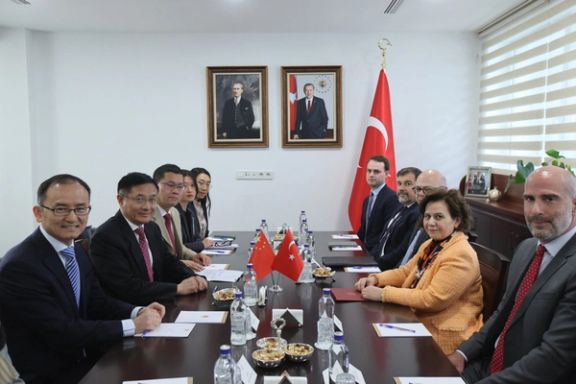
Türkiye’s Foreign Ministry has announced that Deputy Ambassador Berris Ekinci met with Yue Xiaoyong, China’s special envoy for Afghan affairs, to discuss ongoing engagement with Taliban-controlled Afghanistan and joint efforts to address the country’s humanitarian crisis.

In a statement released Wednesday, May 21, the ministry shared a photograph of the meeting and said, “They exchanged views on engagement with Afghanistan as well as efforts to improve the humanitarian situation in the country.”

Türkiye remains one of the few nations to have kept its embassy in Kabul operational following the Taliban’s return to power in August 2021. In recent months, Afghanistan’s embassy and consulates in Türkiye have also come under the control of Taliban-appointed representatives.

While Turkish President Recep Tayyip Erdoğan has openly criticized the Taliban’s treatment of women and girls, Ankara has maintained a cautious diplomatic approach toward the de facto rulers of Afghanistan.

China, by contrast, has pursued a more stable and pragmatic policy, sustaining close ties with the Taliban over the past four years. Beijing has accepted the Taliban-appointed ambassador and established active diplomatic relations with the regime in Kabul.

However, despite their varying approaches, neither Türkiye nor China has officially recognized the Taliban government.

Most Viewed

Explosions & Aircraft Activity Reported Over Kabul
1

Explosions & Aircraft Activity Reported Over Kabul

2

Nearly 23,000 Militants Operating In Afghanistan, Says Russian Security Chief

3

Afghanistan Instability Is A Direct Regional Security Threat, Says Russia

4

EU Again Calls For Lifting Restrictions On Afghan Women & Girls

5

Taliban Issue New Family Law Rules On Marriage & Divorce

•
•
•

More Stories

Taliban Calls China One Of Its Most Important Economic Partners

May 21, 2025, 13:05 GMT+1

The Taliban has described China as one of its most important economic partners during high-level talks held in Beijing on Wednesday, 21 May.

The meeting between Chinese Foreign Minister Wang Yi and Taliban Foreign Minister Amir Khan Muttaqi focused on strengthening economic cooperation and bilateral relations.

Muttaqi underscored the importance of ongoing collaboration between Taliban commissions and their Chinese counterparts, and reaffirmed the Taliban’s commitment to regional security. He assured Chinese officials that Afghan territory would not be used to threaten neighbouring countries.

Hafiz Zia Ahmad Takal, deputy spokesperson for the Taliban’s Ministry of Foreign Affairs, wrote on the social media platform X that Wang Yi had pledged continued political and economic support for Afghanistan. Yi also reportedly committed to addressing trade barriers, particularly in facilitating Afghan agricultural exports to China.

According to Takal, the Chinese foreign minister stated that China would not hesitate to support Afghanistan’s economic development.

In addition to the bilateral meeting, China also hosted an informal trilateral dialogue with the foreign ministers of Pakistan and the Taliban. Wang Yi, Pakistani Deputy Prime Minister and Foreign Minister Mohammad Ishaq Dar, and Amir Khan Muttaqi discussed regional security and economic integration, agreeing to extend the China–Pakistan Economic Corridor (CPEC) into Afghanistan.

A statement from Pakistan’s Ministry of Foreign Affairs said the three parties viewed trilateral cooperation as a critical platform for advancing regional security and economic connectivity.

World Bank Denies Taliban Claim Over Debt Repayments To Afghan Companies

May 21, 2025, 12:15 GMT+1

The World Bank has formally rejected claims made by the Taliban that it has begun repaying outstanding debts owed to Afghan companies.

In an official statement, the international financial institution clarified that the debts in question were incurred under the former Afghan Republic government and are not the responsibility of the World Bank.

On Monday, 20 May, the Taliban’s Ministry of Finance released a statement asserting that the World Bank’s office in Kabul had resumed operations and had begun repaying approximately $50 million to Afghan logistics and construction firms.

The Taliban further claimed that $10.8 million would be paid directly to companies by the World Bank, while the remaining $39.11 million would be disbursed through the ministry in three instalments. The Ministry described this as a “major financial achievement,” suggesting that it would help revive development projects and generate employment opportunities.

However, the World Bank strongly refuted these claims, stating: “These contracts were concluded between the Republic government and the contractors. Hence, the responsibility to make these outstanding payments lay with the Republic government, not the World Bank.”

The Bank clarified that it is not a party to any of the contracts referenced by the Taliban and that it bears no legal obligation to settle them. It further stated that it is only facilitating payments under exceptional circumstances and strictly after a comprehensive verification process conducted by independent third parties.

The World Bank also denied having reached any agreement with the Taliban on the resumption of previous development projects in Afghanistan.

Efforts are currently underway, the Bank said, to finalise a multi-step mechanism that may allow for the resolution of some of the outstanding claims, though any such payments would remain conditional and subject to independent validation.

Since the Taliban’s return to power in August 2021, Afghanistan has been largely cut off from international funding and aid. The World Bank and other international donors have redirected most assistance through humanitarian channels, bypassing the Taliban administration.

Taliban Governor In Balkh Declares Complete Abolition Of Republic Era Laws

May 21, 2025, 11:11 GMT+1

Yousuf Wafa, the Taliban governor of Balkh province, has declared that all laws from previous Afghan governments have been fully abolished and replaced with the Taliban’s own legal framework.

Speaking at a provincial administrative meeting, Wafa instructed all government offices to strictly implement the group’s laws and to follow the directives issued by the Taliban’s supreme leader, Hibatullah Akhundzada.

In a statement released by the governor’s office on Tuesday, Wafa said, “The old law has been abolished and holds no validity.” He emphasised that all former legal frameworks must be replaced with the Taliban's regulations and that a designated committee would begin reviewing and removing former laws across government departments.

Wafa also directed the local electricity office in Balkh to collect outstanding electricity bills from the homes and properties of former government officials, allowing payment in instalments.

The announcement follows a recent statement by Hibatullah Akhundzada, who declared that he does not accept a single article of Afghanistan’s former constitution. He further stated that a revised version of the old legal code, submitted by the Ministry of Justice and the Supreme Court, was rejected as it did not align with the Taliban’s interpretation of Islamic governance.

The Taliban have said that their scholars are currently working on drafting a new legal code "free from Western influence." Taliban spokesperson Zabihullah Mujahid previously told media outlets that while elements of the former constitution could be reviewed, the new laws would reflect the group’s values and would be finalised soon.

Since regaining control of Afghanistan in August 2021, the Taliban have yet to introduce a formal constitution, making them the only ruling authority in the world operating without one. Most governance under the Taliban is conducted based on tribal customs and strict interpretations of Islamic jurisprudence.

Legal experts have noted that Afghanistan’s previous constitution was among the strongest in the region, with no contradiction to Islamic principles. Article One of the former constitution stated, “The religion of the Islamic Republic of Afghanistan is the sacred religion of Islam,” while Article Three stipulated, “No law shall contravene the beliefs and provisions of the sacred religion of Islam.”

Despite this, the Taliban continue to reject the document, claiming it was imposed under foreign influence and does not represent their vision for Afghanistan.
Taliban Fires 300 From National Broadcaster, Including 91 Women, Over Budget Cuts

May 21, 2025, 10:31 GMT+1

The Taliban has dismissed at least 300 employees from Radio Television Afghanistan (RTA), including 91 women, as part of a nationwide cost-cutting initiative aimed at reducing government spending.

Sources within RTA told Afghanistan International on Tuesday that the layoffs affected long-serving journalists, editors, and technical staff—some of whom had worked at the broadcaster for two to four decades. In addition to being dismissed, their employee identification cards were reportedly confiscated by Taliban officials.

Those affected also reported that they have not received their salaries for the past two months, a problem that extends beyond RTA. Teachers and other civil servants across Afghanistan have similarly gone unpaid for several weeks.

The dismissals follow a directive from Taliban supreme leader Mullah Hibatullah Akhundzada, mandating a 20 percent reduction in the workforce across all government institutions. Sources indicate the decision stems from severe budget shortfalls and the ongoing suspension of international aid.

The Taliban has also announced plans to restructure and downsize numerous government bodies, including its own security institutions. According to internal documents, the Ministry of Education alone is expected to lay off at least 90,000 employees.

In earlier rounds of cuts, the Taliban’s Ministry of Agriculture, Irrigation, and Livestock terminated 31 employees from its provincial directorate in Parwan. More than 90 female staff have also been dismissed from state-run kindergartens.

China, Pakistan, Taliban Agree To Extend CPEC Into Afghanistan

May 21, 2025, 09:38 GMT+1

In a significant step toward strengthening regional connectivity and economic cooperation, the foreign ministers of China, Pakistan, and the Taliban have agreed to extend the China–Pakistan Economic Corridor (CPEC) into Afghanistan.

The agreement was reached during an informal trilateral meeting held in Beijing on Wednesday, attended by Chinese Foreign Minister Wang Yi, Pakistan’s Deputy Prime Minister and Foreign Minister Mohammad Ishaq Dar, and Taliban Foreign Minister Amir Khan Muttaqi.

In a statement released by Pakistan’s Ministry of Foreign Affairs, the three sides reaffirmed their commitment to deepening cooperation on regional security and economic development. The trilateral platform, they stated, plays a crucial role in promoting stability, countering terrorism, and enhancing economic connectivity across the region.

The ministers exchanged views on intensifying diplomatic engagement, improving communication, and adopting practical measures to increase trade, develop infrastructure, and drive shared prosperity through mutually beneficial projects.

The expansion of CPEC into Afghanistan was highlighted as a key initiative for integrating Afghanistan into broader regional development efforts. CPEC, a flagship project under China’s Belt and Road Initiative, has primarily focused on infrastructure and energy development across Pakistan. Its extension into Afghanistan is seen as a strategic move to improve regional integration and support Afghanistan’s post-conflict reconstruction.

All three parties underscored the importance of continued cooperation in combating terrorism and fostering long-term peace and development.

The statement also confirmed that the sixth formal trilateral meeting of the foreign ministers of China, Pakistan, and the Taliban will be held in Kabul at a mutually agreed date.