• العربية
  • پښتو
  • فارسی
Brand
  • Afghanistan
  • Sport
  • Markets
  • Afghanistan
  • Sport
  • Markets
  • Theme
  • Language
    • العربية
    • پښتو
    • فارسی
  • Afghanistan
  • Sport
  • Markets
All rights reserved for Volant Media UK Limited
volant media logo

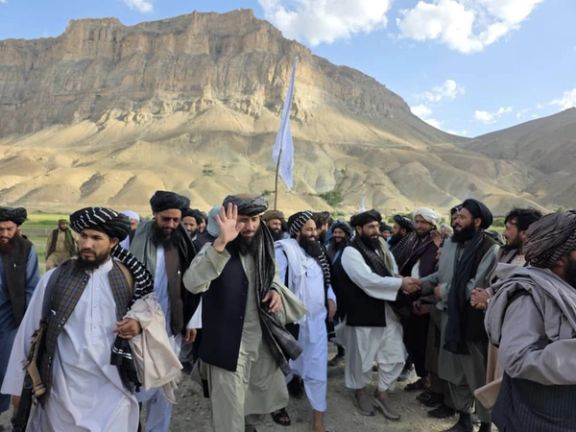
Northern Taliban Governors Visit Ghor to Assess Security Situation
Jun 1, 2025, 09:43 GMT+1

Yousuf Wafa, the Taliban’s governor of Balkh province, has led a high-level delegation of northern governors to central Ghor province to assess the region’s security situation.

The delegation included Abdul Ahad Fazli, governor of Faryab; Mohammad Zarif Muzaffar, governor of Sar-e-Pul; Mohammad Shoaib Resalat, governor of Samangan; and other senior Taliban officials. They travelled to Firozkoh, the provincial capital of Ghor, with the aim of strengthening border areas and enhancing security coordination.

According to a statement from the Balkh governor’s office, the delegation met with Hayatullah Mubarak, the Taliban governor of Ghor; Ahmad Shah Dindost, commander of the 205 Al-Badr Army Corps for the south-western zone; as well as other civilian and military officials based in the province.

During the visit, the security status of Ghor’s Al-Farooq, Taywara, Allahyar, and Charsadda districts was reviewed. Officials exchanged plans and coordinated proposals to implement more effective security measures across the province.

Speaking during the meetings, Yousuf Wafa stressed the importance of safeguarding Afghanistan from all threats. He also called for the maintenance of positive relations with neighbouring countries, particularly other Islamic nations, in accordance with directives from Taliban supreme leader Hibatullah Akhundzada. Wafa added that fostering such international engagement could contribute to improvements in Afghanistan’s economic, political, and cultural landscape.

Ghor remains one of Afghanistan’s most underdeveloped provinces. Its mountainous terrain has long served as a corridor for militant movements between the country’s south and north. While previous reports highlighted the presence of ISIS in the region, the Taliban claimed last year to have dismantled the group’s network in Firozkoh.

Considered a close ally of the Taliban’s leader, Wafa has recently assumed a prominent role in convening regular meetings of northern governors. His visit to central Afghanistan underscores his growing influence within the Taliban administration.

Most Viewed

Explosions & Aircraft Activity Reported Over Kabul
1

Explosions & Aircraft Activity Reported Over Kabul

2

Nearly 23,000 Militants Operating In Afghanistan, Says Russian Security Chief

3

Afghanistan Instability Is A Direct Regional Security Threat, Says Russia

4

Taliban Issue New Family Law Rules On Marriage & Divorce

5

EU Again Calls For Lifting Restrictions On Afghan Women & Girls

•
•
•

More Stories

Taliban Launches 43-Megawatt Wind, 5-Megawatt Solar Projects In Herat

May 31, 2025, 16:32 GMT+1

The Taliban inaugurated two major renewable energy projects in Herat province on Saturday: a 43.2-megawatt wind power plant and a 5-megawatt solar energy facility.

According to Da Afghanistan Breshna Sherkat (DABS), the state-run power company, senior Taliban officials were joined by diplomats and representatives from 77 Turkish companies at the opening ceremony.

Speaking at the event, Mullah Abdul Ghani Baradar, Deputy Prime Minister for Economic Affairs, reiterated the Taliban’s commitment to promoting renewable energy as part of its efforts to protect the environment.

“These projects will provide clean and reliable electricity,” Baradar stated during the ceremony.

The Taliban’s push for renewable energy comes despite the group’s significant reliance on coal revenue in recent years. Reports suggest that unregulated and excessive extraction of thousands of tonnes of coal has caused considerable environmental degradation.

In November 2023, Bakhtar News Agency, controlled by the Taliban, reported that the group had registered 31 state-owned and 1,028 privately operated coal mines across northern provinces.

According to the report, approximately 1,000 tonnes of coal are extracted daily from these northern mines alone.

In December 2024, the Taliban’s Ministry of Industry and Commerce announced that roughly 654,000 tonnes of coal had been exported over an eight-month period to markets in Pakistan, China, Iran, India, and Türkiye, generating a total revenue of $605 million for the group.

The contrast between the Taliban’s coal-driven income and its promotion of green energy projects underscores the complex dynamics of the group’s economic and environmental policies.

Khyber Pakhtunkhwa Cabinet Slams Pakistan’s Afghan Policy As ‘Ineffective’

May 31, 2025, 14:12 GMT+1

The cabinet of Pakistan’s Khyber Pakhtunkhwa province has passed a resolution denouncing the federal government’s policy towards Afghanistan as “ineffective”. The cabinet members called for an immediate review of these policies.

According to the resolution, the current approach has fuelled rising terrorism, heightened tensions between the two countries, deepened public resentment, and disrupted cross-border trade.

The resolution was adopted during a cabinet meeting held on Friday, chaired by Chief Minister Ali Amin Gandapur.

Both the chief minister and cabinet members called for swift and concrete measures to rebuild trust between Pakistan and Afghanistan and to lay the foundation for lasting peace in the region.

Dawn newspaper reported that the resolution urged the provincial government to pressure federal authorities to urgently revise and reform its Afghanistan policy.

In addition, the cabinet demanded greater provincial autonomy to “play an effective role in resolving all outstanding issues through direct and meaningful dialogue with Afghanistan, so that lasting peace and stability in the region can be achieved.”

The resolution also underscored the fact that Khyber Pakhtunkhwa has endured terrorism for decades, and that its people continue to seek a lasting solution to this ongoing crisis.

Chief Minister Gandapur has previously called on the federal government to formally delegate to him the responsibility of negotiating with the Afghan Taliban, arguing that dialogue with the Taliban represents the only viable path to peace in Khyber Pakhtunkhwa.

In response, officials in Islamabad have maintained that provincial authorities do not have the mandate to conduct foreign policy or engage in negotiations with Taliban representatives.

Tajikistan Deports 49 Afghan Migrants, Says Taliban

May 31, 2025, 12:09 GMT+1

On Saturday, the Taliban's Ministry of Refugees and Repatriation said that Tajikistan deported 49 Afghan migrants on Wednesday and Thursday. The group re-entered Afghanistan via the Sher Khan border crossing in Kunduz province.

According to the ministry, 36 deportees held Tajik residence cards, while 12 had valid passports and visas. The reasons for their deportation remain undisclosed.

Tajikistan has recently escalated its deportation efforts, with Afghan refugees reporting that authorities are expelling even those with valid documentation and UNHCR registration, often without notice.

The UNHCR previously urged Tajikistan to stop forced deportation of Afghan migrants. By late 2024, approximately 9000 Afghans were residing in Tajikistan.

Taliban To Elevate Diplomatic Ties With Pakistan To Ambassador Level

May 31, 2025, 10:38 GMT+1

The Taliban’s Ministry of Foreign Affairs has welcomed Pakistan’s decision to elevate its diplomatic mission in Kabul from a chargé d’affaires to a full ambassador. The group described Pakistan’s move as a positive step towards strengthening bilateral relations.

In a statement issued on Friday, 30 May, the Taliban announced that it would reciprocate by upgrading its own diplomatic representation in Islamabad to the ambassadorial level. However, the ministry did not specify when this change would be formally implemented.

The Taliban stated that enhancing diplomatic ties between Afghanistan and Pakistan would lay the groundwork for broader cooperation across various sectors.

The announcement follows a recent statement by Pakistani Foreign Minister Ishaq Dar, who said Islamabad was prepared to appoint an ambassador to Kabul. He characterised Pakistan’s relationship with the Taliban as moving in a positive direction, particularly following his recent visit to the Afghan capital.

The move represents a notable diplomatic shift, as both countries had maintained lower-level representation since the Taliban’s return to power in August 2021.

Residents Raise NRF Flag During Taliban Pro-Palestine Rally In Andarab

May 31, 2025, 09:53 GMT+1

During a Taliban-organised rally in support of Palestine on Friday, several residents in Andarab raised the flag of the National Resistance Front alongside the Palestinian flag, according to local sources.

Sources told Afghanistan International that shortly after the NRF flag was raised, Taliban forces disrupted the rally and dispersed the demonstrators.

The Taliban had staged rallies in multiple cities across Afghanistan on Friday to express solidarity with Palestine and to condemn the killing of Palestinians in Gaza by Israeli forces.

However, in Andarab, the demonstration reportedly shifted from a pro-Palestinian event into an anti-Taliban protest. Local sources said the rally initially featured chants in support of Palestine, but tensions rose after participants displayed NRF flags.

Images circulating on social media show a group of protesters holding black, green, and white flags, colours associated with the NRF.

Sources further said that the NRF flags were raised for only a few minutes before Taliban forces intervened, removed the flags, and forcibly broke up the gathering.

Andarab, located in Baghlan province, has long been a stronghold of armed resistance against Taliban rule. Over the past four years, the region has witnessed numerous violent clashes between NRF fighters and Taliban forces. In response, the Taliban have conducted multiple operations in the area, employing airstrikes and carrying out mass arrests in an effort to suppress the resistance.