• العربية
  • پښتو
  • فارسی
Brand
  • Afghanistan
  • Sport
  • Markets
  • Afghanistan
  • Sport
  • Markets
  • Theme
  • Language
    • العربية
    • پښتو
    • فارسی
  • Afghanistan
  • Sport
  • Markets
All rights reserved for Volant Media UK Limited
volant media logo

Taliban Health Minister Visits Iran For Talks On Medical Cooperation

Jun 9, 2025, 11:05 GMT+1

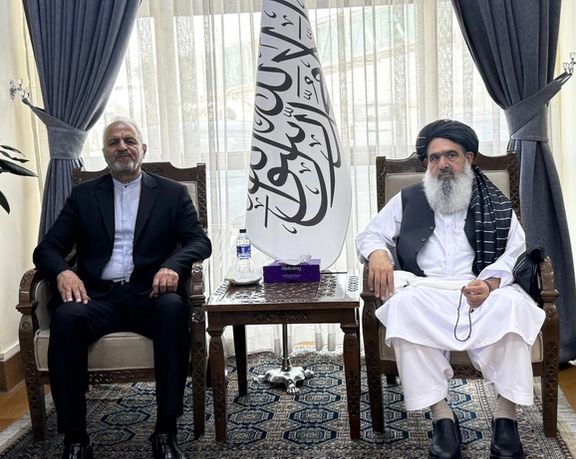
Noor Jalal Jalali, the Taliban’s minister of public health, travelled to Iran on Monday morning to pursue health cooperation between the two countries, the Iranian embassy in Kabul said.

In a brief statement posted on X, the embassy said the purpose of Jalali’s visit is to expand health-related collaboration. No further details about the visit have been released.

In March, the Taliban’s Ministry of Public Health said in a press release that Alireza Bikdeli, Iran’s ambassador in Kabul, had announced that Iran would soon resume construction of two hospitals in Kabul and Bamiyan.

Jalali has previously criticised the forced deportation of Afghan refugees from Iran.

The Taliban health minister has described the forced deportation of Afghan migrants from both Pakistan and Iran as a sign of those countries’ fear of Afghanistan’s progress. He said Afghan migrants face harassment, mistreatment and confiscation of their property in both countries.

Most Viewed

Explosions & Aircraft Activity Reported Over Kabul
1

Explosions & Aircraft Activity Reported Over Kabul

2

Nearly 23,000 Militants Operating In Afghanistan, Says Russian Security Chief

3

Afghanistan Instability Is A Direct Regional Security Threat, Says Russia

4

EU Again Calls For Lifting Restrictions On Afghan Women & Girls

5

More Than One Million Added To Afghanistan’s Poor Under Taliban Rule, Says UN

•
•
•

More Stories

Taliban’s Call For Opponents To Return Is Aimed At Silencing Dissent, Says Ex-MP

Jun 9, 2025, 10:16 GMT+1

Fawzia Koofi, a former member of Afghanistan’s parliament, has rejected the Taliban’s recent invitation for former officials to return to the country, saying it is not an effort at reconciliation but a calculated move to silence dissenting voices.

In a speech during Eid al-Adha at the presidential palace on Saturday, Taliban Prime Minister Mullah Hasan Akhund called on opponents including those who had worked with the Americans to return to Afghanistan. He claimed that the Taliban has declared a general amnesty and does not intend to harm anyone.

Zalmay Khalilzad, the former US envoy for Afghanistan, described Akhund’s message as a positive step.

Koofi, however, stressed that many former officials particularly former security personnel who have returned to Afghanistan have faced arrest, torture or execution. She said there is credible evidence of targeted killings of returning former security forces.

The United Nations Assistance Mission in Afghanistan (UNAMA) has confirmed killings of former military personnel.

In a report published in May 2024, UNAMA stated that despite the Taliban’s announcement of a general amnesty, the group continues to arrest, torture and kill employees and soldiers of the former government. Over a three-month period, UNAMA documented 38 cases of arbitrary detention, 10 cases of torture and mistreatment, and at least four extrajudicial killings of former government personnel.

The Taliban has denied such reports, dismissing them as propaganda.

The US State Department has also expressed concern over the Taliban’s retaliatory actions against former Afghan security forces.

Taliban officials maintain that the war ended with their takeover of Afghanistan and that security has been restored. The group has established a commission to invite opponents to return to the country. However, no major political figures have accepted the invitation. Aside from Hamid Karzai and Abdullah Abdullah leaders of the former government who remained in Kabul most prominent non-Taliban political figures remain in exile.

Political opponents of the Taliban have repeatedly stated that the group is not genuinely interested in dialogue or reconciliation, but is instead seeking allegiance. They have emphasised that under no circumstances will they pledge allegiance to the Taliban.

Taliban Leader Criticises Trump’s Travel Ban, Calls US ‘Oppressor’

Jun 8, 2025, 16:08 GMT+1

Taliban leader Hibatullah Akhundzada has condemned US President Donald Trump’s new travel ban, labelling the United States an “oppressor.”

This marks the Taliban’s first public response to Trump’s decision to bar entry to citizens of 12 countries, including Afghanistan. The order is due to take effect on Monday.

In his Eid al-Adha speech on Saturday, Akhundzada said: “Citizens of 12 countries have been banned from entering America, and Afghans are also not allowed. Why? Because they claim the Afghan government doesn’t have control over its people. So, O oppressor! Is this what you call friendship with humanity?”

He linked the US travel ban to Washington’s role in global conflicts, accusing the United States of responsibility for the deaths of women and children in Gaza.

Criticising those who seek closer ties with Washington, Akhundzada said: “Some people are pleased with friendship with America and consider it a success.” He described the US as the “great oppressor,” claiming that “what it is doing today in Palestine is the same as what it did yesterday in Afghanistan.”

His remarks come as the Taliban continues to seek formal recognition and diplomatic relations with the United States. Taliban officials have repeatedly urged Washington to recognise their government.

Background on the Travel Ban

Trump defended the travel ban which covers nationals from 12 countries, including Afghanistan as a measure to protect US citizens “from aliens who intend to commit terrorist attacks, threaten our national security, espouse hateful ideology, or otherwise exploit the immigration laws for malevolent purposes.”

His administration argued that Afghanistan lacks a credible central authority for issuing passports or civil documents and does not have an adequate system for screening visa applicants.

According to the New York Post, one reason cited for the ban is the high rate at which Afghan nationals overstay their visas in the United States.

Although the ban includes certain exceptions for Afghans who worked with US forces, Trump suspended a key refugee resettlement programme in January, effectively halting support for thousands of Afghans who had cooperated with the United States leaving many in legal limbo and with no clear path forward.

Taliban Raises Gaza Funds As Aid Groups Warn Of Worsening Crisis At Home

Jun 8, 2025, 14:33 GMT+1

Coinciding with Eid al-Adha, the Taliban has announced that it has collected donations from residents of Paktia province to aid the people of Gaza. The Taliban police command in the province said 821,000 Afghanis had been raised so far.

The Taliban command in Paktia stated that the campaign to collect aid for the “oppressed and displaced people” of Gaza would continue. In a statement, it said: “The faithful people of Afghanistan consider themselves partners in the sorrow and grief of the oppressed people of Gaza.”

According to the Taliban, similar financial and humanitarian donations for Gaza have been collected in other parts of Afghanistan. However, the group did not clarify the mechanism or process for collecting and distributing the aid.

Several business owners in various provinces have previously reported that armed Taliban fighters forcibly collected money from them under the pretext of helping Gaza.

The Taliban’s fundraising efforts come as international organisations warn of a worsening hunger crisis in Afghanistan.

The Integrated Food Security Phase Classification (IPC) announced on Thursday that about 20 percent of Afghan children approximately five million are facing crisis or emergency levels of food insecurity.

The UN Office for the Coordination of Humanitarian Affairs (OCHA) has reported that nearly 23 million Afghans are in need of humanitarian assistance. According to the agency, one in three Afghans does not know where their next meal will come from.

Meanwhile, several Islamic countries, marking Eid al-Adha, have announced that they will send sacrificial meat to support vulnerable people in Afghanistan. According to international organisations, since the Taliban took power nearly four years ago, poverty, unemployment and hunger have steadily worsened across the country.

Turkish Firm Leads $65 Million Investment In Afghanistan’s Wind Energy Sector

Jun 8, 2025, 12:29 GMT+1

Türkiye’s 77 Construction Company will invest $65 million in the first phase of a wind power plant project in Herat, Afghanistan, Anadolu Agency has reported.

The Taliban had earlier announced plans to develop renewable energy projects in the province, including the generation of 43.2 megawatts of wind power and five megawatts of solar power.

According to the report, the first phase will see the construction of a plant with a capacity of 43.2 megawatts, as part of a broader plan to eventually produce a total of 200 megawatts of wind power.

Emre Unal, commercial attaché at the Turkish Embassy in Kabul, said Turkish companies have invested around $7 billion in Afghanistan to date. He noted that this project marks the first time wind turbine technology is being introduced into Afghanistan by a Turkish company.

Unal added that Türkiye’s positive image among the Afghan population, trust in the quality of Turkish goods and engineering, and economic advantages including a young workforce and low business startup costs had created favourable conditions for expanding bilateral investment.

The Taliban officially launched the Herat wind power project on Saturday, 31 May, in a ceremony attended by Abdul Ghani Baradar, the group’s deputy prime minister. During the event, Baradar stated that the Taliban seeks to protect the environment by investing in renewable energy.

Taliban Chief Justice Pledges Full Sharia Enforcement, Rejects Foreign Influence

Jun 8, 2025, 10:02 GMT+1

Abdul Hakim Haqqani, the Taliban’s chief justice, said in an Eid al-Adha speech that with the group’s return to power, there is no longer any excuse for not fully implementing Islamic Sharia.

He emphasised that no obstacles remain to establishing an Islamic system and ensuring justice under Taliban rule.

Haqqani, along with other Taliban leaders, performed Eid al-Adha prayers at the presidential palace on Saturday. During the ceremony, he spoke about the Taliban’s return to power, claiming that it occurred without the backing of any foreign government, organisation or alliance, and was instead the result of direct divine intervention.

He argued that if the Taliban had come to power with foreign support, they would have been forced to comply with demands contrary to “Islam, and the Hanafi jurisprudence.” Haqqani stated: “Fortunately, we are not indebted to anyone and are not obliged to carry out others’ orders.”

For two decades, many Taliban leaders and commanders were based in Pakistan, and the former Afghan government accused them of waging war with the backing of Pakistan’s intelligence agency.

Observers also point to the 2020 Doha Agreement, which led to the withdrawal of US forces and the collapse of the Afghan republic, as a key factor in the Taliban’s return. Some analysts believe regional players such as Russia, Iran and Qatar also contributed to the group’s resurgence.

Since taking power in 2021, the Taliban have resisted international pressure,particularly from Western countries and the United Nations, to respect human rights, guarantee women’s rights and reopen schools and universities for girls and women.

Haqqani also claimed that the Taliban are not facing any active armed opposition in any part of the country.

However, reports indicate that the National Resistance Front and the Afghanistan Freedom Front continue to carry out guerrilla attacks against Taliban forces in northern provinces. The United Nations has confirmed some of these attacks.

In addition, ISIS has launched attacks against Taliban forces and officials, including the assassination of senior figures such as Khalil Haqqani, the former minister of refugees and former Taliban governor of Balkh.

Haqqani remains a senior figure within the Taliban leadership. Recently, the chief prosecutor of the International Criminal Court requested an arrest warrant for him and the Taliban’s supreme leader on charges that include widespread human rights violations and crimes against humanity.