• العربية
  • پښتو
  • فارسی
Brand
  • Afghanistan
  • Sport
  • Markets
  • Afghanistan
  • Sport
  • Markets
  • Theme
  • Language
    • العربية
    • پښتو
    • فارسی
  • Afghanistan
  • Sport
  • Markets
All rights reserved for Volant Media UK Limited
volant media logo

Former Pak FM Links US Afghan Exit To Regional Terror Surge

Jun 10, 2025, 15:13 GMT+1

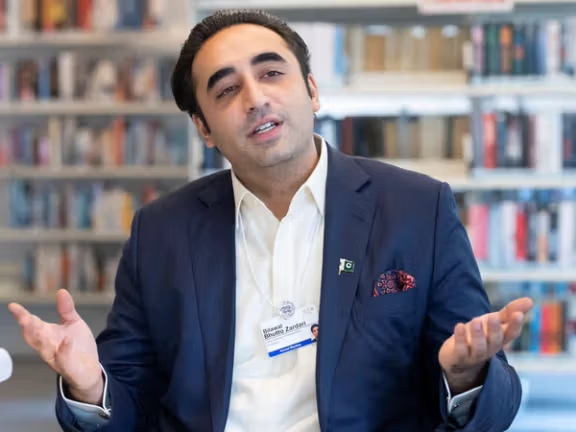
Former Pakistani Foreign Minister Bilawal Bhutto Zardari has attributed the surge in terrorism in the region to the United States’ withdrawal from Afghanistan, citing the fallout as a major contributor to Pakistan’s internal security challenges.

During a visit to Washington, the Pakistan People’s Party chairman said his country continues to grapple with the consequences of the US exit, including the proliferation of American-made weapons left behind in Afghanistan.

“Pakistan has been harmed by the manner in which the United States exited Afghanistan,” Bhutto Zardari said, according to a report by The Economic Times on Tuesday.

In remarks that indirectly criticised both Washington and regional dynamics, the former minister stressed the need for a renewed international strategy. “We talk about terror, we talk about Afghanistan, we talk about other things. That’s what we’ve spent the last couple of decades of this relationship discussing,” he said.

Bhutto Zardari called for enhanced regional and international cooperation to confront the lingering threat of terrorism. “We need more cooperation, regional and international, on what we are going to do now, post-Kabul, to deal with the remnants of terrorism that are left over,” he stated.

Islamabad has repeatedly accused the Taliban of distributing American weapons to extremist groups, a charge the Taliban denies. His comments come as Pakistan and the Taliban-led Afghan government appear to be strengthening diplomatic ties, despite ongoing security concerns.

Most Viewed

Explosions & Aircraft Activity Reported Over Kabul
1

Explosions & Aircraft Activity Reported Over Kabul

2

Nearly 23,000 Militants Operating In Afghanistan, Says Russian Security Chief

3

Afghanistan Instability Is A Direct Regional Security Threat, Says Russia

4

EU Again Calls For Lifting Restrictions On Afghan Women & Girls

5

More Than One Million Added To Afghanistan’s Poor Under Taliban Rule, Says UN

•
•
•

More Stories

Taliban Education Delegation Attends International Forum In Russia

Jun 10, 2025, 13:04 GMT+1

A delegation from the Taliban’s Ministry of Education, led by Deputy Minister Sakhaullah Saeed, has travelled to Russia to participate in the Third International Forum of Ministers of Education, the ministry announced on Monday.

The forum comes amid ongoing criticism of the Taliban’s education policies, particularly the regime’s ban on girls attending school beyond the sixth grade, a restriction that has been in place since the group returned to power nearly four years ago.

According to the ministry, the delegation aims to seek international cooperation to support Afghanistan’s education sector.

Since taking control of the country, the Taliban has barred girls from secondary schools and universities, a move that has drawn widespread condemnation from both domestic and international human rights groups for violating the fundamental right to education.

Despite repeated calls from the international community and Afghan civil society to lift the restrictions, the Taliban has so far refused to reverse its stance.

Rights Groups Urge Netherlands To End Afghan Envoy’s Mission Over Taliban Ties

Jun 10, 2025, 11:37 GMT+1

More than 60 Afghan human rights organisations have called on the Dutch government to terminate the diplomatic mission of Asif Rahimi, Afghanistan’s ambassador to the Netherlands, citing his alleged allegiance to the Taliban.

In an open letter, the organisations claimed Rahimi is not acting as a neutral diplomat and has expressed loyalty to the Taliban. They raised concerns over his continued presence at the Afghan Embassy in The Hague, particularly in light of Afghanistan’s ongoing human rights crisis, including widespread violations of women’s rights.

Rahimi, who previously served under the former Afghan government, was among the first officials to declare cooperation with the Taliban following their takeover in 2021. According to sources cited by Afghanistan International, Rahimi receives between $20,000 and $30,000 per month from the group.

He has reportedly travelled to Kabul and met with Taliban officials to discuss ongoing cooperation. Rahimi also came under criticism after removing the national emblem and flag of the Islamic Republic of Afghanistan from the embassy’s social media platforms and website. Following public backlash, the symbols were later restored.

In the letter, obtained by Afghanistan International, the signatory organisations accused Rahimi of violating diplomatic neutrality and misusing embassy resources in Europe to unofficially represent Taliban interests.

The groups urged the Dutch government to clarify the legal and political status of the Afghan Embassy in The Hague and conduct a thorough review of its operations in line with the Netherlands’ obligations under international human rights conventions.

They stated that, should any formal affiliation with the Taliban be confirmed, the embassy’s diplomatic activities must be suspended.

The organisations warned that continuing to accommodate a figure allegedly aligned with a group accused of widespread human rights abuses would undermine the Netherlands’ credibility as a defender of international human rights.

The controversy comes as the International Criminal Court in The Hague investigates potential arrest warrants for senior Taliban leaders, including Supreme Leader Hibatullah Akhundzada and Chief Justice Abdul Hakim Haqqani. The presence of key international legal institutions in the city, they noted, further underscores the importance of scrutinising the Afghan Embassy’s operations.

Taliban Has Delivered Only Limited Helmand River Water, Says Iranian Official

Jun 10, 2025, 10:45 GMT+1

An Iranian official said Monday that negotiations with the Taliban over the Helmand River water rights have yet to yield tangible results, accusing the group of failing to meet their obligations under a decades-old treaty.

Isa Bozorgzadeh, spokesperson for Iran’s water industry, said in a press conference that the Taliban had not upheld the terms of the 1973 Helmand River Treaty and had delivered only a small volume of water to Iran.

“According to the 1973 treaty, Afghanistan is obligated to deliver a specified share of Helmand River water to Iran. However, since the beginning of the current water year, only about 119 million cubic metres of water have entered the country, a figure significantly below expectations,” Bozorgzadeh said.

He noted that although a recent meeting between commissioners from both countries had taken place and diplomatic channels remained open, no “concrete outcome” had yet been reached.

Emphasising Iran’s commitment to international agreements, Bozorgzadeh acknowledged the severity of the regional drought but said water flow to Iran should still be higher than it currently is. He warned that eastern Iran particularly the Sistan and Baluchestan province is facing a worsening water crisis.

“Iran expects its neighbours to fulfil their obligations within the framework of regional norms and international law,” he added.

The Taliban, however, maintains that it is complying with the treaty. Speaking during a recent visit to Iran, Taliban Foreign Minister Amir Khan Muttaqi said his government was committed to honouring the water-sharing agreement, despite the drought that has gripped much of Afghanistan.

“Delivering water to Iran is a religious and Islamic responsibility,” Muttaqi said. “Our goal is to prevent water wastage and ensure it reaches Iran properly. This is a virtuous act and a positive political step.”

He stressed that water shortages were not isolated to Iran, but also impacted Afghan provinces such as Nimruz, Helmand, Farah and Baluchistan. Muttaqi claimed that in the absence of drought, water would flow naturally into Iran, as it had over the past month.

The dispute over Helmand River water rights has long strained relations between Tehran and Kabul. Some Iranian officials have accused the Taliban of deliberately restricting water flow to Iran by constructing dams and diverting the river.

Muttaqi did not directly address those accusations but reiterated that Afghanistan’s intent was to use water efficiently and minimise waste.

The Helmand River Treaty was signed in 1973 between Mohammad Musa Shafiq, then Prime Minister of Afghanistan, and Amir-Abbas Hoveyda, then Prime Minister of Iran, under the Afghan monarchy. Despite political changes in both countries since then, the agreement remains in force though implementation remains a source of contention.
Acting Cabinet Is Due to Political Considerations, Says Taliban Spokesperson

Jun 10, 2025, 09:39 GMT+1

Taliban spokesperson Zabihullah Mujahid said Monday that the group’s continued use of acting ministers is based on political considerations, but stressed that the officials hold full authority despite their interim titles.

In an interview with Ariana News, Mujahid stated that while the cabinet remains temporary, all ministers and department heads have been granted full powers by the group’s leadership.

“The Taliban leadership has granted full authority and powers to the ministers and heads of departments, which are exercised within the framework of the institutions,” he said. “Being in an acting position does not mean their powers are limited.”

Since seizing power in August 2021, the Taliban have maintained that their cabinet is provisional and that a permanent government would be formed after further evaluation. Nearly four years later, however, all key posts remain filled on an acting basis, with no clear timeline for formal appointments.

Mujahid described the arrangement as being in the interest of both the regime and the Afghan people, though he declined to elaborate on the specific political factors preventing permanent appointments.

Observers note that such prolonged rule by acting officials is highly unusual in modern governance. No internationally recognised government has continued in this manner for such an extended period, raising concerns about the Taliban’s political intentions and internal cohesion.

Hekmatyar Calls For Unconditional Dialogue To Achieve Peace In Afghanistan

Jun 9, 2025, 16:04 GMT+1

In his Eid message, Gulbuddin Hekmatyar, leader of Hezb-e-Islami Afghanistan, said that genuine and unconditional dialogue among all parties is the only path to lasting peace in the country.

Citing Afghanistan’s history of conflict, he warned that a return to “violent methods of the past and renewed reliance on foreigners” would plunge the country back into previous crises.

Hekmatyar stressed the damaging effects of foreign intervention, the need for national consensus and the importance of sincere engagement among political actors to achieve sustainable peace.

He emphasised that political power should be transferred peacefully through the people’s vote and collective will, adding that no individual or group should seize authority through force, coups or foreign backing.

“It is the religious and human right of the nation to entrust divine leadership to someone worthy of the responsibility,” Hekmatyar wrote. “We will only accept a leader, and refrain from opposing him, if the majority of people recognise him as such.”

He called for the establishment of an Islamic system in Afghanistan, rooted in religious principles. He also criticised recent remarks by some former Afghan leaders and urged the rejection of violent tactics.

He condemned what he described as “the absolute despotism of a tribe, family or individual,” and, reflecting on Afghanistan’s history of coup-driven regimes, said that preventing future disasters would require resisting threats and ending violence.

Those in or vying for power, he said, must avoid “bloody and inhumane” means of attaining or holding authority.

Hekmatyar also called for the creation of a council that genuinely represents the people, asserting that Afghans must have a direct and decisive role in key national issues including domestic policy, foreign relations, war and peace.

He argued that no government should unilaterally decide such matters and noted the current absence of a constitution. A proper constitution, he said, should clearly define the country’s political and social system, as well as the rights and powers of its institutions.

“The only legitimate body to draft and approve such a constitution,” he wrote, “is a council elected by the people, one that represents national consensus and the collective will of the nation.”