• العربية
  • پښتو
  • فارسی
Brand
  • Afghanistan
  • Sport
  • Markets
  • Afghanistan
  • Sport
  • Markets
  • Theme
  • Language
    • العربية
    • پښتو
    • فارسی
  • Afghanistan
  • Sport
  • Markets
All rights reserved for Volant Media UK Limited
volant media logo

Women & Girls Erased From Public Life In Afghanistan, Says UN Rights Chief

Jun 16, 2025, 12:32 GMT+1Updated: 14:09 GMT+1

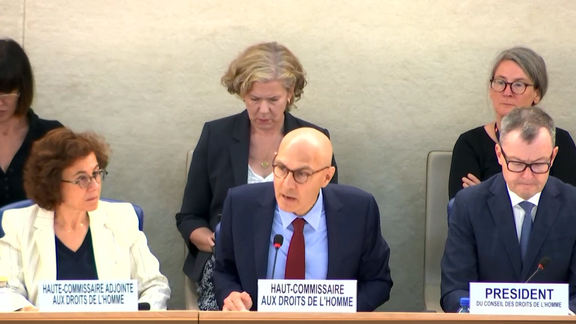
Volker Türk, the United Nations High Commissioner for Human Rights, has said that women and girls in Afghanistan have effectively been erased from public life, as he raised alarm over the deteriorating human rights situation in the country.

Speaking during the 59th session of the UN Human Rights Council, Türk highlighted growing concerns over the repression of Afghan women and girls, stating that their voices have been silenced and their presence restricted to within the home.

“The rights of women and girls in Afghanistan have been systematically erased from public life,” he said. “They are excluded from education, employment, and civic participation.”

Türk also warned of serious threats facing other vulnerable groups, including persons with disabilities and LGBTQ+ individuals. “Influential figures have openly mocked people with disabilities,” he noted. “LGBTIQ+ people continue to face legal restrictions, hate speech, and even violence.”

He further expressed concern that some countries have reduced funding for aid programmes in Afghanistan, despite worsening conditions on the ground.

Most Viewed

Female Ismaili Entrepreneur Shot Dead In Badakhshan
1

Female Ismaili Entrepreneur Shot Dead In Badakhshan

2

Afghanistan May Not Remain Intact In Future, Says Pakistani Analyst

3

French Parliament Hosts Two-Day Meeting On Afghanistan

4

Taliban, Iran Working On Surveillance App For Afghan Users, Say Sources

5

Pakistan Welcomes Local Ceasefire Agreement In Kunar & Nuristan Border Areas

•
•
•

More Stories

Iran Arrests Suspect In Killing Of Afghan Woman Kubra Rezai

Jun 14, 2025, 10:13 GMT+1

Iranian authorities have announced the arrest of a suspect in the murder of Kubra Rezai, a 26-year-old Afghan migrant woman whose mutilated body was discovered earlier this month in Varamin, south of Tehran.

Akbar Arabi, police commander of Pishva County in Tehran Province, confirmed the arrest on Friday, 13 June. He stated that the suspect confessed to the killing during specialised interrogations and has since been transferred to prison following initial legal procedures.

“Through intelligence and operational efforts by the criminal investigation police, the suspect was identified and immediately arrested,” Arabi told domestic media. The identity of the accused has not yet been made public.

Rezai was reportedly abducted while on her way to work in Tehran. On the evening of 3 June, local residents found parts of her dismembered body among rubbish in Varamin. Following the gruesome discovery, a case was opened by the criminal investigation unit in Pishva County.

Calls for Justice Grow

Rezai’s murder has sparked outrage among human rights organisations and Afghan migrant communities, who say the killing underscores the systemic violence faced by migrant women in Iran.

Activist groups have urged Iranian authorities to conduct a thorough and impartial investigation. The Afghanistan Women’s Light of Freedom Movement issued a statement demanding legal accountability and transparency in the judicial process. The group also called on international organisations to pressure Tehran to protect the rights and dignity of migrants.

The Taliban’s embassy in Tehran also responded, describing the murder as an “unforgivable crime” and stating that the perpetrator must be brought to justice, “regardless of nationality or affiliation.”

Taliban Arrests Clerics, Residents In Daikundi For Early Eid Observance

Jun 9, 2025, 09:17 GMT+1

The Taliban have detained dozens of people in Daikundi province including clerics and local residents for holding Eid al-Adha prayers on Friday, in defiance of the group’s officially designated date.

Local sources told Afghanistan International that the arrests took place in the provincial capital of Daikundi and in the Ashtarlay district.

According to the sources, while some detainees were released after a few hours, around 50 people remain in Taliban custody.

Unlike many Islamic countries, including Saudi Arabia, the Taliban observed Eid al-Adha a day later, on Saturday. In some areas of Afghanistan, including Daikundi province, residents marked the holiday on Friday, prompting a harsh response from Taliban authorities.

In neighbouring Iran, Friday was also recognised as the first day of Eid al-Adha.

Sources told Afghanistan International on Sunday that a number of clerics and local residents who had performed Eid prayers and animal sacrifices on Friday were arrested in central Daikundi and the Ashtarlay district. Although some have since been released, approximately 50 remain detained.

Historically, Eid al-Adha in Afghanistan was celebrated in accordance with Saudi Arabia’s official calendar. In recent years, however, the Taliban have adopted different dates for Eid observance, a move that has caused growing tension among segments of the population.

Iran Executes Two Afghan Nationals, Says Rights Group

Jun 8, 2025, 17:20 GMT+1

The Iran Human Rights Organisation, based in Norway, has reported the execution of seven prisoners including two Afghan nationals at Ghezel Hesar Prison in Karaj.

According to the organisation, the Afghan prisoners had been arrested more than a decade ago on charges of “premeditated murder” and “rape.”

In a statement released Sunday, 8 June, the group identified the executed Afghan inmates as Ahmadullah Ismaeili, 31, and Shukrullah.

Quoting its sources, the organisation said: “Ahmadullah Ismaeili, originally from Faryab province in Afghanistan, had been arrested 10 years ago on murder charges and sentenced to death.” His execution was reportedly carried out on Wednesday, 4 June.

The statement also cited Javan newspaper, reporting that Shukrullah was executed on the morning of Sunday, 1 June. According to the report, he had been arrested in 2013 on charges of “premeditated murder and rape” and later sentenced to death.

Iran Human Rights noted: “The lack of classification for premeditated murder in Iran leads to the issuance of death sentences regardless of the severity, context or motivation behind the act.”

These executions come as more than 80 human rights organisations recently issued a joint appeal condemning the rising number of executions of Afghan nationals in Iran and calling for an immediate halt to the practice.

According to the appeal, the number of executions of Afghan citizens in Iran has surged since the Taliban’s return to power, rising from 16 in 2022 to 80 in 2024.

Child Rights Groups Urges Iran To Halt Afghan Migrant Deportation Plan

Jun 8, 2025, 11:00 GMT+1

A number of Iranian civil society organisations advocating for children’s rights have issued a joint statement calling for an immediate halt to the government’s crackdown on Afghan migrants.

The groups warned that Afghan migrants particularly children are facing discrimination, psychological distress and hate speech, and now live in fear of forced expulsion.

“The discrimination against Afghan refugees, particularly children, has a long history in Iranian state policy,” the statement said. “Over the past three years, Afghan children have endured immense psychological pressure, from daily violence and systemic exclusion to waves of hate speech in the media that have made their lives increasingly difficult.”

The organisations cautioned that the deportation policy targets not only two million undocumented migrants, but also an estimated two million who possess census registration papers.

“Children who once had hope for a future are now confronted with the nightmare of returning to Afghanistan, a country under Taliban rule, where they face no security, no education and no dignified life,” the statement said.

Activists warned that fear and anxiety are now widespread among migrant children. They added that the threat of losing access to education, the risk of forced marriage, especially for girls, and an uncertain future in a country plagued by poverty, unemployment and insecurity are exposing children to serious emotional and psychological harm.

The organisations also noted that since 2023, the Islamic Republic of Iran has gradually restricted educational and health services for migrants in an attempt to pressure them to leave. This began with the exclusion of undocumented children from the school system, a reversal of progress made in 2016.

Girls’ schools in Afghanistan remain closed under Taliban orders. Activists stressed that for many Afghan girls, deportation would mean the permanent end of their education.

The child rights organisations condemned the actions of the Iranian government as a clear violation of national and international child rights laws and inconsistent with the Convention on the Rights of the Child, to which Iran is a signatory.

“No policy should come at the cost of a child’s health, dignity or future,” the statement said.

The organisations called on the Iranian government to immediately halt the mass deportation plan and to respect the rights of migrant children.
Taliban Publicly Flogs 7 People Across 4 Afghan Provinces

Jun 4, 2025, 10:34 GMT+1

The Taliban’s Supreme Court announced on Tuesday that seven people were publicly flogged across four Afghan provinces, each receiving approximately 60 lashes in total.

Among those punished was a woman who was lashed under Taliban court orders for the “crime of fleeing home.”

According to the court’s statement, Taliban officials flogged one man and three women in Balkh and Parwan provinces, accusing them of “moral corruption” and engaging in extramarital relations. Each reportedly received about 30 lashes.

In separate incidents, three individuals including one woman were publicly flogged in Badakhshan and Laghman provinces on charges of “alcohol sales and fleeing home,” also receiving 30 lashes each.

Despite repeated international appeals urging the Taliban to halt public corporal punishment of both men and women, the group continues to administer lashings across various provinces for a range of alleged offences.

Richard Bennett, the UN special rapporteur on human rights in Afghanistan, expressed grave concern on Monday over the Taliban’s increasing use of corporal punishment. He called the practice a violation of international law and urged an immediate end to it.

Citing figures from the Taliban’s Supreme Court, Bennett reported that the group had flogged at least 63 men and four women across several provinces in the past week alone.