UN Warns Of Intensifying Heatwave Across Afghanistan
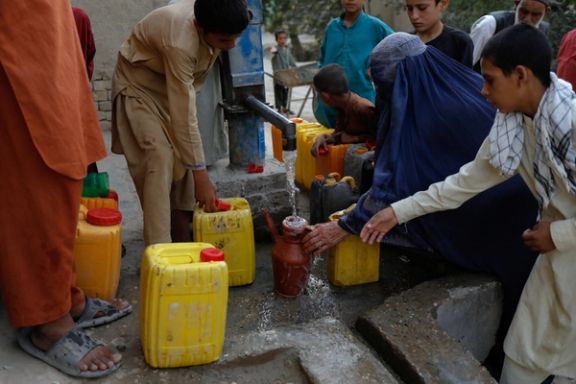
The United Nations Food and Agriculture Organization (FAO) has issued a warning about a severe heatwave expected to persist across Afghanistan through Saturday, 5 July.

The United Nations Food and Agriculture Organization (FAO) has issued a warning about a severe heatwave expected to persist across Afghanistan through Saturday, 5 July.
In its latest advisory, the FAO urged residents to stay hydrated and to limit outdoor activities, particularly in the agriculture and construction sectors, during the period of extreme heat.
In a post on the social media platform X on Tuesday, 1 July, the organisation again called on the public to take extra precautions, especially for vulnerable groups such as the elderly, the sick, pregnant women and children.
The FAO also advised the public to protect livestock by keeping them in shaded areas and ensuring they have access to sufficient water.
Earlier, the organisation warned that temperatures could exceed 45°C in parts of the country, particularly in the southern, eastern and northern regions.
The United Nations Assistance Mission in Afghanistan (UNAMA) has also noted that climate change is contributing to the increasing frequency and intensity of heatwaves across South and Central Asia.


One person was killed and at least ten others were injured on Tuesday during a clash between Taliban forces and local residents in Khash district, Badakhshan province, according to local sources.
The violence reportedly erupted during the burial ceremony of four individuals killed a day earlier in similar clashes. Health officials in Badakhshan confirmed Tuesday’s casualties, adding that three of the injured are in critical condition.
The unrest began on Monday after Taliban fighters attempted to destroy poppy fields in Khash, prompting resistance from local residents. That confrontation resulted in the deaths of four civilians and injuries to at least ten others.
Local sources said tensions escalated further on Tuesday, 1 July, as mourners gathered for funerals. Another clash broke out between Taliban forces and villagers, again resulting in civilian casualties.
Amid the growing unrest, Taliban reinforcements have reportedly been deployed to the area. Protesters, meanwhile, have blocked roads leading to Khash district in an attempt to prevent further military access.
As of Tuesday, Taliban officials had not issued any public statements regarding the incident.

More than 3000 Afghan families were deported from Iran within a 24-hour period, according to the Taliban-run Bakhtar News Agency.
The agency reported on Monday, 30 June, that 3284 families were returned to Afghanistan, with 2510 crossing via the Islam Qala border and 652 through the Pul-e Abrisham crossing.
In addition, Bakhtar noted that 60 Afghan families returned from Pakistan via the Torkham border, while another 62 families entered through the Spin Boldak crossing.
The mass deportations come amid a sharp escalation in Iran’s removal of undocumented Afghan migrants. Last week, the governor of Taybad County in Iran’s Razavi Khorasan Province announced that more than 100000 Afghan nationals had been deported in a single week.
The surge in returns has heightened concerns among humanitarian organisations about the capacity of Afghan authorities and aid agencies to support the growing number of returnees.

Iran is forcibly deporting Afghan refugees in breach of humanitarian principles and international law, the International Federation of Human Rights Defenders in Exile said Tuesday.
In a statement issued 1 July, the federation accused Iranian authorities of “force, humiliation and violent behaviour” toward Afghan asylum seekers, saying such actions “seriously violate human dignity.”
“The situation in Afghanistan remains critical and insecure, and the power structure that drove people to flee has not changed,” the group said. “The forced deportation of thousands of Afghan migrants without examining their asylum claims, humanitarian needs, health conditions or the life-threatening dangers awaiting them is a clear breach of the principle of non-refoulement, a cornerstone of international refugee law.”
The organisation urged the United Nations and other international bodies to condemn what it called Iran’s “systematic” human-rights violations and to take effective action to halt further expulsions.

The third round of the Doha Working Group meetings began Monday in the Qatari capital, with representatives of the Taliban and several foreign diplomats in attendance. The two-day event focuses on counter-narcotics efforts and private sector development in Afghanistan.
The Taliban delegation comprises seven officials from the Ministries of Public Health, Interior, Foreign Affairs and Agriculture. The meetings are part of the broader UN-led Doha Process, which seeks to facilitate dialogue and regional cooperation on Afghan affairs.
Mohammad Sadiq, Pakistan’s special envoy for Afghanistan, also confirmed his participation in what he described as an “important informal discussion” held on the sidelines of the meeting. In a message posted on social media, he said the dialogue involved special representatives and ambassadors from Pakistan, China and Russia, reflecting what he called a shared commitment to regional stability and cooperation.
Despite these developments, some analysts have questioned the political significance of the gathering. Ahmad Saeedi, a political commentator, said the low-level representation from the Taliban and the absence of senior diplomats from major powers had undermined the credibility of the talks.
“This meeting appears to be more of a low-profile event than a meaningful platform capable of bringing about change in Afghanistan,” Saeedi said.
Observers note that while Afghanistan continues to face escalating humanitarian, economic and human rights crises, the Doha meeting has so far failed to meet international or domestic expectations. Critics point to the lack of a clear framework for political dialogue and the narrow focus on technical issues as key shortcomings.
The Doha Process, launched following the Taliban’s return to power in 2021, has aimed to provide a space for international engagement on Afghanistan. However, the absence of inclusive political discourse and limited engagement with Afghan civil society have led some to question its long-term effectiveness.

More than 70 percent of undocumented Afghan migrants are being forcibly deported from Iran, according to a senior official from the country’s Foreign Ministry.
Ahmad Masoumifar, head of the Foreign Ministry’s office in Iran’s northeast, confirmed that the majority of recent returns are involuntary. Speaking on Monday, 30 June, he said that between 22 and 28 June, the first week of the month of Saratan in the Solar Hijri calendar, around 85000 undocumented Afghans were deported via the Dogharoun border crossing.
Masoumifar stated that only 25 to 30 percent of Afghan migrants return voluntarily, while the remaining 70 to 75 percent are deported by force. He added that the pace of deportations has intensified ahead of a 6 July deadline issued by Iran’s Ministry of Interior for undocumented migrants to leave the country.
According to Masoumifar, approximately 10000 Afghans were deported over two days, 27 and 28 June, and around 21000 were returned on 26 June alone.
He noted that Afghan migrants who opt for voluntary return are permitted to bring their personal belongings with them to the border for transfer into Afghanistan.
The remarks appear to contradict earlier claims by the governor of Taybad, who stated that more than 90 percent of undocumented Afghan migrants had left the country voluntarily.
Iran has seen a sharp rise in deportations in recent weeks, amid growing international concern over the treatment of Afghan migrants and the humanitarian implications of mass returns.