Iran Steps Up Deportations Of Afghans, Schedules Talks With Taliban

Iran is intensifying efforts to deport undocumented Afghan migrants through planned meetings with Taliban representatives, an Iranian provincial official said.

Iran is intensifying efforts to deport undocumented Afghan migrants through planned meetings with Taliban representatives, an Iranian provincial official said.
Mansour Bijar, governor of Sistan and Baluchestan province, confirmed on Sunday, 6 July, that discussions have been scheduled with Taliban officials to streamline the expulsion process. He said the initiative targets only those without legal documentation.
“The return of Afghan nationals continues, and all relevant agencies in Iran have been mobilised,” Bijar stated.
He reported a significant rise in the number of Afghan nationals returning via Iran’s eastern borders, particularly through the Melak and Khorasan Razavi crossings. While local return camps in Sistan and Baluchestan have capacity for about 3,000 people, Bijar said as many as 14,000 individuals had recently sought repatriation to Afghanistan.
According to Bijar, more than 75,000 undocumented Afghan migrants have left Iran in the past two weeks, with over 75 percent doing so voluntarily. He added that Iranian authorities are providing transportation, food, and healthcare services at border points.


The United Nations General Assembly will hold a meeting on Monday, 7 July, to address the ongoing situation in Afghanistan, with a focus on its implications for international peace and security.
During the session, member states are expected to adopt a resolution expressing strong support for the Afghan people, particularly women and girls, amid worsening humanitarian and human rights conditions under Taliban rule.
Naseer Ahmad Faiq, the acting representative of Afghanistan to the UN, stated on Sunday that the resolution will underscore the international community’s commitment to upholding the rights, dignity, and aspirations of the Afghan population, especially women and girls. He added that member states are united in calling for a peaceful and inclusive future for the country.
This will be the second major UN meeting on Afghanistan in the past two weeks. On 23 June, the UN Security Council convened a special session to assess the situation following the latest report from the UN Secretary-General, delivered by the United Nations Assistance Mission in Afghanistan (UNAMA). The report highlighted a range of concerns, including intensifying restrictions on women, deepening economic hardship, the suspension of critical aid projects, and widespread human rights abuses.
The Taliban have dismissed such international meetings as ineffective, citing the absence of their representatives in the proceedings. They have instead called for direct diplomatic engagement between their administration and individual states, a position backed by regional powers including Russia and China.

A social media campaign led by Afghan activists is urging Afghan investors and business owners in Iran to withdraw their capital from Iranian banks. The campaign is launched in protest against what they describe as growing racism and mass deportations targeting Afghan migrants.
The campaign emerged following a sharp escalation in deportations by the Islamic Republic of Iran, particularly in the aftermath of its recent 12-day conflict with Israel.
Some social media users have shared an unverified list allegedly identifying Afghan businessmen with substantial accounts at Iran’s Bank Sepah. The authenticity of the list has not been independently verified.
Seta Sultani, one of the campaign organisers, wrote: “Afghan investors in Iran, if you have even a shred of dignity, pull your investments out. At the very least, don’t accept this humiliation.”
Samiullah Amin, another participant, called on Afghan traders to explore alternatives: “If you won’t return to your country, the best alternative is Dubai: no discrimination, no conflict, and a suitable place for business and life. It even offers renewable 10-year golden visas.”
Laila Forugh, writing on X (formerly Twitter), also appealed to Afghan business owners: “Withdraw your capital from Iran. At the very least, don’t accept this disgrace. If there are no opportunities at home, go to Oman, the UAE, or Saudi Arabia. In Iran, even your money isn’t safe. It could be seized at any moment.”
The United Nations High Commissioner for Refugees (UNHCR) recently reported that more than 1.2 million Afghan citizens have been forcibly deported from Iran and Pakistan since the beginning of the year. The agency warned that continued large-scale deportations could further exacerbate Afghanistan’s already dire humanitarian crisis.

Local sources in Panjshir province say Taliban fighters have executed two men following several days of detention and interrogation in the mountainous Malam-Khak area.
The victims, identified as Hakimullah and Ahmad Ali, were reportedly arrested about ten days ago in the Abdullah Khel Valley and transferred to the central prison at Dashtak, according to residents who spoke to Afghanistan International.
Ghulam Farooq Alem, a civil activist from the district now living abroad, said the pair were repeatedly taken from the prison into the surrounding mountains as Taliban fighters searched for alleged hidden weapons. “They were accused of stashing arms, but no evidence was produced,” Alem told the broadcaster.
Alem and another local source, who asked not to be named for security reasons, said the two men were executed by firing squad on Saturday, 5 July, and that their bodies have not been returned to their families. The second source stressed that neither man had any links to the National Resistance Front (NRF), an anti-Taliban group active in the region.
The Malam-Khak mountains are regarded as strategically significant. In the summer of 2022, Haji Malik Khan, a former Taliban commander who joined the NRF, was killed there alongside dozens of fighters.
Taliban officials in Panjshir have not commented on the latest allegations. Rights groups have previously accused the Taliban of carrying out extrajudicial killings in the province, a charge the group denies.

A senior Pakistani official has said there is no urgency for Islamabad to formally recognise the Taliban administration, despite maintaining extensive unofficial ties with the group.
“We, of course, will take a decision keeping in view our national interest. I can tell you there is no hurry,” the official told The Express Tribune on condition of anonymity.
The remarks come just days after Russia became the first country to formally recognise the Taliban as the official government of Afghanistan raising its flag over the Afghan embassy in Moscow. Some analysts believe the move could open the door for other regional powers to follow suit.
According to the report, Pakistani officials were not surprised by Russia’s decision, noting that Moscow had already signalled its acceptance of Taliban rule, seeing no viable alternative. Russia’s decision is also understood to be driven by its desire to counter terrorist threats and safeguard strategic interests in the region. Analysts say the Kremlin is concerned that disengagement could leave a vacuum to be filled by rivals such as the United States.
At a press briefing on Friday, a spokesperson for Pakistan’s Ministry of Foreign Affairs responded cautiously to Russia’s announcement, stating that such matters are between two sovereign states. While Islamabad has not yet formally recognised the Taliban regime, it has agreed to upgrade diplomatic ties.
Last month, following a trilateral meeting in Beijing involving the foreign ministers of Pakistan, Taliban, and China, Islamabad and Kabul agreed to elevate their diplomatic engagement, including the formal appointment of ambassadors in both capitals. China reportedly played a key role in brokering the agreement, hoping to promote regional stability and security.
Despite progress, one major factor behind Pakistan’s hesitation to formally recognise the Taliban is the ongoing concern over terrorist safe havens in Afghanistan. However, recent Taliban actions have been viewed by Islamabad as constructive. These include steps against Afghan nationals affiliated with Tehreek-e-Taliban Pakistan (TTP) and a decree from the Taliban’s supreme leader banning Afghans from participating in “jihad” against Pakistan.
There are also unconfirmed reports that the Taliban have disarmed militant groups near the Afghan-Pakistan border following recent terrorist attacks in North Waziristan.
Sources suggest the Taliban now see it in their interest to address the security concerns of Pakistan and other neighbouring countries.
Bilateral relations have gradually improved since Pakistani Foreign Minister Ishaq Dar’s visit to Kabul in April, with increased high-level exchanges underway. Taliban Foreign Minister Amir Khan Muttaqi is expected to visit Islamabad later this month to review bilateral ties and follow up on commitments made during Dar’s visit. His trip had been postponed due to the recent Iran-Israel conflict.
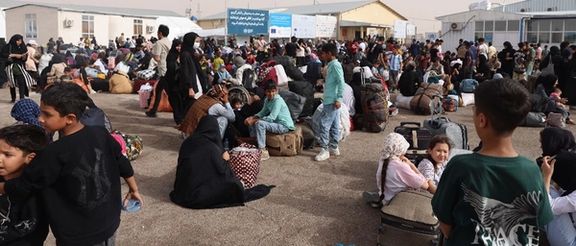
The Taliban’s High Commission for Migrants’ Issues has reported that 26320 Afghan migrants were deported from Iran on Saturday, 5 July, one of the highest daily figures recorded in recent months.
In a statement issued Sunday, the commission said 12574 individuals entered Afghanistan through the Islam Qala border crossing, while 13746 crossed via Pul-e Abrisham in Nimruz province.
The commission stated that the deported migrants collectively received 40.7 million Afghanis in humanitarian assistance. Of those returned, 1257 individuals have so far been relocated to seven northern provinces: Baghlan, Kunduz, Takhar, Balkh, Jowzjan, Badakhshan and Sar-e Pol.
Separately, the Taliban governor’s office in Nimruz reported that at least 65000 Afghan migrants entered the country through the Pul-e Abrisham crossing over the past week alone.
Iran has intensified its deportation of undocumented Afghan nationals in recent months, citing border security and economic pressures. Rights groups and humanitarian organisations have raised concerns about the scale of the returns and the lack of support services for returnees amid Afghanistan’s ongoing humanitarian crisis.