Over 16000 Afghan Migrants Deported From Iran In Single Day, Says Taliban
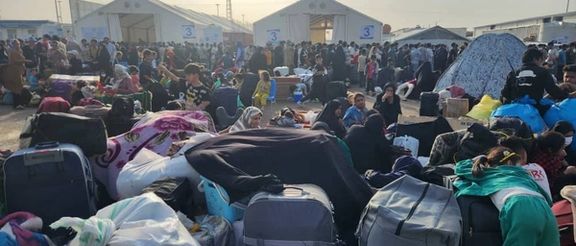
The Taliban’s High Commission for Migrants’ Affairs has reported that more than 16000 Afghan migrants were deported from Iran in a single day on Tuesday, 8 July.
The Taliban’s High Commission for Migrants’ Affairs has reported that more than 16000 Afghan migrants were deported from Iran in a single day on Tuesday, 8 July.
According to figures released by the commission, 13324 individuals returned to Afghanistan via the Islam Qala border crossing, while 3289 crossed through the Pul-e-Abrisham border crossing.
The commission also stated that on the same day, 2010 migrant families re-entered the country through Islam Qala and 496 families through Pul-e-Abrisham.
In addition, the Taliban reported that 237 Afghan migrants returned from Pakistan through the Spin Boldak border crossing and another 255 via the Torkham crossing.
Iran and Pakistan have significantly increased deportations of undocumented Afghan nationals in recent months, citing security and legal concerns. Human rights groups have raised alarms over the conditions faced by deportees, many of whom lack access to basic services upon return.

Pakistani media have reported that security forces killed eight militants from Tehreek-e-Taliban Pakistan (TTP) as they attempted to cross into Bajaur district from Afghanistan’s Kunar province on Tuesday.
According to Dawn newspaper, citing security sources, the militants were intercepted and killed during an intelligence-based operation in the mountainous Lowi Mamund area of Bajaur. The Pakistani military has not yet issued an official statement regarding the incident.
Following the operation, security forces reportedly increased surveillance and patrols along the border to prevent further infiltration by militants based in Afghanistan.
Residents of the area said the clashes between security personnel and militants lasted for several hours. One child was reportedly injured during the fighting.
Separately, local sources reported heavy clashes between the army and TTP fighters in the Ghanam Shah Mamund area of Bajaur on the same day.
The TTP later confirmed the clashes in a statement, saying that Pakistani forces had attacked its hideouts, but claimed its fighters had managed to escape.
Cross-border attacks and militant infiltration from Afghanistan have been a growing concern for Islamabad, which has repeatedly urged the Taliban authorities in Kabul to prevent TTP militants from using Afghan territory as a staging ground.
Human Rights Watch (HRW) has welcomed the International Criminal Court’s decision to issue arrest warrants for two senior Taliban officials, calling the move a vital step toward accountability for human rights abuses in Afghanistan.
Liz Evenson, HRW’s director for international justice, said the warrants send an important signal that “repressive actions” will not go unpunished. “The international community should back the ICC in its critical work in Afghanistan and globally,” she added.
Evenson urged the prosecutor’s office to keep investigating alleged crimes by the Taliban, Islamic State Khorasan (ISIS-K), former Afghan security forces and United States military personnel to ensure justice for all victims.
HRW noted that meaningful justice is essential to breaking Afghanistan’s cycle of violence and impunity. Evenson said the ICC’s action should refocus global attention on the Taliban’s persecution of women, girls and people of diverse gender identities.
Since returning to power in 2021, the Taliban have been accused of imposing “gender apartheid” by barring women from education, work and public life, as well as carrying out arbitrary arrests and torture. In September 2023, HRW reported that Taliban authorities had committed crimes against humanity through gender-based persecution of Afghan women and girls.
The organisation says the Taliban have issued more than 100 decrees severely restricting women’s and girls’ rights, including freedom of movement, expression and assembly.
The Afghanistan Freedom Front (AFF) has hailed the International Criminal Court’s arrest warrants for Taliban leader Hibatullah Akhundzada and chief justice Abdul Hakim Haqqani, calling the move an important step toward justice for victims of Taliban abuses.
In a statement issued Wednesday, the armed opposition group said the warrants mark “a significant milestone” but insisted they are insufficient on their own. “All Taliban leaders and commanders involved in repression, killings, discrimination and other crimes against humanity must be brought to justice,” the AFF said.
The group urged the international community to impose tougher sanctions and other punitive measures on the Taliban, warning against what it described as “rewarding terrorism and extremism on the global stage”. It also criticised what it called a “contradictory” approach by foreign governments toward the Taliban, arguing that Afghanistan has become a safe haven for regional and transnational extremist organisations.
“The Taliban’s so-called fight against ISIS has become a lobbying tool rather than a genuine counter-terror effort,” the statement said.
Nearly four years after the Taliban’s return to power, the AFF contended, international attempts to hold the group accountable have yielded “no meaningful progress or results”. The group called for coordinated legal, political and economic pressure to ensure justice for Afghan victims and to prevent further rights violations.
A senior Taliban official has called on prominent exiled Afghan political and jihadi leaders to return home, promising they will be protected under a general amnesty.
Shahabuddin Delawar, head of the Taliban’s Commission for Contact with Afghan Political Figures, made the appeal at a gathering in Kabul on Tuesday. Addressing veteran jihadi commander Abdul Rab Rasul Sayyaf by name, he said, “Ustad Sayyaf will either die in Türkiye or India; it is better for him to return to his homeland.”
Delawar extended similar invitations to former vice-presidential candidate Mohammad Mohaqiq, former vice-president Karim Khalili and former Balkh governor Ata Mohammad Noor, assuring them that their “life, property and security” would be guaranteed. “If these figures care about Afghanistan and want a dignified life, they should return to the country,” he told the audience.
He added that, apart from private civil claims, “no legal action” would be taken against returnees, noting that Taliban leader Hibatullah Akhundzada has granted them amnesty “even if they committed injustices in the past”.
The Taliban’s commission says it has already issued security guarantees to some former officials and members of the previous security forces. Yet, nearly four years after the Taliban seized Kabul, none of the most prominent political figures from the former government have accepted the offer to return.
Those leaders continue to reject Taliban legitimacy, arguing that the group demands allegiance rather than genuine dialogue. They insist they will not come back without a negotiated political settlement, the formation of an inclusive national government and an end to Taliban dominance. Many have pledged to pursue both political and armed resistance instead.
Their distrust has been deepened, they say, by cases in which former officials invited back by the Taliban were reportedly detained and prosecuted on arrival.
A group of Afghan asylum seekers in India has begun a sit-in protest outside the UNHCR office in New Delhi, demanding the resumption of stalled refugee case processing and an end to deteriorating living conditions.
The protest, which began on Monday, comes amid the suspension of UN assistance and a worsening economic crisis for Afghan refugees in the country.
Qais Malikzada, one of the organisers, told Afghanistan International TV that although many Afghan migrants received refugee cards in 2023 and 2024, the process was halted in 2025 due to major funding cuts to relevant agencies.
According to Malikzada, the suspension has left many asylum seekers unable to pay rent or meet basic needs. He added that the Indian government does not grant legal work rights to refugee card holders, exacerbating their hardship.
Farshad Moradi, another protester, said more than 380 people have joined the sit-in. Their key demand is the urgent resumption of refugee case reviews. He also highlighted the precarious status of undocumented asylum seekers, who are vulnerable to police arrest. He reported that two young Afghan women had already been detained in Kolkata.
“Afghan refugee children are not allowed to attend public schools in India,” he said. “Families are forced to enrol their children in expensive private classes.”
Moradi emphasised that temporary asylum seeker cards lack legal recognition in India and only formal refugee cards are considered valid.
The demonstration follows multiple rounds of unsuccessful discussions between the protesters and UNHCR representatives in New Delhi.
Protesters are calling for faster processing of refugee applications, the issuance of legal refugee cards, and improved access to education, healthcare, housing, and employment rights. They also seek humane treatment by Indian authorities and an end to the harassment of Afghan refugees by security forces.