• العربية
  • پښتو
  • فارسی
Brand
  • Afghanistan
  • Sport
  • Markets
  • Afghanistan
  • Sport
  • Markets
  • Theme
  • Language
    • العربية
    • پښتو
    • فارسی
  • Afghanistan
  • Sport
  • Markets
All rights reserved for Volant Media UK Limited
volant media logo

First Political Consultations Held With Taliban, Says Uzbek FM
Jul 18, 2025, 14:47 GMT+1

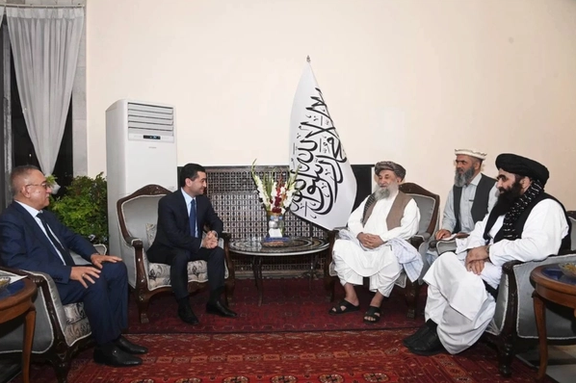
Bakhtiyor Saidov, Uzbekistan’s Foreign Minister, has announced that he held the “first political consultations” with the Taliban during his recent visit to Kabul.

He emphasised Uzbekistan’s continued support for Afghanistan’s deeper integration into regional and global processes that promote peace, stability, and development.

On Thursday, Saidov shared photos of his meetings with senior Taliban officials, including Acting Foreign Minister Amir Khan Muttaqi, Acting Interior Minister Sirajuddin Haqqani, and the group’s Prime Minister, Mullah Hassan Akhund.

Saidov said the political consultations took place during his meeting with the Taliban’s foreign minister, though he did not provide further details. He reaffirmed Uzbekistan’s commitment to regional connectivity, shared water management, economic cooperation, educational support, and the cultural revival of Afghanistan.

Security Cooperation

During his Kabul visit, the Uzbek foreign minister held separate meetings with Taliban leaders. In his meeting with Interior Minister Sirajuddin Haqqani, Saidov said the two sides discussed growing cooperation in the fields of security, law enforcement, and regional stability. While he did not elaborate, he acknowledged concerns over the infiltration of extremist groups and drug trafficking, particularly along the country's 144-kilometre shared border.

Writing on X (formerly Twitter), Saidov said he commended the Taliban’s Interior Ministry for “significant improvements” in Afghanistan’s overall security situation and efforts to combat drug production.

Economic Cooperation

Expanding economic ties was another major focus of Saidov’s visit. He confirmed that he discussed trade, humanitarian cooperation, and economic engagement with Taliban Prime Minister Mullah Hassan Akhund.

Saidov highlighted the signing of the Trans-Afghan Railway feasibility study agreement between Uzbekistan, the Taliban, and Pakistan, calling it a vital step toward Afghanistan’s regional integration. The Taliban’s Foreign Ministry previously confirmed that the agreement had been signed by the Taliban’s Ministry of Public Works, Uzbekistan’s Ministry of Transport, and Pakistan’s Ministry of Railways.

Amir Khan Muttaqi described the project as more than a transit corridor, calling it one of the first steps toward strategic connectivity. Pakistan’s Foreign Minister Ishaq Dar, who also attended the signing, said the agreement, linking Central Asia to Pakistani ports via Afghanistan, was the outcome of intensive negotiations and sustained engagement.

Dar noted that the proposed Uzbekistan–Afghanistan–Pakistan railway is expected to create a new corridor for trade between Central and South Asia, significantly contributing to regional commerce and economic growth.

Saidov also stated that Uzbekistan is prepared to strengthen cooperation with Afghanistan in infrastructure, transport, energy, and education. He added that Afghanistan should serve as a bridge between Central and South Asia.

Invitation to Taliban Prime Minister

Hamidullah Fitrat, deputy spokesperson for the Taliban administration, provided additional details of the meeting between Saidov and Mullah Hassan Akhund on X.

According to Fitrat, the Uzbek foreign minister extended a formal invitation to the Taliban prime minister to visit Uzbekistan. Citing Saidov, he added that hundreds of meetings have already taken place between Uzbekistan and the Taliban, reflecting strong ties between the two sides.

The Taliban prime minister was quoted as saying that Uzbekistan understands problems are best resolved through dialogue and engagement, and has therefore adopted a “constructive approach” to its relationship with the Taliban.

Despite deepening political and economic ties, Tashkent has not formally recognised the Taliban government.

Most Viewed

Taliban Ignore Afghanistan’s Interests By Backing Militants, Says Pakistan Army Chief
1

Taliban Ignore Afghanistan’s Interests By Backing Militants, Says Pakistan Army Chief

2

United Nations Delivers Education Kits To Four Million Afghan Children

3

Taliban Renews Call For China To Launch Aynak Copper Mine

4

Taliban Leaders In South-West Hold Security Meet In Kandahar

5

Afghan Deportations Is Strategic Mistake, Says European Parliament Member

•
•
•

More Stories

Taliban Morality Police Legitimate Target After Arrest Of Afghan Women, Declares AFF

Jul 18, 2025, 13:38 GMT+1

The Afghanistan Freedom Front (AFF) has declared the Taliban’s Ministry for the Propagation of Virtue and Prevention of Vice a legitimate military target following the arrest of dozens of women by Taliban morality police in Kabul.

In a statement issued on Friday, the AFF condemned the arrests as a violation of moral values, human rights, and Afghanistan’s deeply rooted religious and cultural traditions. The group warned that the Taliban and its enforcers would bear direct responsibility for the consequences of what it called “inhumane actions” and pledged retaliation.

The announcement follows the detention of nearly 100 young women by Taliban forces in the Shahr-e Naw area of Kabul on Wednesday. According to sources who spoke to Afghanistan International, the women were taken from streets, markets, and hospitals and transferred to facilities operated by the Taliban’s morality police.

The AFF condemned the mass arrests as a deliberate attack on personal freedoms, stating: “Violating personal boundaries, trampling on human dignity, social status, and women’s fundamental rights and freedoms is neither legitimate, justifiable, nor tolerable.”

The group vowed continued resistance against what it described as the Taliban’s “violent, inhumane, and criminal behaviour.”

The Taliban has not issued a formal statement explaining the motive behind the mass detentions. Human rights groups have repeatedly criticised the group for its treatment of women and the expansion of morality policing across Afghanistan.

Germany Deports 81 Afghan Refugees With Criminal Records To Kabul

Jul 18, 2025, 11:46 GMT+1

Germany has deported 81 Afghan refugees to Kabul, marking the country’s second such deportation since the Taliban returned to power in 2021.

According to the Interior Ministry, all individuals had been ordered to leave and were identified as having criminal records or being a threat to public security.

The group was flown from Leipzig Airport to Kabul on Friday via a Qatar Airways flight. This marks the first large-scale deportation of Afghan nationals under the new German government led by Chancellor Friedrich Merz.

The Interior Ministry said the action is part of the government’s coalition agreement, which prioritises the deportation of foreign nationals convicted of crimes or deemed dangerous. Officials stressed that public safety remains the top priority in implementing the policy.

German media reported that the deportees were transported to Leipzig Airport in several buses, with at least one individual reportedly restrained with leg shackles.

Under former Chancellor Olaf Scholz, Germany carried out a similar deportation in which 28 Afghan nationals with criminal records were returned to Afghanistan.

Separately, German politician Alexander Dobrindt recently stated he is open to negotiating with "those in charge" in Afghanistan to facilitate further deportations of Afghan criminals.

Germany’s Foreign Ministry has confirmed that Berlin maintains only technical-level contact with the Taliban and has no formal diplomatic relations with the group.

Pak FM Tells Taliban Security Must Improve For Regional Trade & Transit Projects

Jul 18, 2025, 10:20 GMT+1

Pakistani Foreign Minister Ishaq Dar has emphasised that resolving security challenges and strengthening border management are essential for unlocking economic potential and advancing regional connectivity.

Dar made the remarks during a meeting in Kabul with Sirajuddin Haqqani, the Taliban’s acting interior minister. According to a statement from the Taliban’s Ministry of Interior, the talks focused on three key issues: regional security, counter-narcotics efforts, and the development of cross-border economic initiatives.

Dar stressed that sustainable regional growth cannot be achieved without addressing security threats and improving coordination at the borders. He also highlighted the importance of closer security cooperation between Pakistan and Afghanistan.

The meeting coincided with the signing of a feasibility study agreement for the Trans-Afghan railway project, a joint initiative between Afghanistan, Pakistan, and Uzbekistan. Officials from all three countries have stated that the success of the railway, intended to boost regional trade and connectivity, depends on long-term stability along the proposed transit routes.

In a separate meeting, Haqqani met with Uzbek Foreign Minister Bakhtiyor Saidov and Transport Minister Ilhom Makhkamov to discuss progress on the railway project. The Taliban’s Interior Ministry said the two sides also explored ways to expand political, economic, and cultural ties between Kabul and Tashkent.

Saidov noted that trade between Afghanistan and Uzbekistan has nearly tripled over the past year. He also reaffirmed Uzbekistan’s support for Afghanistan’s participation in international forums, assistance in resolving the Afghan migrant crisis, and efforts to unfreeze the country’s central bank assets.

Iran Faces Civil Society Outcry Over Mass Expulsions Of Afghan Refugees

Jul 18, 2025, 09:31 GMT+1

More than 300 Iranian women’s rights activists, academics, journalists, artists, and civil society campaigners have issued a joint statement condemning the mass deportation of Afghan migrants from Iran.

The signatories described the ongoing expulsions as part of a “deliberate project of exclusion and repression,” warning that refugees, migrants, and Iranian citizens of Afghan descent are once again being made scapegoats amid rising political tensions.

The statement argues that, under the guise of regulating undocumented foreigners, Iranian authorities are engaged in efforts to erase marginalised communities, suppress dissent, and reinforce national and gender-based hierarchies.

Particular concern is raised for Afghan women, who are described as among the most at-risk groups. The activists note that many Afghan women in Iran are the sole breadwinners for their families and live without stable legal protections. Deporting them, they warn, will return them to a country where women are barred from working and have no viable means to support themselves or their children.

The statement also highlights the plight of girls born and raised in Iran who are now being returned to Afghanistan, where access to education for girls is currently banned under Taliban rule.

The signatories argue that deportation in this context is not simply a matter of physical relocation but constitutes “exile, homelessness, and, in some cases, direct threats to life.”

Calling for urgent action, the activists urged civil society organisations, academics, journalists, and artists not to remain silent in the face of what they described as the “systematic expulsion of the other.”

In recent weeks, Iran has significantly increased the pace of deportations of undocumented Afghan migrants, particularly following the ceasefire with Israel. While Iranian authorities have framed the move as a plan to “organise undocumented foreigners,” international organisations have described the situation as a growing humanitarian crisis.

Uzbekistan, Pakistan, Taliban Sign Railway Study Agreement In Kabul

Jul 17, 2025, 16:53 GMT+1

The Taliban’s Foreign Ministry has announced the signing of a feasibility study agreement for the Trans-Afghan railway project.

The agreement was signed between the Taliban’s Ministry of Public Works, Uzbekistan’s Ministry of Transport, and Pakistan’s Ministry of Railways during a ceremony held in Kabul. The event was attended by the foreign ministers of all three parties.

On Thursday, the foreign ministers of Uzbekistan and Pakistan arrived in Kabul to finalise and formalise the agreement.

Amir Khan Muttaqi, the Taliban’s acting foreign minister, said the project represents more than a mere transit route, describing it as a foundational move toward a broader strategic partnership.

Pakistan’s Foreign Minister Ishaq Dar noted that the agreement, reached after extensive negotiations, is intended to connect Central Asia to Pakistani ports via Afghanistan. He emphasised that the railway would establish a new corridor for the transit of goods between Central and South Asia, fostering regional trade and promoting economic development.