Pakistan’s Interior Minister Arrives In Kabul For Security Talks With Taliban
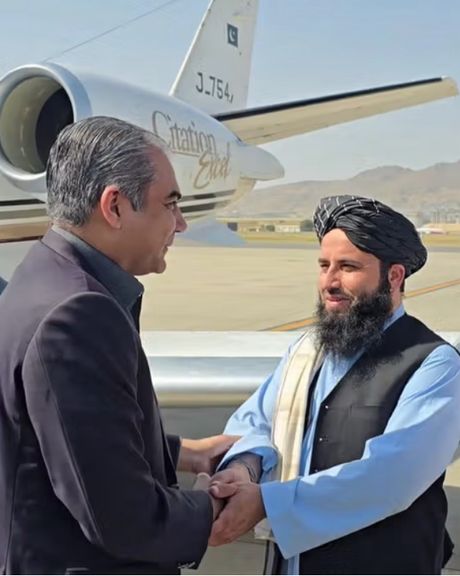
Pakistan’s Interior Minister, Mohsin Naqvi, arrived in Kabul on Sunday, leading an official delegation for talks with the Taliban.

Pakistan’s Interior Minister, Mohsin Naqvi, arrived in Kabul on Sunday, leading an official delegation for talks with the Taliban.
He was accompanied by Mohammad Sadiq, Pakistan’s Special Representative for Afghanistan, and another senior official from the Interior Ministry.
Mohammad Nabi Omari, Deputy Interior Minister of the Taliban, welcomed the Pakistani delegation at Kabul Airport.
Sources earlier told Afghanistan International that Naqvi is expected to hold discussions with Taliban Interior Minister Sirajuddin Haqqani on security issues.
Relations between the Taliban and Pakistan have remained tense and inconsistent since the Taliban returned to power in Afghanistan. Islamabad accuses the Taliban of sheltering Tehreek-e-Taliban Pakistan (TTP) fighters, who allegedly use Afghan territory to launch cross-border attacks against Pakistan.
Taliban officials have consistently denied these allegations, claiming that Pakistan’s internal security failures are being unfairly blamed on Afghanistan.


The Taliban foreign minister has denounced the International Criminal Court’s decision to issue arrest warrants for the group’s leader and chief justice, calling it “unjust” and “politically motivated.”
Amir Khan Muttaqi said the ICC’s ruling was “unenforceable” and claimed the Taliban bears no responsibility for it.
Speaking at a gathering at the Taliban’s Foreign Ministry on Sunday, Muttaqi asserted that the group’s declaration of a general amnesty had saved hundreds of thousands of lives and ensured security across the country.
He also said the Taliban had begun what he described as a “constructive engagement agenda” with regional and international actors but had been met with threats instead of recognition.
Muttaqi reiterated the Taliban’s rejection of the court’s decision, stating that the group would not remain silent in the face of the arrest warrants and would voice its opposition globally.
On 7 July, the International Criminal Court issued arrest warrants for Taliban supreme leader Hibatullah Akhundzada and Chief Justice Abdul Hakim Haqqani. The court accuses the two of crimes against humanity, including the systematic persecution of women and girls in Afghanistan.
The ICC stated that there are reasonable grounds to believe the two senior Taliban figures committed crimes against humanity based on gender persecution.
Over the past four years, Akhundzada has issued dozens of decrees severely restricting Afghan women’s rights in both private and public life.

Taliban morality police have detained dozens of young women in the Qala-e-Fathullah and Kote Sangi neighbourhoods of Kabul in a continued crackdown on alleged violations of the group’s dress code.
Sources told Afghanistan International that the detentions took place on Friday and Saturday, with women being removed from restaurants, streets, and shopping centres and transported to unknown locations.
Eyewitnesses reported that Taliban officers used physical force during the arrests and said no female officers were present during the operations.
In Qala-e-Fathullah, women were reportedly taken into custody without explanation, with officers entering public venues and forcibly detaining them. In Kote Sangi, sources described women being beaten before being forced into vehicles.
The arrests are part of a broader campaign by the Taliban’s Ministry for the Propagation of Virtue and Prevention of Vice, which has been targeting women in several Kabul neighbourhoods in recent days.
Earlier last week, nearly 100 women were detained in the Shahr-e Naw and Dasht-e Barchi areas of Kabul under similar circumstances. Reports indicate that some women were apprehended in markets, streets, and even hospitals, with no formal charges disclosed.
Residents in other areas, including Reg Rishan and Taimani, have also reported increased Taliban patrols and further detentions of women.
The Taliban have not issued an official statement regarding the reasons for the latest arrests.

Abdul Salam Hanafi, the Taliban’s deputy prime minister for administrative affairs, said on Saturday that between 30000 and 35000 Afghan migrants are being forcibly deported from Iran each day through the Islam Qala border crossing.
Hanafi made the statement during a meeting in Kabul with Filippo Grandi, the United Nations high commissioner for refugees. He said the large-scale deportations have created serious challenges and called for support from the UN refugee agency and other humanitarian organisations to assist with the permanent resettlement and reintegration of returnees.
According to Taliban officials, Grandi acknowledged the volume of deportations and said the Taliban had managed the situation effectively. His visit to Kabul comes amid a sharp rise in deportations from both Iran and Pakistan.
During the meeting, Acting Foreign Minister Amir Khan Muttaqi said that Afghan citizens face mounting hardships and require assistance from international agencies. He also urged that Afghan migrants be given time to settle financial obligations before being returned.
In recent months, hundreds of Afghan families have been deported from Iran without receiving unpaid wages or recovering rental deposits. Many were not permitted to take their belongings with them.
In a separate meeting with Taliban refugee minister Abdul Kabir, Grandi announced plans to hold a trilateral meeting with Iran and Pakistan to address the situation. He also confirmed plans to visit Iran to further assess the impact of the deportations.

Senior figures from two major Afghan opposition groups have condemned the recent wave of arrests of women and girls by the Taliban in Kabul, warning that the actions will not go unanswered.
Dawood Naji, head of the political committee of the Afghanistan Freedom Front, and Ali Maisam Nazary, head of foreign relations for the National Resistance Front, both criticised the Taliban’s ongoing crackdown on women, calling it part of a wider campaign of repression.
In recent days, the Taliban have detained dozens of women and girls from various areas across the capital. The group has not issued any formal response to the growing domestic and international criticism regarding the detentions.
Naji, in a statement on social media, said the Taliban’s actions had exceeded the limits of human, religious, and cultural norms. He criticised those remaining silent, suggesting that inaction equates to complicity. He called for reflection on how much further such repression can be tolerated.
Nazary also responded to the arrests, describing them as only a small part of the broader suffering inflicted on Afghan women under Taliban rule. He linked the current situation to the Taliban’s systematic exclusion and targeting of women.
He further stated that regional and international actors have failed to address the root causes of Afghanistan’s humanitarian crisis, warning that as long as the Taliban remain in control, Afghan women will continue to seek safety and a better life abroad.

Taliban authorities have detained dozens of young women in western Kabul, marking a renewed wave of arrests targeting women in the Afghan capital.
Local sources in Dasht-e Barchi reported that officers from the Taliban’s Ministry for the Propagation of Virtue and Prevention of Vice carried out the arrests on Friday, and Saturday.
According to eyewitnesses, women were taken from multiple locations, including 20-Metre Road, Barchi City Centre, and two minivans in Rasalat Alley. Witnesses also reported that Taliban enforcers used force during the arrests and that no female officers were present.
The location of the detainees remains unknown, and families have expressed growing concern over their well-being.
This marks the second such operation within days. On Wednesday, nearly 100 young women were detained in the Shahr-e Naw area of Kabul. Local sources reported that women were taken from streets, markets, and hospitals and transferred to Taliban-run detention centres. Most of the women were reportedly in compliance with Islamic dress codes at the time of arrest.
Footage obtained by Afghanistan International shows women visibly distressed and surrounded by Taliban enforcers during the raids. Some of those detained were released after spending one night in custody, following written guarantees submitted by their families.
The latest arrests coincided with reports of Taliban morality police conducting inspections at restaurants in the Shahr-e Naw district on the same day.
The Taliban has not issued an official statement regarding the reason for the detentions.
In the wake of the arrests, the Afghanistan Freedom Front announced that the Ministry for the Propagation of Virtue would now be considered a legitimate military target. Former Afghan officials and political leaders have also condemned the arrests, describing them as unlawful and a violation of basic rights.