Two Taliban Fighters Killed In Internal Clash Over Land In Sar-e Pol

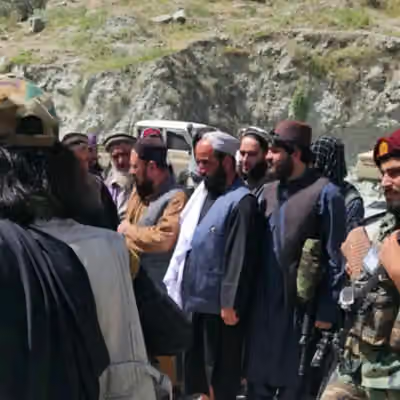
Two Taliban fighters were killed during an internal clash over land in Afghanistan’s Sar-e Pol province, local sources told Afghanistan International.

Two Taliban fighters were killed during an internal clash over land in Afghanistan’s Sar-e Pol province, local sources told Afghanistan International.
The incident occurred in the village of Kuchan in the Kohistan district on Tuesday. According to local sources, the initial clash broke out between Taliban members over a land dispute, leaving one fighter dead. Taliban intelligence officials later arrested the alleged perpetrator.
While transporting the suspect to the district center, the Taliban intelligence vehicle was ambushed near the Khawamat crossroads by armed men, reportedly riding six motorcycles. A second gunbattle ensued, during which the detained fighter was also killed, sources said.
The Taliban have not commented publicly on the incident or the reported deaths.
This is not the first instance of infighting among Taliban ranks. Similar internal disputes have previously resulted in violence in provinces including Baghlan, Badakhshan, and other areas.
United Nations High Commissioner for Refugees has called for a trilateral meeting of the Taliban and Iranian officials to address mass deportation of Afghan migrants, warning that Afghanistan is not equipped to absorb such a large influx.
Filippo Grandi, the UN refugee chief, made the appeal during his visit to Iran on Tuesday, where he met with Iranian Interior Minister Esmail Momeni to discuss the situation.
Grandi stressed that Afghanistan lacks the economic and social capacity to manage the return of tens of thousands of migrants in a short period and urged a phased and voluntary repatriation process.
Momeni said individuals suffering from serious health conditions or whose lives are in danger would not be deported. He added that the deportation process had not involved the use of force and emphasised the cultural, historical and religious ties between the two countries.
Iranian officials said they have worked to prevent the deportation policy from creating tensions between Iranian citizens and Afghan migrants.
Grandi called for a collaborative approach and proposed a three-party dialogue between Iran, the Taliban, and the UNHCR to develop a structured and humane return mechanism.
Nader Yar Ahmadi, an adviser to Iran’s interior minister and head of the Bureau for Aliens and Foreign Immigrants Affairs, said international assistance has been insufficient. He noted that aid received so far does not match the scale of Iran’s efforts to manage the Afghan refugee population.
Iran and Pakistan have deported hundreds of thousands of Afghans in recent months, citing visa expirations and security concerns. Human rights groups have warned the forced returns could trigger a worsening humanitarian crisis in Afghanistan.

Mawlawi Abdul Malik former deputy head of Panjshir province’s council of religious scholars has been hospitalised in Rokha district after his health reportedly deteriorated during Taliban custody, local sources said Tuesday.
Taliban forces arrested Abdul Malik on July 8 at a mosque in Kabul’s 15th police district and transferred him to an undisclosed location. His family was initially unaware of his whereabouts or the authority responsible for his detention. It was later confirmed that he had been moved from Kabul to Panjshir.
Sources close to Abdul Malik said his physical and mental condition had worsened following two weeks in detention, during which he was allegedly subjected to torture.
This marks the second time the Taliban have detained Abdul Malik. In 2022, he was arrested over alleged links to the anti-Taliban resistance front and was held for nearly two years before being released. His relatives have denied any connection to resistance forces.
Abdul Malik is known as one of Panjshir’s most respected religious figures. He served for years as deputy head of the provincial religious council and headed two Islamic seminaries, Mawlawi Abdul Wahid and Bibi Aisha Siddiqa, in Abdullahkhel village, Dara district.
Since regaining control of Afghanistan in 2021, the Taliban have arrested thousands of individuals across the country on suspicion of supporting or participating in armed resistance movements.

Newly obtained documents shared with Afghanistan International allege that Abdul Hakim Sharei, the Taliban’s justice minister, has unlawfully detained four civilians in a private detention facility located within the Ministry of Justice compound in Kabul.
The detentions were reportedly carried out without formal judicial orders.
Afghanistan International had previously reported on the existence of a clandestine prison operating inside the Taliban-controlled Ministry of Justice. Reliable sources have confirmed that, in recent years, multiple individuals have been held in this facility on the direct orders of Minister Sharei, bypassing legal channels.
In the latest case, four senior officials from the Hazrat Wali Asr Charity Foundation, an organisation affiliated with Ayatollah Vaezzada Behsoodi, were detained during a visit to the ministry for registration purposes. According to sources, the arrests followed inquiries by the individuals into the foundation’s financial matters. The detentions were made at the direct order of the minister.
The detainees have been identified as Haji Mohammad Taqi Ansari, head of the foundation; Hassan Nikzad, deputy head; Baqer Akhlaqi, office manager; and Wakil Chaman, an adviser to the foundation. They were initially held for several hours within the ministry before being transferred to Taliban intelligence custody, where they remained for approximately one week.
Afghanistan International contacted Abdul Hamid Jihadyar, the Taliban’s Ministry of Justice spokesperson, for comment, but he declined to respond.
This is not the first time reports have surfaced of arbitrary arrests linked to the Ministry of Justice. Earlier, Afghanistan International revealed that Haidar Jan Naemzoi, a former Afghan parliamentarian, was also held in the same private facility.
In a separate incident last December, Sharei reportedly ordered the arrest of 30 residents of the Sanatorium area in Kabul after they opposed forced evictions. Sources said the residents were summoned under the pretext of verifying land ownership documents and subsequently handed over to the police.
Following publication of these incidents, the Taliban’s Ministry of Justice claimed that, under orders from the Taliban leader, the minister holds the authority to detain individuals for up to ten days in land usurpation cases.
While the ministry did not name Naemzoi directly, it appeared to confirm his detention, referring to the arrest of a “rebellious” individual by the anti-land usurpation commission and his subsequent transfer to Kabul provincial authorities.

The National Resistance Council for the Salvation of Afghanistan has condemned the Taliban’s ongoing repression of women and girls, warning that such policies are pushing the country toward instability and darkness.
In a statement issued Tuesday, the council criticised the recent arrests of women in Kabul’s Dasht-e-Barchi neighbourhood and the continued exclusion of girls from education, calling on the international community to act urgently.
The council urged the United Nations, the European Union, the Organisation of Islamic Cooperation and human rights groups to intervene and press for the release of detained women and the reopening of schools and universities for Afghan girls.
According to the statement, the Taliban’s recent actions including the arrest of women and the absence of girls from the 2025 university entrance examination are part of a broader effort to erase women from public life. The council said these policies violate legal and moral standards and warned that the continuation of such practices threatens the country’s stability.
The group also criticised the muted international response to the Taliban’s gender-based restrictions, saying global indifference has emboldened the regime to escalate its crackdown.
Earlier, local sources in Kabul reported that Taliban morality police arrested dozens of young women in Dasht-e-Barchi on Friday and Saturday. Witnesses said the arrests were carried out in public areas, including streets and commercial centres.

Pakistani police carried out another raid in Islamabad’s B-17 sector on Tuesday, detaining several Afghan migrants, including women and children, according to witnesses who spoke to Afghanistan International.
Multiple Afghan residents in the area reported that police entered homes, detained entire families, and transported them to an undisclosed location. One migrant, speaking on condition of anonymity, said officers forcibly entered houses and arrested individuals whose visas had expired.
Another resident confirmed that police arrived to search their home, but the occupants managed to avoid detection and arrest.
While the exact number of arrests on Tuesday remains unclear, a source told Afghanistan International that approximately 50 Afghan nationals, including women and children, had been detained in the area the previous day.
Saturday also saw widespread police raids in various parts of Islamabad, including B-17, with dozens of Afghan families taken into custody. The latest arrests come amid an ongoing crackdown that has seen Pakistan deport dozens of Afghan migrants in recent days, including journalists and civil society activists.
According to figures provided by the United Nations High Commissioner for Refugees (UNHCR), Pakistan deported 286,631 Afghan nationals between April 1 and July 15.
