Iran’s Pezeshkian Open To Visiting Afghanistan To Improve Relations
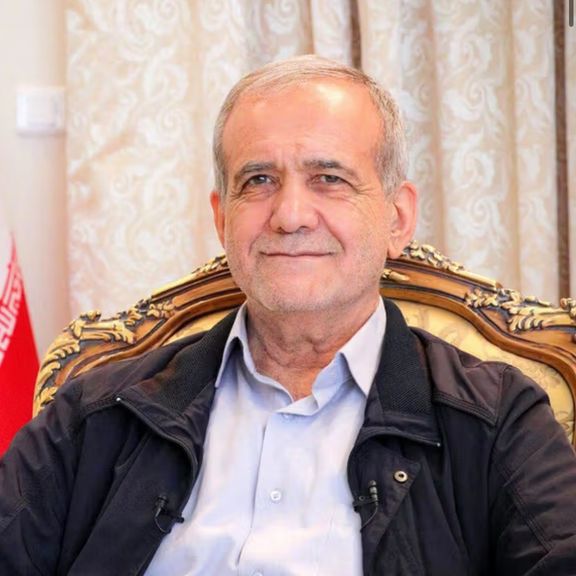
Iranian President Masoud Pezeshkian has expressed his willingness to visit Afghanistan to open what he described as a new chapter in bilateral relations.
Iranian President Masoud Pezeshkian has expressed his willingness to visit Afghanistan to open what he described as a new chapter in bilateral relations.
Speaking during a meeting with officials from Iran’s Ministry of Foreign Affairs, Pezeshkian said that strengthening ties with neighbouring countries is a key priority of his administration’s foreign policy.
The Embassy of the Islamic Republic of Iran in Kabul announced Pezeshkian’s intention in a post on the social media platform X on Saturday.
In the post, Pezeshkian was quoted as saying he is ready to travel to Afghanistan to open a new chapter in the history of relations between the two countries.

Pakistani police have arrested a group of Afghan migrants in Islamabad’s B-17 township, with women and children reportedly among those detained, according to local community leaders.
Afghan residents told Afghanistan International on Saturday that police conducted a raid in the area and detained multiple individuals. One resident shared a video, stating he had entered Pakistan legally but now lives in fear of arrest due to the suspension of visa renewals. He said he witnessed police vehicles transporting Afghan migrants from the area early that morning.
Maiwand Alami, head of the Afghan Council in Islamabad, confirmed the arrests and said police have been conducting wide-scale operations across the capital for the past 10 days. He reported that Afghan families are being detained from their residences daily and transferred to Haji Camp, a facility used for holding deportees.
While the exact number of arrests remains unclear, the Afghan Council said dozens of Afghan nationals have been detained in recent days, including in B-17 township, and some have already been deported to Afghanistan.
The crackdown has intensified following changes to Pakistan’s visa policy for Afghan citizens. The duration of visas has been reduced from three or six months to just one month, and the renewal process has been suspended for more than three weeks. This shift has left thousands of Afghan migrants in legal limbo and at heightened risk of arrest and deportation.
The Refugee Rights division of Human Rights Watch has described recent footage showing the detention of Afghan women and girls in Pakistan as shocking and deeply distressing to the human conscience.
The organisation expressed grave concern over the treatment of Afghan women and minors, warning that their forced deportation poses a serious threat to their safety and dignity.
The footage, released by Afghanistan International, captured the moment Pakistani police detained a group of Afghan women and girls. In one scene, a young girl is seen crying and pleading with officers not to arrest her family, before they are forcibly placed into a police vehicle.
The rights group said thousands of Afghan refugees in Pakistan are living under intense pressure. Many are eligible for relocation to third countries, but ongoing detentions and deportations have disrupted the processing of their resettlement cases and diminished their hopes.
Refugee Rights Watch called on the UN High Commissioner for Refugees (UNHCR), the International Organization for Migration (IOM), and countries including the United States, Canada, Germany, France, and Australia to take immediate action to protect Afghan refugees in Pakistan.
The organisation stressed that now is the time for global solidarity, stating that refugees are not criminals and should be supported rather than punished.
Arrests and deportations of Afghans in Pakistan have increased in recent weeks, coinciding with the suspension of the Afghan visa renewal process.
Authorities in Rawalpindi have intensified efforts to arrest and deport undocumented Afghan nationals, following new orders issued by the city’s police chief to divisions in Rawal, Potohar, and Saddar.
According to Dawn newspaper, the directive instructs police to detain Afghan migrants residing or working in the area without valid legal documents and transfer them to a holding centre at the Government Associate College.
The police chief stated that Afghan Citizen Card (ACC) holders, individuals with expired visas, those lacking legal documentation, and holders of temporary UN cards are all subject to arrest under the new enforcement measures. He expressed dissatisfaction with the performance of station heads in identifying and detaining undocumented migrants and urged officials to use all available resources to implement the directive.
Police officers have also been instructed to submit daily reports directly to the police chief’s office.
Dawn further reported that police have launched operations across various neighbourhoods in Rawalpindi, checking the identities of residents, particularly those living in rented properties.
Earlier, Afghan migrants in Islamabad alleged that police had entered homes without warning, detained families, and taken them into custody.
According to the UN High Commissioner for Refugees (UNHCR), Pakistan deported 286,631 Afghan nationals between 1 April and 15 July.
Pakistan’s Foreign Minister,Ishq Dar, said Islamabad is prepared to take any positive step toward supporting Afghanistan’s future but does not intend to interfere in the country’s internal affairs.
Speaking at the Atlantic Council on Friday, Dar addressed regional tensions with India and the future of Pakistan’s relationship with the United States. He also responded to a question from Afghanistan International regarding Pakistan’s readiness to engage with anti-Taliban groups.
Dar referred to Pakistan’s diplomatic relations with the Taliban, noting that while Pakistan has not officially recognised the group, it has recently elevated its engagement from humanitarian coordination to full embassy-level representation. He said other countries had taken similar steps earlier.
He stated that Pakistan is open to constructive cooperation aligned with shared interests, while reiterating that the country does not seek to involve itself in the internal matters of others and expects the same in return.
In response to a question about whether Pakistan regrets its past support for the Taliban, Dar said the past remains open for discussion. He added that Pakistan has been one of the main victims of terrorism, having suffered significant human and financial losses in its efforts to combat the threat. He said those efforts may have prevented the threat from reaching the United States.
Addressing a separate question about Russia’s engagement with the Taliban, Dar said Moscow’s decision to recognise the group as Afghanistan’s government was an independent one. He added that Pakistan does not currently consider the time appropriate for formal recognition.
Dar is on an official visit to the United States, where he met with his American counterpart in Washington to discuss enhancing bilateral cooperation, combating terrorism, and promoting regional peace.
Pakistan’s Foreign Ministry has dismissed reports suggesting imminent recognition of the Taliban administration, calling the matter “speculation.”
Foreign Ministry spokesperson Shafqat Ali Khan made the remarks during a press conference in Islamabad on Thursday, where he also confirmed that Taliban Foreign Minister Amir Khan Muttaqi is expected to visit Pakistan, with dates to be announced soon.
During the Taliban’s first rule in the 1990s, Pakistan, along with the United Arab Emirates and Saudi Arabia, formally recognised the group. However, none of these countries have extended official recognition to the Taliban since their return to power in August 2021. Current diplomatic engagement remains limited. Russia is the only country known to have recently recognised the Taliban administration.
Khan stated that talks with the Taliban leadership are ongoing, and discussions are focused on security cooperation. He also provided further details about the recent visit to Kabul by Pakistan’s Interior Minister Mohsin Naqvi, who held meetings with senior Taliban officials.
Key topics during those meetings included cross-border security and the presence of Tehreek-e-Taliban Pakistan (TTP) militants. Islamabad accuses the Taliban of allowing TTP fighters to operate from Afghan soil and launch attacks into Pakistan, an allegation the Taliban have consistently denied.
Khan said Taliban officials acknowledged Pakistan’s security concerns, though the group maintains that Islamabad is responsible for addressing its internal security challenges.
Tensions between the two sides have remained high in recent years, with frequent clashes between border forces in areas such as Torkham, Spin Boldak, and Dand Wa Patan.
Despite strained relations, diplomatic ties have advanced, with the Taliban recently upgrading their mission in Islamabad from chargé d’affaires to ambassadorial level. The move followed a trilateral meeting of the foreign ministers of Pakistan, China, and the Taliban held in Beijing earlier this year.