Taliban Hand Public Floggings To 24 People In Sar-e Pul, Laghman
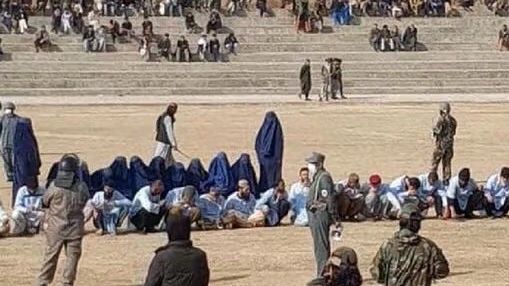
The Taliban’s Supreme Court says local courts in Sar-e Pul and Laghman provinces have sentenced 24 people, including five women, to prison terms and public floggings.

The Taliban’s Supreme Court says local courts in Sar-e Pul and Laghman provinces have sentenced 24 people, including five women, to prison terms and public floggings.
They are accused of offences such as “running away from home, phone contact, and assault.” The punishments ranged from 25 to 39 lashes and eight months to three years in prison.
In a statement issued Wednesday, the court said 21 people, including four women, in Gosfandi district, Sar-e Pul, were sentenced to eight months to three years in prison and 25 to 39 lashes.
In Alishang district, Laghman, three people, including one woman, were given prison terms of one to 1.5 years and 30 to 39 public lashes.
The Taliban have recently stepped up the use of corporal punishment. In the past day alone, they flogged 16 people in Kabul and three others in Khost and Paktia provinces.
Figures from the Taliban Supreme Court indicate that in the past month, the group has publicly punished more than 100 men and women across Afghanistan.
Despite repeated calls from international organisations to end corporal punishment, the Taliban continue to arrest and flog citizens on various charges, describing such actions as part of the “implementation of Islamic Sharia rulings.”

The Taliban’s Supreme Court says local courts in Khost and Paktia provinces have publicly flogged three people convicted of what it described as murder and extramarital sexual relations.
The group sentenced them to between 30 and 39 lashes and one to three years in prison.
In a statement on Wednesday, the court said a primary court in Alisher district, Khost, punished two individuals for murder and extramarital sex, giving each 39 lashes and a three-year prison term.
In a separate statement, the Taliban said another person in Zadran district, Paktia, was convicted of murder and sentenced to 30 lashes and one year in prison.
According to the court, the punishments were carried out in the presence of local officials, court staff and visitors, Taliban fighters, and ordinary citizens.
The floggings came a day after the Taliban punished 16 people in Kabul for allegedly selling alcohol and narcotic tablets. Despite opposition from international organisations to corporal punishment, the Taliban continue to administer public lashings, calling them an “order of Islamic Sharia.”

The US State Department’s 2024 annual report on Afghanistan has documented extensive human rights abuses by the Taliban, including severe restrictions on women, press freedom, arbitrary detentions, suppression of civil liberties.
In the report, released Tuesday, the State Department said respect for the rights of women and girls had sharply declined over the past year. It stressed that the Taliban’s “morality” law imposes sweeping limits on the personal lives of all Afghans, particularly women and girls.
The report also cites extrajudicial and unlawful killings, stating that the Taliban and Islamic State Khorasan Province (ISIS-K) have carried out multiple targeted killings. Reliable information indicates that Taliban security forces arbitrarily killed civilians in Panjshir, Kunduz, Kabul, Nimruz, Ghazni, Khost, Jowzjan, Faryab, Takhar, Sar-e Pul and Herat provinces.
According to the State Department, these killings occurred in areas where the National Resistance Front of Afghanistan operates, with some victims being former military personnel and government employees. The Taliban, it said, have neither acknowledged responsibility for such killings nor established accountability mechanisms.
On press freedom, the report said the Taliban have imposed severe restrictions on the media, threatening, arresting and abusing journalists. More than 180 violations of press freedom were recorded over the past year, alongside widespread censorship and restrictions on internet access.
The report also documents the use of torture and corporal punishment, noting that the Taliban have conducted public lashings, beatings and executions without due process. Citing UNAMA figures, it said that in 2023 more than 360 instances of corporal punishment were recorded, affecting both men and women.
Contrary to official statements, the Taliban have recruited and trained children for their armed forces. In 2023, more than 340 children were used, some in combat roles and others in support positions. In Badakhshan province, about 30 boys aged 10 to 18 were reportedly undergoing training at a military facility.
The report further highlights arbitrary arrests and enforced disappearances, with detainees often denied access to lawyers, family contact and judicial proceedings. Women’s rights activists, journalists and critics of the Taliban are among those most affected.
On refugee protection, it said the Taliban have provided only limited assistance to returnees while creating obstacles for international organisations working to register and support internally displaced persons. Taliban morality police have reportedly been stationed at border crossings to enforce strict rules on returnees.
The State Department concluded that the Taliban show no commitment to respecting international human rights law and frequently disregard existing laws. It called on the international community to closely monitor the situation in Afghanistan and take effective action to protect the rights of its people, particularly women and children.

Sima Samar, the former chair of the Afghan Independent Human Rights Commission, has called on women and men to continue resisting the Taliban’s oppression, marking the fourth anniversary of the group’s return to power.
Speaking to Afghanistan International on Tuesday, Samar said 15 August 2021 was “the darkest day” for the people of Afghanistan and for herself personally. She praised the resilience of Afghan women, noting that despite severe restrictions and pressure, many continue to stand firm.
Samar expressed hope that women’s resistance will persist, emphasising that the struggle is not solely a women’s issue but one that affects the fate of 40 million people, particularly children.
She sharply criticised pro-Taliban lobbying, accusing such efforts of attempting to mislead the public into believing the group had changed. The past four years, she said, have proved otherwise, with the Taliban continuing policies such as closing both girls’ and boys’ schools in areas under their control, practices dating back two decades.
The Taliban seized power in Afghanistan in August 2021 and have since imposed sweeping restrictions, particularly on women and girls, depriving them of basic rights including education, employment, and freedom of movement.

Four years after the Taliban’s return to power, Afghan women are living shorter and less healthy lives as a result of the group’s restrictive decrees, the United Nations said on Monday.
In a statement issued on 11 August, the UN said the Taliban have introduced a series of measures limiting the rights of women and girls, with “devastating” consequences. It reported that more than 78 percent of Afghan women are neither in education nor employed, making it increasingly difficult for them to find work.
The UN warned that this exclusion means nearly half of Afghanistan’s potential workforce is making no significant contribution to the economy, compounding the crisis in a country already facing economic collapse.
Due to women’s restricted access to healthcare, maternal mortality is projected to rise by 50 percent by 2026, the UN said, attributing the increase largely to the Taliban’s discriminatory policies.
It also reported an increase in child marriage and growing levels of violence against women, both at home and in public.
Afghan women have not only been excluded from public life but, according to the UN, 62 percent say they have no role in decision-making even within their own households.

The Taliban’s morality police have detained a man in Balkh province on charges of “insulting sacred beliefs” and making controversial comments about Islamic history, the group’s Ministry for the Propagation of Virtue and Prevention of Vice said.
In a statement on 11 August, ministry spokespersons said the man, identified as Jamshid, a resident of Balkh, was tracked down and detained by morality police.
Obaidullah Haqqani, head of the ministry’s directorate in Balkh, alleged that the suspect had made “contradictory remarks on social media about the existence of God and the Battle of Uhud, which hurt people’s religious sentiments.”
The case has been referred to Taliban courts for “Sharia-based” proceedings, according to the ministry.
The Taliban have previously detained multiple people on similar charges. In the most recent case, a teacher in Paktika province was arrested for allegedly “insulting the Prophet of Islam” and later sentenced to death by a Taliban court.
