Taliban Publicly Flog Man & Woman In Jowzjan For ‘Illicit Relations’
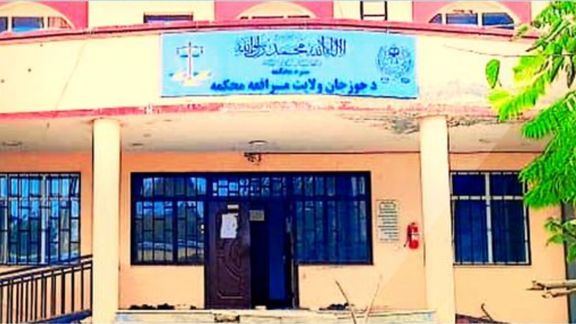
A Taliban court said Saturday it publicly flogged a man and a woman in northern Jowzjan province after convicting them of “illicit relations.”

A Taliban court said Saturday it publicly flogged a man and a woman in northern Jowzjan province after convicting them of “illicit relations.”
According to the Taliban’s judiciary, the pair were sentenced to prison terms ranging from six months to one year and 15 lashes each. The punishment was issued by the primary court in Aqcha district and carried out after being approved by the Taliban’s Supreme Court.
The Taliban have punished hundreds of people over the past four years on charges of “illicit relations” and have also resumed enforcing capital punishment. In several provinces, executions have been carried out in public in the presence of senior Taliban officials.
Human rights organisations have condemned public punishments as degrading and in violation of international human rights standards.
Observers say the Taliban are gradually reverting to policies from their 1990s rule, when public executions and floggings became defining images of their regime. Videos of women and men being executed in sports stadiums remain symbolic of that period.
In contrast, the Taliban have now banned filming or broadcasting of such punishments. Taliban forces routinely confiscate phones and cameras from people entering stadiums or public squares before punishments are carried out.


Financial aid from Gulf countries to the Taliban, intended to support the relocation of Tehreek-e-Taliban Pakistan (TTP) families, has been suspended due to concerns over transparency, sources told Afghanistan International.
The suspension followed the Taliban’s failure to provide financial details on how the money was spent on relocating families to Ghazni province, the sources said.
Under a pilot scheme, one Gulf Arab country provided $6 million to resettle about 2,000 TTP families. That country has now conditioned further support on accountability and clearer reporting from the Taliban.
According to the sources, the Taliban secretly moved dozens of families from the Gulan camp in Khost and border areas of Paktika to refugee settlements in Ghazni, paying each family member $40 a month.
The Taliban had earlier asked Pakistan to support relocating TTP fighters from eastern and southern Afghanistan to other provinces, but the broader international backing they sought has not materialised.
TTP forces are believed to be concentrated in Nangarhar, Khost, Paktia, Paktika and Kunar provinces. The Taliban promised to move them to Ghazni, Helmand and the north, but many TTP fighters reportedly refused the resettlement.
Pakistan had considered a 30-billion-rupee resettlement plan, but dropped it over distrust of Taliban leadership. Defence Minister Khawaja Asif said the Taliban had demanded 10 billion rupees to relocate fighters away from border areas, but declined to guarantee they would not return.
Islamabad accuses the Taliban of harbouring TTP militants and Baloch separatists. It claims some Afghan Taliban factions remain allied with the TTP, which Pakistan says fields about 6,000 fighters on Afghan soil.
Pakistan’s military has repeatedly struck TTP positions across the border. On Tuesday, Pakistani jets bombed sites in Khost and Nangarhar provinces. The Taliban condemned the attacks, warned of consequences and summoned Pakistan’s ambassador.

The Taliban governor of Panjshir has warned that foreign backing for opposition groups and their gatherings abroad could drag Afghanistan into civil war.
Mohammad Agha Hakim made the remarks at a public meeting in Shutul district on Thursday. Without naming countries, he said Afghanistan’s “enemies” were attempting to unite Taliban opponents under different banners to push the country to its past. He urged citizens to support Taliban rule.
Hakim also told the audience not to allow “tested figures and political profiteers” to undermine national unity.
His comments follow reports that a meeting of Taliban opponents planned in Islamabad was postponed under Taliban pressure. The Pakistani daily The Nation reported that Taliban Foreign Minister Amir Khan Muttaqi raised strong objections with his Pakistani counterpart, Ishaq Dar, during talks in Kabul on 20 August, leading to the conference being delayed.
Opposition groups have organised multiple meetings abroad since the Taliban seized power in 2021, but the Islamabad gathering was expected to be the first public assembly bringing together Afghanistan’s diverse political movements. It has now been postponed three times.
Analysts say the Taliban see such efforts as a direct challenge to their political legitimacy and fear the emergence of a united platform for opponents in the region.

More than 23,000 fighters from international terrorist groups are active in Taliban-controlled Afghanistan, posing a serious threat to regional and global security, Russia’s Security Council secretary said Monday.
In an article for Rossiyskaya Gazeta, Sergei Shoigu wrote that Russian estimates indicate about 20 international militant groups are present in Afghanistan with a combined strength exceeding 23,000. He said the greatest concern is the Khorasan branch of ISIS, which Moscow believes operates training camps and support bases in the east, north and north-east of the country.
Shoigu said the Taliban government “is taking measures to fight terrorism to the extent it can” and regularly kills ISIS fighters, but argued that Western sanctions have weakened its ability to counter the threat. He also claimed fighters from other regions were being moved into Afghanistan, alleging that Western intelligence services were attempting to destabilise the area by supporting extremist groups hostile to the Taliban.
The Taliban have issued conflicting statements on ISIS’s presence, at times insisting the group has been “suppressed” while also reporting operations against its cells. The UN Security Council has repeatedly confirmed the continued activity of ISIS-K and other groups in Afghanistan, though the Taliban reject those findings.
Shoigu further warned that Western powers, having lost influence in Afghanistan, are planning to restore NATO’s military infrastructure in the region. He noted that envoys from the United States, the UK and Germany have recently travelled frequently to Kabul despite publicly ruling out recognition of Taliban rule.
A recent UN report said the Taliban provide a permissive environment for foreign terrorist groups, with several al-Qaeda-linked training camps operating across Afghanistan, including three newly established sites where al-Qaeda and Tehreek-e-Taliban Pakistan (TTP) fighters are reportedly being trained.

The Taliban’s Defence Ministry has warned Pakistan of consequences following airstrikes in eastern Afghanistan that it said killed civilians, including women and children.
In a statement issued late Thursday, the ministry condemned the strikes in Nangarhar and Khost provinces as “brutal and cruel,” saying they would only deepen divisions between the people of both countries and fuel animosity. It added that “such irresponsible attacks will have consequences.”
Pakistani forces bombed areas of Nangarhar and Khost on Wednesday night. Local sources said the strikes targeted hideouts of Tehreek-e-Taliban Pakistan (TTP), but the Taliban insisted civilians were among the victims. In response, the Taliban’s Foreign Ministry summoned Pakistan’s ambassador in Kabul.
It is not the first time Pakistan has launched cross-border strikes. Last year, Islamabad targeted suspected TTP bases in Khost and Paktia. Pakistani officials have previously vowed to track down and punish militants anywhere in the region.
For the past two years, Pakistan has repeatedly urged the Afghan Taliban to rein in TTP fighters carrying out attacks across the border. The Taliban, however, deny that the Pakistani Taliban operate from Afghan soil.
Growing TTP violence and unrest in Pakistan’s tribal areas have further strained relations between Islamabad and the Taliban administration.

More than 100 human rights organisations have called on the UN Human Rights Council and the European Union to establish an independent investigative mechanism for Afghanistan.
They said such a step is vital to hold perpetrators of past and ongoing abuses accountable.
In an open letter, 107 Afghan civil society groups and international rights organisations said Afghans have faced widespread abuses under Taliban rule over the past four years. They cited extrajudicial killings, torture, enforced disappearances, systemic discrimination against women and girls, bans on their education and work, exclusion from public life, and persecution of minorities including Hazaras, Shias, Sikhs and Hindus. The groups also noted pressure on activists, journalists, artists, lawyers and judges.
Amnesty International, Human Rights Watch, the International Federation for Human Rights and the International Bar Association were among the signatories.
The groups said decades of impunity had fuelled repeated atrocities in Afghanistan. They argued that only an independent body tasked with collecting evidence, investigating abuses and pursuing accountability could end what they described as a cycle of violence.
The letter stressed that such a mechanism should complement the work of the International Criminal Court, the International Court of Justice and national courts with universal jurisdiction. It also warned that inaction by the Human Rights Council would allow violations to continue and undermine efforts to build transitional justice.
Rights groups said the Taliban’s systematic attacks on women and girls, restrictions on civic space, arbitrary punishments and reprisals have continued into the group’s fifth year in power.
Human Rights Watch described Taliban policies as “crimes against humanity in the form of gender persecution,” while UN experts have labelled them “gender apartheid.”
Richard Bennett, the UN special rapporteur on human rights in Afghanistan, warned earlier this year that “the international community’s failure to hold the Taliban accountable has emboldened them.”
The signatories urged the EU to use its position on the Human Rights Council to table a resolution establishing the mechanism, saying it could provide a path to justice for victims of past and ongoing crimes in Afghanistan.