Taliban Interior Minister Haqqani Repeats Call To Build Public Trust
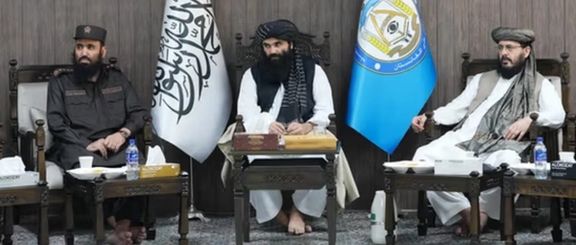
Taliban Interior Minister Sirajuddin Haqqani has again urged officials to focus on gaining public trust and improving security, the Interior Ministry said Wednesday.

Taliban Interior Minister Sirajuddin Haqqani has again urged officials to focus on gaining public trust and improving security, the Interior Ministry said Wednesday.
The ministry said Haqqani chaired a meeting on 10 September with deputy ministers, directors and department heads to review security issues. In a statement, the ministry quoted him as saying that “efforts must be increased to ensure the individual and social security of the people.”
Haqqani also stressed that building trust among Afghans was essential for the Taliban’s system of governance. He has previously said that strengthening relations with the public forms the foundation of confidence in the group’s rule.
His remarks come as the Taliban faces mounting criticism for its actions, including closing schools and universities to women and girls, imposing sweeping restrictions on women, monopolising power and state institutions, excluding diverse social groups, and disregarding political participation.
The group has also been accused of carrying out reprisals against former security personnel and targeted communities, while enforcing strict laws on the population.


UNICEF has appealed for $22 million in urgent funding to support children and families affected by recent earthquakes in eastern Afghanistan, warning that needs far exceed its current capacity.
The UN agency said the six-month plan would provide assistance to more than 212,000 children and 400,000 people in Kunar and Nangarhar provinces.
Tajudeen Oyewale, UNICEF’s representative in Afghanistan, said the situation was critical and stressed that immediate support was needed.
The agency listed its top priorities as providing emergency health services, deploying mobile medical teams, ensuring access to safe drinking water and sanitation, and treating children suffering from malnutrition.
UNICEF said it also planned to deliver emergency financial support to more than 13,000 vulnerable families, offer psychosocial services for children, particularly through female social workers, and set up temporary classrooms until damaged schools can be rebuilt.
The organisation warned that limited access, difficult terrain and cultural restrictions on women pose major challenges to relief operations. It stressed that deploying female staff was essential to guarantee equal access for women and girls.

Afghan Political leaders marked the 24th anniversary of the assassination of Ahmad Shah Massoud with a virtual memorial on Tuesday, warning that divisions among Taliban opponents risk weakening resistance against the group.
Ahmad Massoud, leader of the National Resistance Front and son of the late commander, said political infighting only benefits the Taliban.
“The enemy succeeds when opposition groups become preoccupied with fighting one another,” he said. Massoud stressed the importance of a “battle of narratives” against the Taliban, accusing the group of trying to undermine the resistance by fuelling internal rifts.
“We are bound to fight for freedom and we do not accept defeat or surrender,” he said, adding: “No tyranny lasts forever, and the Taliban’s brutality will also come to an end.”
Marshal Abdul Rashid Dostum, leader of the National Islamic Movement of Afghanistan, said in a message: “To die in bed is a disgrace for me.” He vowed to see the Taliban regime overthrown, saying tyranny is short-lived and would eventually bow to the will of the people.
Mohammad Mohaqiq, leader of the People’s Islamic Unity Party of Afghanistan, also criticised the lack of unity among Taliban opponents, urging political factions to accept one another.
Former Vice President Sarwar Danish called for a sustainable solution to Afghanistan’s crisis. He warned that without serious reflection on the future, the post-Taliban era could mirror the chaos that followed the Mujahideen victory and the 2001 Bonn Conference.
Mohammad Omar Daudzai, a former interior minister, said the stature and legitimacy of Ahmad Shah Massoud had only grown stronger with time. He also criticised Taliban activists’ behaviour on social media, accusing them of insulting opponents with harsh language that defies Afghan cultural norms.

The United Nations on Tuesday appealed for more than $139 million to support nearly 500,000 people affected by recent earthquakes in eastern Afghanistan, warning that the crisis could worsen with winter approaching.
The funds would cover a four-month emergency plan to aid 457,000 survivors, the UN said. Indrika Ratwatte, deputy head of the UN mission in Afghanistan (UNAMA), urged the international community to demonstrate solidarity.
He added that Afghanistan’s resilience has been “tested time and again” and cautioned that each new crisis risks undoing fragile progress made in recent years.
According to UN figures, the quakes killed more than 2,200 people and directly affected around half a million residents in Kunar, Laghman and Nangarhar provinces. More than 6,700 homes were destroyed or damaged, with most families losing food stocks and sheltering outdoors in unsafe and temporary conditions.
The UN said damage to health facilities, schools and water systems has compounded the humanitarian emergency.
The proposed funding would allow aid agencies to quickly expand operations in remote mountainous areas ahead of winter, delivering shelter, food, water, education and agricultural support to protect lives and livelihoods.

Russia’s Foreign Ministry said the release of a detained Russian anthropologist in Afghanistan was secured thanks to Moscow’s “friendly relations” with the Taliban, the only government to formally recognise the group.
Ministry spokeswoman Maria Zakharova said Sviatoslav Kaverin was freed after Russian authorities made a formal request to the Taliban. Kaverin had been arrested in July while travelling in Kunduz province for anthropological research. He was accused of smuggling jewellery and later transferred to Taliban intelligence in Kabul.
Kaverin had gone to Afghanistan to study in Kunar, Nuristan, Kapisa and Nangarhar provinces. After his detention, he was unreachable for weeks, prompting concern from his family and colleagues, who said the jewellery found in his luggage was nothing more than souvenirs and gifts.
Reports in mid-August suggested Kaverin was being held in a Kabul detention centre, though no formal charges were filed. After his release, he said he spent 52 days in custody, during which he was moved several times. To pass the time, he exercised with fellow inmates, sang songs and painted the walls of his cell. He said he was beaten during interrogations, though not severely enough to leave visible marks.
His mother had appealed to Rustam Minnikhanov, president of Tatarstan, during a recent conference in the region attended by Taliban representatives.
Russian news agency RIA Novosti first reported his release on 8 September. The following morning, Kaverin posted a photo of himself at Moscow’s Sheremetyevo Airport, writing hours later that he had “finally returned home.”

Taliban leader Mullah Hibatullah Akhundzada has ordered the dissolution of Interpol police structures within the group’s Interior and Foreign Ministries, according to a document obtained by Afghanistan International.
The directive, sent to the Taliban’s Administrative Affairs Office two weeks ago, disbanded units comprising about 150 staff, sources said. Roughly 120 personnel had been assigned to the Interior Ministry and 30 to the Foreign Ministry under the Interpol structure.
Afghanistan became a member of Interpol on 21 October 2002 during the organisation’s 171st General Assembly in Cameroon. Interpol operations were first established inside the Interior Ministry and later expanded.
In 2010, with international support, the Interpol police unit was upgraded to an independent directorate under the deputy interior minister for security. The unit managed offices at 13 land border crossings and four international airports — Kabul, Mazar-e-Sharif, Herat and Kandahar.
Since the Taliban takeover in 2021, the Interpol directorate has maintained only limited contacts with Iran, Pakistan, Russia and the UAE, sources in the Interior Ministry said. They cited the group’s lack of international recognition as the main reason for curtailed activities.
Under the previous Afghan government, the Interpol directorate provided national institutions with access to Interpol databases and facilitated cooperation with its 193 member states.