• العربية
  • پښتو
  • فارسی
Brand
  • Afghanistan
  • Sport
  • Markets
  • Afghanistan
  • Sport
  • Markets
  • Theme
  • Language
    • العربية
    • پښتو
    • فارسی
  • Afghanistan
  • Sport
  • Markets
All rights reserved for Volant Media UK Limited
volant media logo

Qatar, Kazakhstan Envoys Hold Talks On Afghanistan’s Political Situation

Oct 1, 2025, 16:22 GMT+1

Faisal bin Abdullah Al-Hanzab, Qatar’s special envoy for Afghanistan, met in Doha with Yerkin Tokumov, the Kazakh president’s special envoy on Afghanistan, to discuss political, security and humanitarian developments in the country.
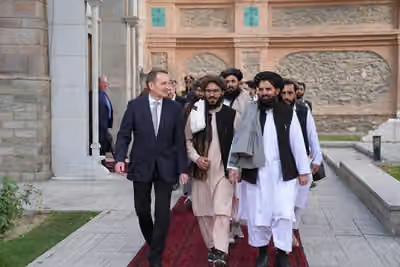
Qatar’s Foreign Ministry confirmed Tokumov’s visit but released no further details of the talks.

Both Qatar and Kazakhstan maintain close contacts with the Taliban despite not formally recognising the group.

At the 80th session of the UN General Assembly, Kazakh President Kassym-Jomart Tokayev emphasised the importance of peace and stability in Afghanistan, saying inclusive development is key to ensuring long-term regional security.

Most Viewed

Arrests & Killings Of Former Afghan Forces Continue, Says UN
1

Arrests & Killings Of Former Afghan Forces Continue, Says UN

2

Taliban To Put TOLOnews Journalists On Trial

3

Taliban Beat Shia Cleric In Kabul After Marriage Dispute, Say Sources

4

Attack On Pakistani Police Centre Was Not Planned In Afghanistan, Says Taliban

5

Taliban-Pakistan Border Clashes Killed 372 Civilians in 3 Months, Says UN

•
•
•

More Stories

Internet Restored On Prime Minister’s Orders, Says Taliban Official

Oct 1, 2025, 14:59 GMT+1

A Taliban official said internet and telecommunications services were restored on the orders of the group’s prime minister, Mullah Hassan Akhund, after being shut down on instructions from Taliban leader Mullah Hibatullah Akhundzada.

On 29 September, the Taliban administration cut fibre-optic internet and telecom services nationwide, disrupting government institutions, halting banking and customs operations, and grounding flights.

In Washington, US Congressman Tim Burchett wrote to President Donald Trump’s ambassador to the United Nations, calling the blackout “a flagrant assault on the Afghan people’s fundamental rights.” He urged the UN Security Council to condemn the move in a resolution.

Burchett later said the Taliban’s actions suppress Afghans and deepen the country’s isolation. Taliban spokespersons have not commented on either the shutdown or the subsequent restoration of services.

Internet Shutdown Disrupts Migrant Services At Islam Qala Border

Oct 1, 2025, 13:47 GMT+1

The nationwide internet shutdown in Afghanistan has disrupted services for migrants at the Islam Qala border crossing, where aid operations rely heavily on computer systems, local sources told Afghanistan International.

They said the outage has disabled registration systems, forcing officials to process cases manually. The disruption has stalled parts of humanitarian operations and left many migrants unable to receive cash assistance.

Registration and assistance for returnees from Iran and Pakistan are fully computerised, with aid groups providing both cash and non-cash support once individuals are entered into the system.

With services paralysed, many aid workers have left their posts, the sources said. Migrants are now facing mounting hardships and are calling for internet access to be restored.

Taliban Internet Shutdown Violates Afghans’ Basic Rights, Says HRW

Oct 1, 2025, 13:10 GMT+1

Human Rights Watch said Wednesday that the Taliban’s nationwide internet shutdown is violating Afghans’ basic rights and causing widespread harm to livelihoods, education and access to information.

In a statement, the rights group said the suspension of telecommunications services has disrupted commerce, media, health care and schooling.

“The Taliban’s moves to cut internet access harm the livelihoods of millions of Afghans and deprive them of their basic rights to education, health care and access to information,” said Fereshta Abbasi, HRW’s Afghanistan researcher. She urged the Taliban to end what she called a baselessly justified blackout.

The Taliban cut off internet and telecom services across the country on Monday evening, effectively shutting down businesses, airports, aid operations and television networks. Online classes, considered the last option for girls barred from schools and universities, have been halted.

A university lecturer told HRW that out of 28 students enrolled in his course, including 18 women, only nine managed to connect. The group said the blackout further isolates women and girls and closes off one of the few remaining avenues for learning, online work and access to services.

Activists warned the shutdown undermines community support programmes, particularly women-led initiatives. Journalists told HRW they have been unable to make domestic or international calls, even through platforms such as WhatsApp and Signal. Aid agencies also reported severe disruptions to relief efforts, which rely on connectivity for coordination.

“This is another crisis on top of the existing crises, and the impact is going to be on the lives of Afghan people,” said Indrika Ratwatte, the UN’s humanitarian coordinator in Afghanistan.

HRW stressed that access to the internet is widely recognised as essential for the realisation of human rights. The UN Human Rights Office has previously warned that shutdowns can undermine freedom of expression, political participation, safety, education, work and health, while worsening social and gender inequalities.

Abbasi said Afghans were already isolated from the world, but the blackout has “completely cut them off.” She added: “The longer the Taliban internet shutdowns continue, the more harmful the consequences for both the people and the country.”

Taliban Have Turned Afghanistan Into ‘Giant Prison’, Says AFF

Oct 1, 2025, 10:30 GMT+1

The Afghanistan Freedom Front (AFF) accused the Taliban on Monday of turning Afghanistan into a “giant prison” after cutting off internet access nationwide.

The group said that the move has closed “the last windows of communication with the outside world” and caused millions of dollars in economic damage.

In a statement, the anti-Taliban armed group said internal rifts, growing public discontent and pressure from the United States had left the Taliban unsettled. It described the internet blackout as a desperate attempt by the group to preserve its rule.

Two days into the shutdown, private and public services remain paralysed. Banking, aviation and other essential sectors have been disrupted, while the Taliban has offered no explanation and taken no responsibility for the crisis.

Reports suggest divisions within the Taliban leadership over the decision. Zalmay Khalilzad, the former US envoy to Afghanistan and a politician seen as close to the group, wrote on X that Taliban leader Hibatullah Akhundzada’s order had even shocked his own ministers.

The Afghanistan Freedom Front called the internet cutoff a “foolish strategy” designed to block Afghan voices from reaching the outside world.

Taliban Propaganda Accounts Go Dark After Internet Shutdown In Afghanistan

Oct 1, 2025, 09:39 GMT+1

The Taliban’s network of proxy accounts on social media has gone offline following the nationwide shutdown of internet and telecommunications services, Afghanistan International has learned.

The accounts, which promoted the Taliban and attacked opponents under the names of politicians, journalists, artists and dozens of pseudonyms, have not posted for the past 24 hours. Social media messaging has been a central tool in the group’s propaganda strategy.

Taliban officials, including Interior Minister Sirajuddin Haqqani, had reportedly hired dozens of people to run these campaigns.

The Taliban last week ordered a complete suspension of fibre-optic internet and mobile networks, a move that drew widespread international criticism. The blackout has also stripped platforms such as X and Facebook of Taliban-aligned propaganda.

Sources previously told Afghanistan International that the Taliban’s defence and interior ministers, as well as its intelligence chief, maintained multiple social media groups staffed by dozens of paid propagandists.