Pak Army Accuses India Of Using Afghan Soil For Attacks

Pakistan’s army spokesperson, Major General Ahmed Sharif Chaudhry, has accused India of using Afghan territory to orchestrate attacks against Pakistan.

Pakistan’s army spokesperson, Major General Ahmed Sharif Chaudhry, has accused India of using Afghan territory to orchestrate attacks against Pakistan.
Speaking at a press briefing on Friday, he claimed that militant groups operating in Afghanistan enjoy access to safe havens and advanced weaponry.
Chaudhry said that militant attacks inside Pakistan have sharply increased in recent years, adding that between 2024 and 2025 alone, 161 Afghan nationals involved in terrorist incidents were killed by Pakistani security forces.
He further stated that 135 foreign fighters were killed while attempting to cross into Pakistan from Afghanistan, and that around 30 suicide bombers who carried out attacks in the past two years were Afghan nationals.
“These figures clearly demonstrate how India is using Afghan soil as an operational base for terrorist activities against Pakistan,” Chaudhry said.
The Taliban authorities in Kabul and Indian officials have yet to respond to the allegations.
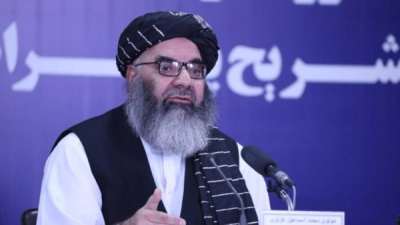
India will upgrade its diplomatic mission in Kabul to embassy level, Indian Foreign Minister Subrahmanyam Jaishankar announced during a meeting with Taliban Foreign Minister Amir Khan Muttaqi in New Delhi on Thursday.
Since the Taliban’s return to power in 2021, India’s presence in Kabul has been limited to a “technical mission.” Muttaqi’s visit marks the first official trip to India by a senior Taliban official.
Jaishankar described the visit as “an important step in advancing our ties and reaffirming the enduring friendship between India and Afghanistan.” He said both sides share a commitment to regional growth and prosperity but face challenges from cross-border terrorism.
“We must coordinate our efforts to combat terrorism in all its forms and manifestations,” Jaishankar said, adding that India appreciated the Taliban’s “sensitivity towards India’s security concerns,” referencing his earlier phone call with Muttaqi following the Pahalgam attack in April.
Pledge of Further Assistance
Jaishankar reaffirmed India’s long-term commitment to Afghanistan’s development, announcing six new projects to be implemented after further discussions. These include the donation of 20 ambulances to Afghan hospitals, five of which were personally handed over to Muttaqi during his visit, and the delivery of a food aid shipment to Afghanistan on Friday.
He also announced that India will provide MRI and CT scan equipment to Afghan hospitals and expressed readiness to cooperate with the Taliban on water management initiatives.
Jaishankar further praised the growing talent in Afghan cricket and said India would expand its support for Afghanistan’s national cricket team.

As airstrikes struck Kabul on Thursday night, sources told Afghanistan International that around midnight, the Margha Bazaar area in Barmal district of Paktika province was also hit.
It remains unclear who carried out the attack, though Pakistan has previously conducted airstrikes in several eastern Afghan provinces. According to local sources, 29 shops were destroyed in the Margha Bazaar strikes, but the number of casualties has not yet been confirmed. The Taliban have not issued any comment on the incident.
A Taliban spokesperson confirmed an explosion in Kabul on the same night. Reports suggest that unidentified aircraft targeted a vehicle carrying a senior leader of Tehreek-e-Taliban Pakistan (TTP).
Pakistan has long accused the Afghan Taliban of harbouring TTP leaders and Baloch separatists inside Afghanistan. Earlier, Pakistan’s representative to the United Nations claimed that around 6,000 TTP fighters and 20 other militant groups, with 60 major hideouts, were operating on Afghan soil.
The Taliban have consistently denied these allegations, insisting that no foreign militant groups are active in Afghanistan and that the country poses no threat to its neighbours or the wider region.

Jan Achakzai, former information minister of Pakistan’s Balochistan province, has described Pakistan’s recent airstrike on Kabul as “historic”. He claimed the strikes were meant to warn the Afghan Taliban to remain neutral in what he called India’s proxy conflicts.
In a post on X on Friday, 10 October, Achakzai said the strike signalled a major shift in Pakistan’s regional strategy, showcasing its resolve and capability to pursue enemies beyond its borders. He argued that the operation “redefined the rules of engagement” against India-backed militants allegedly operating inside Afghanistan.
The Pakistani government has not issued any official comment on the Thursday night airstrike in Kabul, and there has been no independent verification of the incident or its intended targets.
Achakzai added that Pakistan now faces what he termed a “three-front war”, against India in the east, the Afghan Taliban in the west, and domestic militant groups such as Tehreek-e-Taliban Pakistan (TTP) and the Baloch Liberation Army (BLA).
He said the airstrike served as a clear message to the Taliban leadership that Pakistan “will not tolerate” any alignment with India or groups acting against Islamabad’s interests from Afghan soil.

A female journalist testified at the People’s Tribunal for Afghan Women in Madrid, recounting her detention and mistreatment by Taliban forces. She said the Taliban blocked journalists’ advocacy gatherings, arrested reporters, and detained her at gunpoint.
The journalist, who lost her job after the Taliban’s return to power and the imposition of strict media restrictions, said Taliban forces raided her home without cause, threatened her, and beat her husband. She added that after months of hardship, she was forced to flee Afghanistan, but Taliban guards beat her and her son at the Pakistan border.
She told the tribunal that her husband remains in critical condition due to Taliban beatings and that her family continues to suffer from severe psychological trauma. “I have nightmares every night, imagining the Taliban attacking again,” she said, adding that such fear is shared by many Afghan women and female journalists.
The witness also described how the Taliban extract forced confessions from journalists and torture detainees, expressing frustration that “the voices of Afghan women are not being heard.”
Hamid Obaidi, head of the Afghan Media Support Organization, told Afghanistan International on the sidelines of the hearing that the Taliban have imposed at least 25 restrictions on the media over the past four years.
He said these documented human rights violations should be presented to international institutions, emphasising that the persecution of women journalists remains one of the central issues under review at the People’s Tribunal for Afghan Women.

The United Nations Children’s Fund (UNICEF) has reported that one in four Afghan children aged 5 to 17 suffers from anxiety, while one in seven experiences depression.
In a statement released on Thursday, 9 October, UNICEF said it has organised mental health workshops across Afghanistan for children struggling with anxiety and depression. The agency stressed the urgent need for a national child mental health strategy to address the growing crisis.
UNICEF said it continues to work to ensure that Afghan children have access to healthcare, compassion and hope for the future. Global organisations have repeatedly warned of the deteriorating access to healthcare for women and children in Afghanistan.
The head of the children’s ward at Mirwais Hospital in Kandahar previously told reporters that, due to a shortage of facilities, three children often share one hospital bed, with most suffering from severe malnutrition.
In July, UNICEF also warned that climate change is worsening food insecurity among Afghan children. The agency estimates that more than 875,000 children under the age of five are suffering from acute, life-threatening malnutrition.
