Taliban Confirms 48-Hour Ceasefire Agreement With Pakistan
The Taliban confirmed on Wednesday that a ceasefire with Pakistan will take effect from 5:30 p.m. local time, following days of intense cross-border clashes.

The Taliban confirmed on Wednesday that a ceasefire with Pakistan will take effect from 5:30 p.m. local time, following days of intense cross-border clashes.
Taliban spokesperson Zabihullah Mujahid said the group had instructed its fighters to fully observe the truce once it begins.
In a post on X, Mujahid stated that the Taliban agreed to the ceasefire “at the request and insistence of the Pakistani side.”
Earlier, sources within Pakistan’s military told Afghanistan International that Islamabad had accepted the Taliban’s proposal for a 48-hour ceasefire to de-escalate tensions along the border.
The temporary truce comes after several days of heavy fighting between Taliban and Pakistani forces, which left dozens dead on both sides and forced the closure of key border crossings, including Torkham and Spin Boldak.


Pakistan confirmed on Wednesday that its air force conducted strikes inside Afghanistan, targeting what officials described as “important sites” in Kabul and Kandahar, following a series of powerful explosions in both locations.
A senior Pakistani security official, speaking to Afghanistan International on condition of anonymity due to the sensitivity of the issue, said "significant targets in Kabul and Kandahar were hit.”
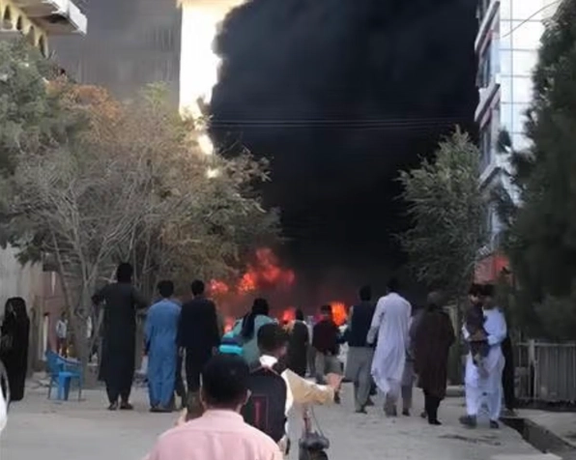
Residents in Kabul reported at least four large explosions near Sarak-e-Panj in the Taimani Project area and the Chaharahi Asbha junction. Witnesses said the blasts continued intermittently, with loud detonations heard every few minutes.
According to locals, the explosions occurred near Sultan Mahmood Ghaznavi School in Taimani. Several residents said they heard fighter jets overhead moments before the blasts.
A resident told Afghanistan International that Taliban military vehicles with sirens rushed to the scene as panicked residents fled the area.
Reliable sources confirmed that the airstrikes were carried out by the Pakistani Air Force. However, there have been no verified reports of casualties so far.
The Taliban have not officially commented, but their spokesperson released a video claiming that one of the explosions was caused by a fuel tanker blast.
The airstrikes mark a significant escalation in tensions between Islamabad and the Taliban government, following days of deadly cross-border clashes and growing mutual accusations over militant activity along the frontier.

Reliable sources told Afghanistan International that Pakistan’s air force carried out another airstrike on Kabul early Wednesday, causing a powerful explosion in the city.
However, Taliban spokespersons claimed the blast was the result of a fuel tanker explosion, not an airstrike.
Images obtained by Afghanistan International show a large explosion in Kabul’s Taimani area and near Chahar Rah-e Shahid. The scale of the damage and the intended target remain unclear, and no official casualty figures have been released.
The incident marks the latest in a series of cross-border escalations following days of intense clashes between Taliban and Pakistani forces along the frontier. Neither Islamabad nor the Taliban have yet issued a detailed statement on the reported strike.

Pakistan’s military said on Wednesday that fighters from the Afghan Taliban and Tehreek-e-Taliban Pakistan (TTP) jointly attacked border outposts in the Kurram region of Khyber Pakhtunkhwa province late Tuesday night.
In a statement, the army said its forces repelled the assault and killed between 25 and 30 militants from both groups during the clashes.
The military added that in retaliatory strikes, Pakistani troops destroyed eight outposts and six armoured vehicles belonging to the Afghan Taliban and the TTP.
State-run Pakistan Television (PTV), citing security officials, reported that the clashes began after militants from the Afghan Taliban and TTP opened fire on Pakistani border positions.
The incident marks another escalation in cross-border violence amid rising tensions between Islamabad and the Taliban government in Kabul over militant sanctuaries and recent airstrikes.

Taliban Interior Minister Sirajuddin Haqqani has criticised senior members of the group who, he said, played little or no role in the war but now claim credit for the Taliban’s victory and return to power.
Speaking at a gathering in Paktika province on Tuesday, October 14, Haqqani expressed frustration that the sacrifices of Taliban fighters were being overlooked, while some individuals “make grand claims” in the media and public meetings.
He urged such figures to “refrain from boastful behaviour” and to recognise the struggles of those who fought on the battlefield. “Do not act in ways that will cause this position and system to be taken away from you,” Haqqani warned. “Just as those stronger than you were once overthrown, God has now granted you this position.”
Although Haqqani did not name anyone, sources told Afghanistan International that his remarks were directed at members of Taliban leader Hibatullah Akhundzada’s inner circle, particularly Neda Mohammad Nadim, the group’s minister of higher education.
Nadim, a hardline Kandahar loyalist, has reportedly begun referring to himself as the “Conqueror of Kabul”, a title previously claimed by Haqqani. The two figures represent rival factions within the Taliban, with Haqqani often viewed as part of a more pragmatic bloc, while Akhundzada’s supporters maintain a rigid ideological stance.
Haqqani reminded Taliban officials to remain humble, saying that many of them were previously “unknown and fearful of drone strikes,” but now enjoyed power and prominence. He warned that arrogance could “tarnish the sacrifices” made by Taliban fighters.
The remarks come amid rising internal tensions within the group, further strained by recent deadly clashes between Taliban and Pakistani forces. Analysts say the fighting has exposed divisions over how the group should respond to Pakistan, with some advocating a tougher stance and others urging restraint.
Haqqani, who has remained silent on the border conflict, has seen his influence gradually eroded by Akhundzada’s Kandahar faction since the Taliban’s return to power in 2021.

Taliban Deputy Foreign Minister Naeem Wardak has condemned Pakistan’s recent airstrike on Afghan territory, calling it “cowardly and cruel,” during a meeting with China’s ambassador to Kabul, Zhao Xing.
Wardak said the attacks violated “all human, Islamic, and neighbourly principles,” adding that the Taliban had delivered an “appropriate response.”
In a statement issued after the meeting, the Taliban’s Foreign Ministry said Wardak emphasised that “war is not a solution” and that the Taliban administration seeks “good and positive relations with all neighbouring countries.”
The Chinese ambassador reportedly urged both sides to resolve their differences through dialogue, stressing the importance of regional stability.
Wardak reiterated that the Taliban remains committed to peaceful engagement but warned: “If anyone violates our rights and values, the Afghan nation considers it its legitimate right to defend them, and will do so with dignity.”
The meeting came amid heightened tensions between Afghanistan and Pakistan following cross-border airstrikes and armed clashes in recent days.