Iran Offers To Mediate Between Taliban & Pakistan After Border Clashes
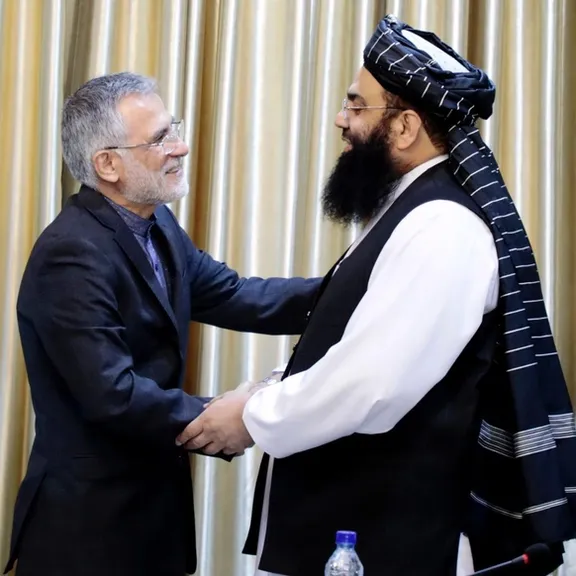
Iran has expressed readiness to mediate between the Taliban and Pakistan to help ease tensions following recent border clashes, according to the Taliban’s Ministry of Refugees.

Iran has expressed readiness to mediate between the Taliban and Pakistan to help ease tensions following recent border clashes, according to the Taliban’s Ministry of Refugees.
Mohammad Reza Bahrami, Director General for South Asia at Iran’s Ministry of Foreign Affairs, conveyed Tehran’s offer during a meeting with Abdul Kabir, the Taliban’s Minister for Refugees, on Friday.
Bahrami voiced concern over the escalating conflict and said Iran was prepared to assist in resolving disputes between the two sides if the Taliban agreed. The ministry’s statement said the officials also discussed broader regional issues.
Iran’s offer comes as Qatar has formally invited senior representatives from both parties to Doha for talks aimed at deescalation.
The Iranian diplomat praised the Taliban’s approach toward Tehran and said a high-level Iranian delegation would soon visit Kabul, though he did not specify who would be included in the delegation.

The Afghanistan Freedom Front (AFF) claimed responsibility for an attack on a vehicle carrying Taliban fighters in Kabul, saying two members of the group were killed and another wounded.
The attack reportedly took place on Thursday evening, in the Kote Sangi area of the capital’s Fifth Police District. The AFF said in a statement that none of its fighters were injured during the operation.
According to the group, the target was a Hilux vehicle transporting Taliban personnel.
Taliban officials have not yet commented on the incident. A resident of Kote Sangi area in Kabul told Afghanistan International that an explosion was heard in the area around the time of the reported attack.

Afghanistan’s state-run television, controlled by the Taliban, has reported the death of a second journalist in attacks allegedly carried out by Pakistani forces.
In a statement, the broadcaster said Abdul Zahir Safi was killed by Pakistani gunfire while on a media assignment near the border. The incident follows the reported death of another network correspondent, Abdul Ghafoor Abed, in Khost a day earlier. Another staff member was injured in the same attack.
The national broadcaster condemned Safi’s killing, calling it a “deliberate attack against journalists.” The statement did not specify the exact location or time of the incident.
The Taliban’s Ministry of Information and Culture also accused Pakistan of killing two journalists from Afghanistan’s national television, though Islamabad has not yet commented on the allegations.

The European Union’s Special Envoy for Afghanistan, Gilles Bertrand, expressed concern over the ongoing conflict between the Taliban and Pakistan during a meeting with Abdul Kabir, the Taliban’s Minister for Refugees, in Kabul.
According to the Taliban’s Ministry of Refugees, Bertrand warned that the continued fighting was worsening Afghanistan’s humanitarian situation and urged both Kabul and Islamabad to resolve their differences through dialogue. Abdul Kabir told the envoy that the clashes had created major difficulties for returning Afghan refugees.
The meeting came as the Taliban and Pakistan agreed to a 48-hour ceasefire following intense border clashes. Pakistan’s defence minister, however, said he was not optimistic about the truce holding.
Bertrand’s concerns follow reports that Pakistan’s border closures amid the conflict have further strained humanitarian conditions. During the meeting, Kabir called on the European Union to continue providing aid and stressed that international assistance should not be politicised.
According to the Taliban ministry, the European Union has allocated €138 million to support basic needs and humanitarian programmes in Afghanistan.

Taliban forces reportedly used drones for the first time in an attack on a Pakistani border post, sources within the group told Afghanistan International. The Taliban’s intelligence media outlet released a video purportedly showing the drone strike.
A Pakistani security source said the drone used was a rotary-wing, or copter-type, similar to those operated by Tehreek-e-Taliban Pakistan (TTP). The black-and-white footage shows a drone dropping explosives from a low altitude onto a rectangular structure described as a Pakistani military position. Moments later, an explosion is seen.
Taliban officials have not disclosed details about the type or origin of the drones. However, the Pakistani security source said TTP had obtained several drones “through traders in Afghanistan,” adding that the Afghan Taliban may have supplied some, though this remains unconfirmed.
These small, lightweight, remotely controlled drones are often used by both state and non-state armed groups. This marks the first time Taliban-linked media have claimed the group has employed drones in combat beyond Afghanistan’s borders.
It remains unclear which country may have supplied military-grade drones to the Taliban. The group maintains close ties with Iran, a major producer and exporter of drones in the region.
Experts note that while commercial drones can be modified for military use, advanced models capable of carrying explosives are tightly controlled and typically sold only to governments.
On Wednesday, Iran’s Tasnim News Agency, affiliated with the Islamic Revolutionary Guard Corps (IRGC), was the first outlet to report, citing sources close to the Taliban, that Taliban forces had attacked Pakistani army positions along the Durand Line using drones. The report was later deleted from the Tasnim website.
According to the deleted report, the attacks “inflicted heavy casualties on Pakistani soldiers.” The Pakistani government has not yet issued an official response.

The Taliban’s Supreme Court announced on Thursday that a man convicted of premeditated murder was executed by firing squad in a stadium in the central city of Badghis province.
The court said the death sentence had been approved by the Taliban’s supreme leader, Hibatullah Akhundzada.
The court identified the executed man as Ismail, who was found guilty of deliberately killing a man named Dost Mohammad and a woman named Gulbarg. According to the statement, the death sentence was upheld by the Taliban’s primary, appellate, and supreme courts.
The execution was carried out in a sports stadium in Badghis in the presence of the Taliban’s chief justice, local officials, the Taliban governor of Herat, judges, government department heads, military personnel, and hundreds of residents.
In April 2024, the Taliban publicly executed four men across three provinces, two in Badghis, one in Nimroz, and one in Farah, all convicted of murder and sentenced to qisas (retribution).
Due to a lack of transparency and independent access, no comprehensive data exist on the total number of executions conducted under Taliban rule, both during their first regime (1996–2001) and since returning to power in 2021. However, based on official Taliban statements and available reports, this marks at least the tenth confirmed execution since the group’s return to power.
The Taliban Supreme Court did not specify whether the accused had access to legal representation or a fair trial.
Human rights organisations have repeatedly raised concerns over the absence of due process and fair trials under Taliban rule. Despite widespread international condemnation of corporal punishment, torture, and public executions, the Taliban continue to conduct public floggings and executions, claiming they are in accordance with Islamic Sharia law.
