Three Taliban Members Killed In Kabul Attack, Says AFF
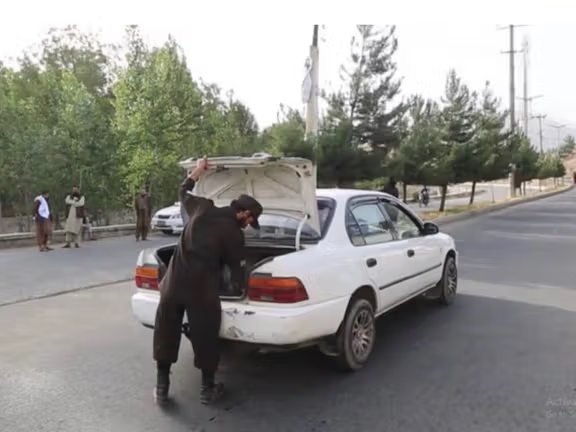
The Afghanistan Freedom Front (AFF) claimed responsibility for an attack in Kabul on Monday evening saying it killed three Taliban members in the city’s First Security District.
The Afghanistan Freedom Front (AFF) claimed responsibility for an attack in Kabul on Monday evening saying it killed three Taliban members in the city’s First Security District.
In a statement, the group said its fighters targeted a Taliban military vehicle near the Chaman-e-Hozori gate. Local residents reported hearing a loud explosion at the time of the incident.
The AFF also released a video purportedly showing the attack, claiming the vehicle belonged to Taliban forces and that none of its members were injured. The footage includes the sound of an explosion.
Taliban officials have not yet commented on the reported attack.
Austria has deported an Afghan asylum seeker convicted of a serious crime to Kabul, marking the first deportation to Afghanistan since the Taliban’s return to power in 2021, Austrian media reported.
The man had previously been sentenced to four years in prison for sexual assault and aggravated battery. After serving his sentence, he was transferred on Tuesday, 21 October, from Vienna to Istanbul and then on to Kabul.
Austrian Chancellor Karl Nehammer said the government maintains a zero-tolerance policy toward individuals who lose their right to stay in the country due to criminal offences. “Anyone who does not follow our rules will have to leave,” he said.
Interior Minister Gerhard Karner confirmed that more deportations are being prepared, adding that the process would continue “with determination.”
The move follows an earlier Austrian delegation visit to Kabul to assess the feasibility of deportations. In September, representatives of the Taliban travelled to Vienna to coordinate the technical details of the plan.
According to Austrian reports, around 30 more Afghan nationals are currently on the list for deportation to Afghanistan.
A Pakistani government delegation is scheduled to travel to Kabul on Tuesday, 21 October, to hold talks with Taliban officials on trade cooperation and border management, Pakistani media reported.
According to Mashriq, a Peshawar-based newspaper, the visit will focus on facilitating cross-border commerce, regulating the movement of goods and people, and implementing the “One Document Regime” aimed at streamlining trade procedures between the two countries.
Sources cited by the paper said the trip had been planned in advance and is not linked to recent clashes at the Torkham border crossing or the rising tension between Kabul and Islamabad.
However, the delegation’s agenda also includes discussions on enforcing the recently agreed ceasefire and addressing Pakistan’s demand that the Taliban curb Tehreek-e-Taliban Pakistan (TTP) and other armed groups operating from Afghan territory.
Government sources said another key objective of the visit is to build mutual trust and develop a joint framework for regional stability and security between the Taliban and Islamabad.
Pakistan’s Defence Minister Khawaja Asif said on Monday that the government will under no circumstances hold talks with Tehreek-e-Taliban Pakistan (TTP) and will instead engage solely with the Taliban in Afghanistan.
His remarks came after both the Afghan Taliban and Imran Khan, the imprisoned leader of Pakistan’s Tehreek-e-Insaf party, urged Islamabad to resolve its dispute with the TTP through dialogue.
Pakistan and the Afghan Taliban reached a Qatar-mediated ceasefire agreement on Sunday to halt hostilities following a week of border clashes.
Asif said the Taliban delegation in Doha had pledged to restrain Pakistani militants, adding that the continuation of the ceasefire depended on the Taliban’s commitment to that promise. He described the talks as having taken place in a "friendly atmosphere.”
The defence minister also clarified that the draft ceasefire agreement contains only four clauses, dismissing the longer version circulating on social media as fabricated.
He added that further discussions on the ceasefire’s implementation will be held in Türkiye in the coming days, while noting that he remains cautiously optimistic about the Taliban administration’s adherence to the truce.
The German government plans to terminate its special admission programmes for Afghan refugees, citing lengthy immigration procedures and complex bureaucratic obstacles, German broadcaster MDR reported on Monday.
The revelation, featured in the latest episode of MDR’s documentary series titled “Afghanistan and the Refugees, Germany’s False Promises,” sheds light on the growing despair among Afghans who fled to Pakistan following the Taliban takeover of Kabul in 2021. Many had hoped for resettlement in Germany but have since been living for years in uncertainty and under threat of deportation.
According to MDR, Germany’s admission programmes for at-risk Afghans have helped only a small fraction of applicants, hampered by slow processing and administrative barriers. The government now intends to cancel the initiatives entirely.
The report said around 2,000 Afghan citizens who had previously received assurances of relocation from Germany remain stranded in Pakistan awaiting visas. Many are women’s rights activists, journalists, human rights defenders, and former employees of the German military, all of whom face the risk of arrest or execution by the Taliban if forced to return to Afghanistan.
The documentary’s producers warned that such a decision could mark “the official end of Germany’s moral responsibility” toward its former Afghan partners and allies.
Pakistan’s Defence Minister Khawaja Asif said the primary goal of the ceasefire agreement with the Taliban is to eliminate terrorism, which has long destabilised border regions. He said both sides had committed to making “serious efforts” to curb militant activity.
In an interview with Al Jazeera, Asif said Pakistan and the Taliban had agreed to establish joint mechanisms to address security concerns and prevent future clashes. He thanked the Emir of Qatar and the President of Türkiye for their diplomatic efforts in mediating the ceasefire.
Referring to the recent surge in border tensions, Asif said both countries recognised that tackling terrorism is vital for regional peace and stability. He added that the Afghan Taliban also view terrorism as the key source of friction and have pledged to take practical steps to address it. He added that the involvement of Qatar and Türkiye serves as a guarantee of the credibility of this agreement.
Asif noted that Pakistan has endured heavy human and economic losses due to terrorism but expressed hope that the ceasefire would pave the way for peace and stability. The agreement, he said, would also help normalise trade and transit relations between the two neighbours.
He announced that Afghanistan would again be allowed to use Pakistan’s ports for trade, while Afghan refugees holding valid documents and visas would be permitted to remain in Pakistan. Those without documentation, however, would continue to be repatriated.
The minister stressed that the Pakistan–Afghanistan border must be managed “in an orderly manner and in accordance with international standards.”
Asif cautioned that it was too early to declare full satisfaction with the agreement.
